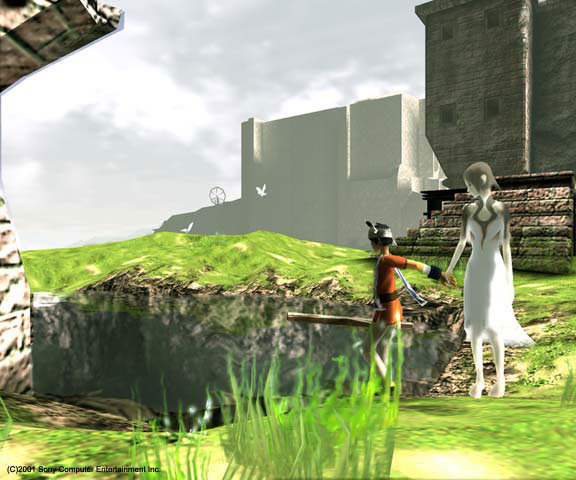
As you explore a random area in this seemingly destroyed castle, you leap down with confidence. You are making sure that the coast is clear, so that Yorda can be safe and not eaten by the shadows. The question here is: why?
Sure, I may sound a bit thick here, like I don't understand the purpose of this particular game: in Ico, your horned main character is trying to protect Yorda, the feeble girl who is enveloped by light, from the Shadows that want to take her away. Sounds simple enough, I'll give you that. Now, while I would like to know why, I should warn that I'm not talking about the game mechanics here. I'm talking about Narrative, and more importantly, handling of emotions - the player's emotions.
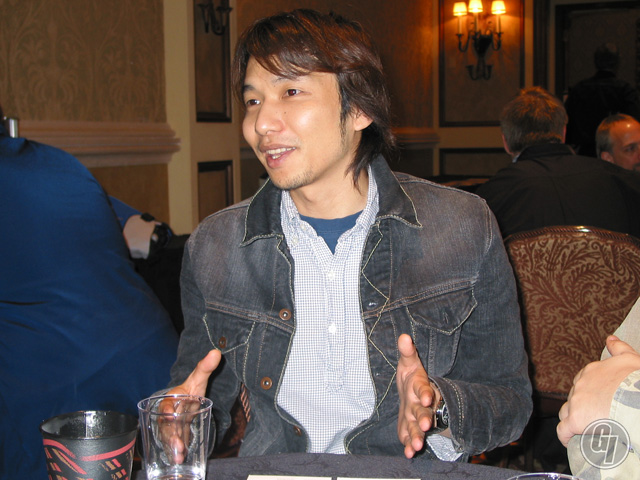
In this case Fumito Ueda ("Ico", "Shadow of the Colossus" and the recently revealed "Project Trico"), chooses a very simple theme: to give you a partner. Many games give you partners (Gears of War, Halo, Resident Evil, Prince of Persia), but they rarely "matter". Objectively, Dominic Santiago, Sheva or Elika are nothing but tools for you to use in the game. They rarely evoke an emotional response out of you, seldom cause you to feel attached to them or feel any sort of real sense of "responsibility" towards them. But that's normal, right? After all, they are bits, code in a program designed for your enjoyment. Yet... Ueda-san's design differs. In all of his games, there are two things that could be considered recurring.
First, we have the partner mechanic. Yorda, Argo and now the big flying puppy thing from Project Trico are all the main character's partner. They help you in terms of gameplay (Yorda allowed you to save the game by sitting on a bench, Argo helped you traverse the expansive game world and from the trailer, the new giant dog seems to be your only means of defense). So, there is not much to read here, since all AI partners are supposed to have a function, and I think we all agree on that much. However, there is that second point I mentioned that I find extremely interesting.
If you think about it, in Ico you weren't just Yorda's partner. It was more like a symbiotic relationship, where she needed you to survive, to traverse the world and, oddly enough, you needed her for more than mere gameplay reasons. Yorda was the only being in that world that made you feel like you weren't alone, were not threatened 100% of the time. She transcended the role of being your in game partner, your game mechanic hindrance. And before you cast me as overly dramatic, here's some food for thought: How would you have felt if Yorda wasn't there? Thrown, all alone, in a bleak world with no company, no one to relate to? At least Yorda was as lost as you were, and she depended on you for her survival, just as you depended on her to not feel completely out of place. In many ways, Yorda was the reason to keep on living - because otherwise, the purpose of the game, of progressing with the narrative would get muddled out of existence.
In the same fashion, Argo was a much more prominent AI partner, that you had a strong bond with from the get go. Exploring a new world that you new nothing about, in a place where you are completely alone and nothing seems relatable, it's not just the in-game character that has an attachment to Argo - you, the player, develop "feelings" for the stallion before you realize it. In many ways, Peter Molyneaux was hoping to develop the same sense of attachment and bi-directional need with the companion mutt in "Fable II", but the game's narrative itself dissolved the importance of your companion, rendering any sort of attachment with your dog almost completely superficial.
Fumito Ueda gets it right. Looking at his games, one can realize that there are two pillars that he uses to bring you in to the game world and make you care for your character and the only relationship you can find in it. The first pillar is the actual companion. Yorda, Argo and whatever Project Trico's thing is called all have a special place for the character -- They are the only other person they can relate to, or the loyal horse that has adventured with you for ages, or the giant creature that you are afraid of that suddenly shows signs of appreciation towards you. Ueda's narrative forms a strong bond between your character and the AI partner, that is fueled not only by the narrative itself, but also by creating a formidable in-game interaction and gameplay mechanic. And the second pillar is none other than this Narrative that Ueda so masterfully conveys. The world is designed to make you feel a certain way, and he taps into that knowledge and sets you up. He knows, or at least expects, that you will feel a certain way, and throws you a life vest in the shape of a partner.
Fumito Ueda's recurring theme of in-game partners succeeds where others fail because of this trifecta of elements: The Partner, the Mechanic and the Narrative. When one could lead to disaster, the other element step in and saves the day. It'd be easy for Argo's inability to traverse certain landscapes to get annoying, but then he makes it possible to beat the gigantic Colossus at the beach - and before you can only think of him as a tool, the narrative picks up the slack and reminds you of how he matters to your character, and to you. Ueda's design and storytelling help to bring this set of elements together, but the real skill here is how well executed and timed these three elements are.
Now then, can it be possible to bring these meaningful relationships that the player can build with Yorda or Argo, into other games? How can Molyneaux or even Cliffy B. incorporate these notions that Ueda uses time and time again into more mainstream titles? Can it even be done? I for one, am curious to find out, because in all honesty, the attachment to these characters which are comprised of bits and textures gives single player gaming a whole new perspective, and transforms what could be a mere thrill ride into an actual emotional roller coaster.
Food for thought.
Comments (2)
Great game, but I just didn't feel that much of a connection with Argo as many people did, I just didn't fall in love. I might go as far as to say I would place him on the same level as other partners you called "tools" such as squadmates in a shooter, or Sheva. What is it, in your opinion, that elevates Argo about the level of "tool" and into a character you have "feelings" for?
I'm just not feeling it.
Granted, not everyone will feel an emotional attachment with a character even if they are designed that way - not every player is the same. This can be taken to any medium: I might find a book or a movie moving and touching, and you might find it nothing but entertainment. Both are valid points of view and valid ways of consuming such a product.
To sum up: Argo isn't just a tool, if only because the narrative helps him transcend that aspect. In terms of gameplay, I don't think any companion is more than a tool. But the narrative transforms the way you perceive a certain partner, and in Argo's case, that is exactly what happens.
Hope that clears it up a bit
