Home
Home

Journey
Thatgamecompany is known for making games with an abstract, artistic, and accessible aesthetic. Both Flow and Flower aimed to expand the emotional palette of the medium beyond the action motif, and Journey will carry on that tradition.
Behind closed doors in room 504 at E3 sat Jenova Chen, lead designer for the project. He described his motivations for Journey, which begin with his observations about technology and personal empowerment.
Our cell phones and laptops allow us to do things and access information in ways never before possible, he tells me. Similarly, video games are almost always about player empowerment, too -- a large swath of titles increase the strength and effectiveness of the player character over the course of the experience, and this progression is nearly always expressed through violence.
Thinking about this, Chen talked with an astronaut pilot who has flown three missions to the moon. He never actually set foot on the rock, since NASA sends mission specialists down while the pilot maintains the shuttle in orbit. This astronaut commented that the specialists sent down would return with a sense of spirituality that they hadn’t expressed previously.
As Chen thought about why this would be, he realized that seeing the Earth -- with everything you care about on it -- so far away must evoke a sense of being small and insignificant in the astronaut, thus igniting a feeling of wonder.
Journey aims to recreate that same feeling of wonder in players. The game begins in a vast desert. In the distance is a mountain of epic proportion, which is the player’s end goal. From that perspective, the mountain is truly a wondrous object in the distance.
The game’s emphasis on exploration also reinfornces that wonder. Journey encourages players to interact with their environment in however they see fit to discover new things.
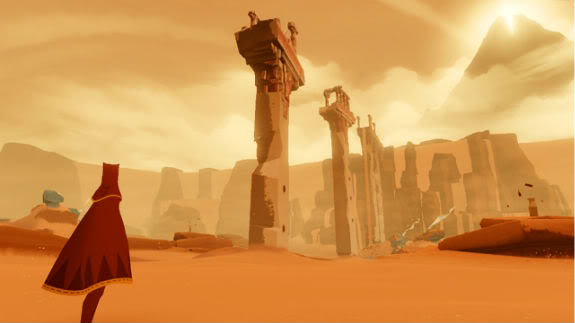
In one section of the desert where the sand moves like water in an ocean, players can “catch” a wave and ride it. Such experimentation will yield other discoveries.
The desolate sand dunes stretch as far as the eye can see. Players traverse the landscape at their own pace and with their own direction, but the mountain will always sit erect as a beacon of mystery. Your smallness is readily apparent each time the geographic feature falls into view.
Although seemingly devoid of life, players will happen upon other travelers making their way to the mountain. Chen could discuss few details about this multiplayer feature, but he likened it to hiking -- sometimes you’ll happen upon another hiker while heading to your own destination. You might even join up for a while. Or, you may decide you want nothing to do with this person and press on alone.
Chen hopes that Journey will re-imagine how we think about multiplayer in video games, and how we feel toward one another. Through the environment and the end goal, he hopes to elicit a feeling of small and wonder.
Mechanics are more than rule sets and a series of systems. As Homefront and Journey hope to demonstrate, gameplay can also be a vehicle for stirring the emotions of those behind the controller. I'm interested in both titles for that exact reason.
 1
2
1
2