Home
Home

Religion and Video Games
The United States of America is a nation with a history steeped in religious conflict. Since its infancy, intolerance and violence, both physical and non-physical, have been sanctioned and advocated, all in the name of religion. Not a whole lot has changed since anti-Catholic and anti-Mormon rhetoric was prevalent in the mainstream media. Today, popular culture, music, film, television, magazines, newspapers, the Internet, and even video games are all used as a means to inform perceptions about non-Protestant religions in the United States. These forms of media also continue to create ideas about religions that often legitimate different forms of violence, whether it is physical or non-physical. The media continues to play a large role in creating what René Girard refers to as the scapegoat. Mainstream media and popular culture have an undeniable influence on how many Americans form their religious ideologies and in creating what are considered to be normative morals. The ideas, identities, and ethics that are promulgated by the U.S. media illustrate how the notions of surrogate victim and sacrificial violence espoused by Girard work in the context of American popular culture.
In Violence and the Sacred, René Girard posits that violence is a form of sacrifice, a “social function” that “serves to protect the entire community from its own violence” (Girard, 8). In his model, sacrifice quells internal communal conflicts, desires, and discord, restoring “harmony to the community” and “reinforcing the social fabric” (Girard, 8). According to Girard, this sacrificial violence is not static, and, if not somehow placated, “seeks and always finds a surrogate victim” (2). This seeking out has been played out throughout American history, time and again, as illustrated by intolerance and violence towards Native Americans, Catholics, Mormons, and Muslims.
Girard later poses the question, “what will happen when we share the same desires?” and answers, “two desires converging on the same object are bound to clash” (146). Regina M. Schwartz raises a similar concern in the introduction of her book, The Curse of Cain, when she asks, “What kind of God is this who chooses one sacrifice over the other?” Her answer points a finger directly at monotheism. Schwartz states, “This God who excludes some and prefers others, who casts some out, is a monotheistic God – monotheistic not only because he demands allegiance to himself alone but because he confers his favor on one alone” (Schwartz, 3). Here, Schwartz is making a claim that monotheism’s legacy of violence is directly linked to the language of scarcity that is prevalent in it’s scripture. This scarcity is what leads to the construction of the “Other,” an act that, according to Schwartz, is not only the antecedent of violence, but is violence itself. Both Girard and Schwartz emphasize that the construction and subsequent sacrifice of the Other are necessary in identity formation. Their theories create a framework that can be used to examine religious intolerance and violence in the U.S. as perpetuated by popular culture and media.
In Pop Culture Wars, William D. Romanowski discusses the critical role popular culture and media play in identity formation. He states, “Popular culture influences how people think about themselves, their relation to others and their place in society” (307). It is important to note that he not only stresses pop culture’s impact on individuals, but also their interactions with others. He continues to state, “Music, movies, television and other aspects of popular culture are both wildly entertaining and instructive, and are a vital means to uncover the religious and cultural forces at work in our world” and that “entertainment plays a significant role in our public discourse, both affirming and challenging prevailing attitudes and assumptions about things that matter” (313). For the purposes of this paper, I will be focusing primarily on the “affirming” aspect mentioned by Romanowski, beginning with the use of video games to echo political rhetoric against Muslims.
In Religion and Popular Culture, Richard W. Santana and Gregory Erickson examine the emerging relevance of video games as legitimate forms of popular media and how they can be used to fabricate national identity and construct an “evil Other” that must be exterminated. “Video games,” they argue, “have become significant sites within which to explore the tension between the religious right and popular mass culture” and that because of their ability to respond “more quickly to shifts in contemporary cultural tastes, they reify the rhetorical models that emerge within the culture while creating interactive stories that more quickly incorporate those rhetorical models into their meaning making systems” (Santana and Erickson, 173). Specifically, Santana and Erickson are applying this framework to political rhetoric following the events of 9/11, when then President George W. Bush referred to the terrorist attacks on the World Trade Center as “evil performed by evildoers.”
Santana and Erickson sate, “within American popular religion, intervention against evil is unambiguous and usually cast in militaristic rhetoric” (170). They explain that “since the events of September 11, 2001, a genre of video game has emerged employing plotlines that logically follow from the adoption of the discourse of evil as the result of evildoers” and that “these games often involve military action against Muslim terrorists” (173). The creation of this genre of video game, as well as other forms of media such as film, music and news turning to the terrorist attacks for content, was the direct result of Bush’s rhetoric.
Video games such as Soldier of Fortune and Fugitive Hunter “cast the enemy, and sometimes the innocent victims, as indistinguishable from the evildoers and thus apt cannon fodder” (174). While video games are often demonized for their realistic depictions of violence, Santana and Erickson argue that games that echo political rhetoric often get a free pass. They claim “games which uphold contemporary rhetorical stances can be very violent indeed without coming under attack, but games that seem to transgress the normative rhetorical positions of the culture are often identified as a corruptive force in the culture” (174). Here, we can see that video games, just like any other form of popular media, can be instrumental in perpetuating the rhetoric that constructs the Other.
While many games feature terrorism, Santana and Erickson point out that very few of them “engage seriously with the issues of the current situation, none engage with the reasons or motivations for terrorist activities, but instead choose to read those motivations as inherent to the religion, culture, or mindset of the Islamic world” and that “despite the moral implication raised by the player’s actions, war-themed games depict the United States versus them ideology prevalent in the culture” (188-189). By employing specific language, that of “Good versus Evil”, where America was “Good” and the Muslim terrorists were “Evil,” Bush is constructing a national identity contingent on an essential Other. Santana and Erickson further argue, “these rhetorical strategies and the discourse of popular culture/popular religion work to unite a disparate society against the perceived threat of evil (always figured as external)” (179). This idea goes hand in hand with the Girardian notion of sacrificial violence as a means of “reinforcing the social fabric.”
This kind of rhetoric can be seen as far back as the Seventeenth century, when English anti-Catholic writings used the “trope of the Amalekites” to “illustrate the rhetorical incitement of hatred of Catholicism in England” (Corrigan and Neal, 26). According to Corrigan and Neal, “English depictions of Catholics as Amalekites, provided an image of evil and a basic inventory of corrupt practices and beliefs that could be applied to other groups” (31) and “English writers articulated a set of attributes that could be applied to other religious opponents who might then also be judged worthy of annihilation” (32). Just as the trope of the Amalekite was used in literature and rhetoric in the seventeenth century to justify hatred of Catholics and Native Americans, Bush’s political rhetoric and demonization of Muslims was intensified by popular media, in this case video games, and his use of the term evil constructed the Muslim as Other.
Girardian themes can also be found in Rachel Wagner’s Godwired: Religion, Ritual and Virtual Reality. Wagner argues that in the same way “Girard sees Mass as the perfect example of substitutionary violence functioning as a salve for societal anxiety” in which “violence is not denied” but is “diverted to another object, something it can sink its teeth into” (182), video games can also serve a similar function. “If Girard is right,” she says, “virtual (mimetic) violence is substitutionary” (183). Here, Wagner is suggesting that violence in video games can be considered a kind of ritual where violence is redirected, and digital beings become the scapegoats. Although Wagner does question whether or not video games can “functionally do the same kind of symbolic work as the Christian Mass” (183) in a Girardian context, she also points out that video games create a liminal space in which the actions of players are excusable because they don’t really hurt anyone. Games such as Second Life, allow players to “blow up virtual churches,” “sit naked on the Koran,” and “paint swastikas on synagogues” (166). One player, Roger Junchke, calls himself a “Second Life terrorist” and says his actions within the game are just “his benign and petty way of expressing my dislike of Christian fundamentalists” (166). Although players who take part in this kind of behavior may consider it “benign,” their actions within the game are fueled by same construction of the Other that Regina Schwartz would refer to as a form of non-physical violence in and of itself.
Godwired also takes a close look at the violence in the controversial video game Left Behind: Eternal Forces, a companion game to Tim Lahaye’s Left Behind series of novels. In the game, the player controls “tanks, helicopters and infantry, with the primary goal of converting the uncommitted (neutral units) to the Christian cause, while killing non-Christians when necessary” (169). The game, like the series of novels it is based on, caused disputes and led one member of the Anti Defamation League (2006) to state “This theology portrays itself as the only path to salvation. And Jews, people of any other faith, or those of no faith who do not convert before it’s too late, are destined to suffer horrible deaths” (170). Not only does this game echo Schwartz’ notion of scarcity, but it also creates the same “dualistic construct of reality in which every entity in the game is identified as with the forces of good or the forces of evil” that was seen in the war-themed games released in the wake of 9/11.
However, this does not mean that video games and the Internet should be viewed as harmful tools. On the contrary, even a living Buddhist Lama can see the benefits of video games. Rachel Wagner explains how twenty-four-year-old Karmapa Lama Trinley Dorje finds that “if I’m having some negative thoughts or feelings, video games are one way in which I can release that energy in the context of the illusion of the game. I feel better afterwards. The aggression that comes out in the video game satiates whatever desire I might have to express that feeling. To me, that is very skillful because when I do that I don’t have to go and hit anyone over the head” (Godwired, 183). For Lama Dorje, video games then become the scapegoat and the violence, or “negative thought” is slaked. Here, we can see that video games can further be seen in a Girardian context by providing a liminal space for sacrificial violence.
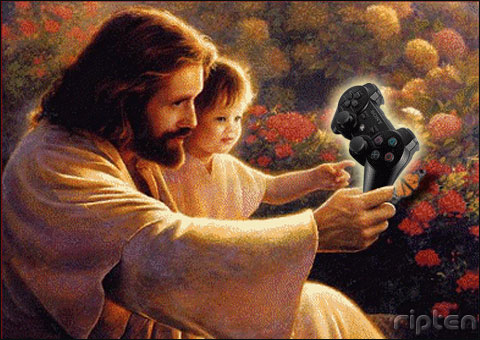
I have examined how video games have recently become a new space, a stage if you will, or as Wagner would have it, a liminal space, for religious intolerance, both in the context of Girardian sacrificial violence and Schwartz’ notion of the creation of the other within the context of monotheistic scarcity. These games allow for the performance of virtual violence without the messy cleanup required by the physical act. However, Scott Thumma and Edward R. Gray’s Gay Religion further examines the use of play, performance, and stage in a Girardian context. In his chapter discussing a play about the life of Harvey Milk, the first openly gay elected official in the U.S., Gray notes that the Christian Right’s obsession with gays “leads it to construct a picture of gay life to suit its own purposes and will inevitably lead to violence” (333). Here, Gray is suggesting that the stage play portrays Christians and gays as “perfect Girardian rivals” (333). He is also echoing the Schwartz’ claim that monotheistic notions of scarcity create religious identities that are contingent on some other, in this case homosexuals. As explained by Gray, “Girard is correct that groups renew their common life through the regular imputation of the cause of social problems to scapegoats, then the obsession with homosexuals by …the Religious Right in the play is a strategy for maintaining the social order. To maintain its status, the religious right must seek the ritual sacrifice of its chosen scapegoat and this is dramatically accomplished on stage” (333). For some semblance of order to be maintained within the community, there must be some group to maintain order against. If Christian ideals such as hetero-normativity become threatened by an ambiguous other from without, intolerance and violence are all but expected. Here, the liminal space created by the stage is used to portray Harvey Milk as a sacrificial scapegoat. The violence is acted out, played at, without any real physical violence.
We know that manipulation of popular media and culture in the construction of the other is nothing new. In his seminal book Orientalism, Edward Said notes that “Since World War II, and more noticeably after each of the Arab-Israeli wars, The Arab Muslim has become a figure in American popular culture” and that “in film and television the Arab is associated either with lechery or bloodthirsty dishonesty” (286). He further echoes Girardian notions of how violence is often redirected to other groups when he explains how cartoons depicted Arabs with “clearly semiotic” features. He states, “their sharply hooked noses, the evil mustachioed leer on their faces, were obvious reminders (to a largely non-Semitic population) that “Semites” were at the bottoms of all “our” troubles” and emphasizes how the “transference of a popular anti-Semitic animus from a Jewish to an Arab target was made smoothly, since the figure was essential the same” (286). This not only resonates with both Girard’s idea of the surrogate victim and Schwartz’ argument that group identity is informed by exclusion, it also suggests that what is largely considered religious intolerance has as much to do with race as it does with religious practice and belief. According to Corrigan and Neal, “Perpetrators of religious intolerance often focus on particular religious or religio-racial groups” and “Jews, for example, are not simply another religion, but in anti-Semitic rhetoric they also become a distinct and threatening race” (255). Moreover, divisive such as abortion, homosexuality, and feminism create even more distinctions that are used to legitimate construction of the other and the avenues for violence and intolerance that inevitably follow.
But much has changed since Said’s example of political cartoons and early film and television. With the advent of the Internet, those who would negotiate their own religious group identities by excluding and being intolerant and violent towards the others they themselves create now have their own liminal stages to perform from, and with the added benefit of the shield of anonymity. According to the Simon Wiesenthal Center, the Internet “provides re-tooled racists with an unprecedented marketing tool. They have populated the World Wide Web with hundreds of sites enabling them to promote their agenda in an attractive, yet unassailable way” (Corrigan and Neal, 252). Much like the aforementioned “Second Life Terrorist,” those who frequent websites such as Fred Phelps Westboro Baptist Church official site “godhatesfags.com,” the anti-Semitic apparel site “aryanwear.com” and the anti-feminist site “womenagainstfeminism.com” (Corrigan and Neal, 250) can enter a virtual, liminal space where they can be openly intolerant, virulent, and spiteful, with minimal, if any, consequences. What began with cartoons and literature has been passed down and is now available to be disseminated to anyone on the Internet. Here we see one way in which the Internet can be used as a tool to promote intolerance towards others, but there is still another way in which it harmful, and that is by creating inaccurate portrayals of groups deemed as “other,” specifically, Muslim women. In The Unknown Abode, Kathleen M. Moore examines how images used on a U.S. State Department Internet Web site can be harmful to Muslim women by creating marginalizing portrayals of Muslim authenticity. Her explanation merits full quotation:
“The ‘Faces of Islam’ section, a photo gallery meant to illustrate the “extraordinary range and richness of the way American Muslims live,” features several photographs of Muslim girls and women purchasing vegetables at a farmers’ market or competing in a high school relay race, in which all females are clad in the modest attire of the hijab. If one were to limit investigation of Muslim life in the United States to this official version, one would come away with the impression that the history and social practice of Muslims in general and U.S. Muslims in particular confine women to wearing this concealing clothing. To be authentically Muslim, it would seem, requires that women conform to a stereotypical and narrow notion of Muslim existence, reducing the scope of that “extraordinary range and richness” of Muslim life to specific perceptions of what constitutes Islam” (129).
This is exemplary of how religious intolerance and violence does not always come in physical form. Here, the Internet is used as a tool by the U.S. government itself, to propagate erroneous ideas about real Muslim ideals, uses the Internet as a tool, however unintentionally. Moore further explains that “while the hijab is a volatile emblem – viewed as a symbol of religious and cultural outsiderhood – it remains an important indicator of Muslim presence in the United States” and “in the othering and homogenizing discourse of Orientalism, the hijab has been construed as a symbol of enforced silence and submission, imposed by a patriarchal faith, which may signify a radical brand of Islam and anti-American terrorism” (130). While the website is designed to promote generally positive views of Muslim life in the U.S., it is also essentializing Muslim women and misappropriating the hijab as a symbol.
Whether it is the liminal space created by the simulated worlds of video games, the actual stages used in plays, or the anonymity fueled virtual spaces populated on the Internet, contemporary popular culture and media have become tools to create the alters on which to lay sacrificial scapegoats. It has been shown that both popular culture and media and technology are becoming increasingly powerful influences when it comes to identity formation, and religious identity is no exception. Knowing this, those looking for a means to rally others to their cause or to simply spread their views of intolerance can manipulate these tools to their advantage, making the construction of the other and the scapegoat something that is smoothly facilitated. Both Girard and Schwartz provide us with a framework in which we can more easily understand the creation of religious identity and the creation of the other and just how linked the two are. This framework can also be used to understand how and why the Internet, video games, films, music, television and even stage plays came to play such a vital role in religious identity formation, intolerance and violence against the other.