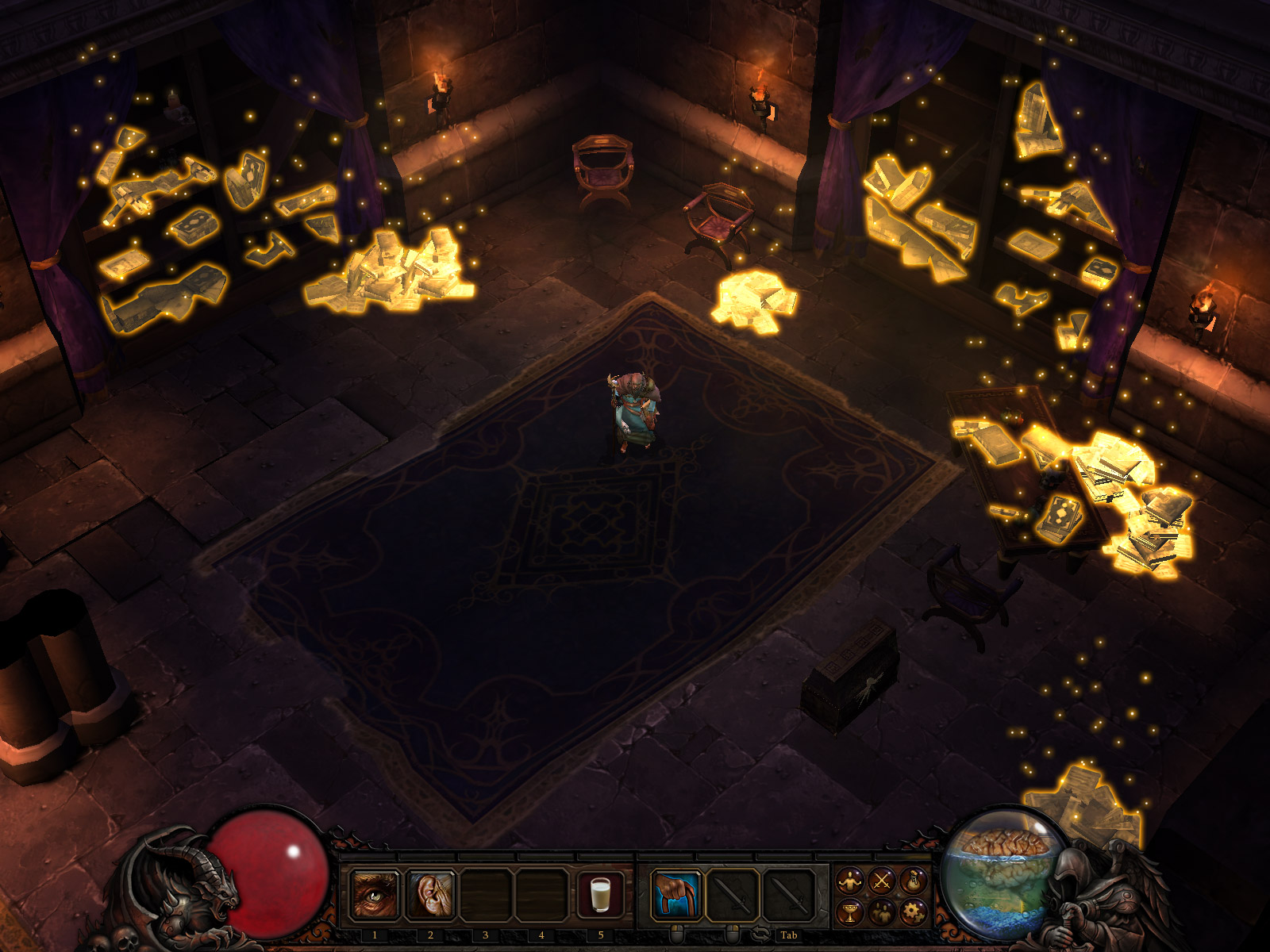
Wait, you want to save this?
Most everyone will agree that Super Mario Bros. is a good -- if not great -- game. Absolutely worthy of preservation. (See my previous post for more canonical games.) But what about the not-so-good games? And what about the absolute dreck like Superman 64, one of the most critically reviled games of all time? Wouldn't it be better to dump those games in a New Mexico landfill and pretend they never happened? Why save Superman?
Read more
The evidence. (Click to embiggen.)
Dear Professor Layton, I have a mystery in dire need of solving. For over a year now, the character Ingrid from your game Professor Layton and the Curious Village has been stuck to the sidewalk at Post and Kearny in downtown San Francisco. The intersection is a well-trafficked area, and I fear the trampling of feet must be dreadfully uncomfortable for her. Also presumably uncomfortable is the fact that she is missing most of her body, save the tip of her nose [see the enclosed photograph]. How did this happen? Was she part of a guerrilla advertising campaign? I believe I recall some bus shelter ads around the time your game came out -- perhaps she was running to catch the bus, tripped, and fell, never to get up again? I eagerly await your response. Sincerely, Brett Bates P.S. The solution is worth 60 picarats.
Ingrid in better times.
[Intermissions is a series of silly little posts on games that may or may not exist. For more Intermissions, click here. Find me on Twitter at http://twitter.com/bbretterson.]
Read more
[You might guess, based on my previous blog posts, that I consider games to be worthy of scholarly scrutiny. Well, you'd guess right. But you know what? Games are fun, too. That's why we play them -- they activate that little pleasure center in our brain that leaves us with a sloppy grin on our face. It's with that in mind that I'm starting Intermissions. Think of these posts as a counterbalance to the serious stuff: silly little posts on games that may or may not exist. First up is What's This Email? Have fun!] What's this email all about? (Click to embiggen.)
In this unique adventure title from the creators of Desktop Folder Shuffle, you play a private detective named Tom who receives a mysterious message in his inbox: "Tom, help. Theres a man with a gun!!1! o no! ROFD." Who sent it? Who -- or what -- is ROFD? And what does it have to do with your ex-wife and the former client she ran off with? Click through weeks of email in order to solve the case. But beware of spam! The prince of Nigeria says he has a clue, but he may just want your credit card number. It's up to you to find out. Available on PC and Mac.
Must you play this? Yes. Desktop Folder Shuffle kept us rearranging our desktops for weeks, and we're confident that the more story-driven What's This Email? will not disappoint.
[Note 1: Special thanks to Jorge Luis Borges and Stanislaw Lem for the inspiration.]
[Note 2: You can follow me on Twitter at http://twitter.com/bbretterson/]
Read more
Editor's Note: Oh, look -- it's Brett Bates again. Like the announcer from NBA Jam would say, "He's on fire!" And for good reason -- his post about game makers revealing more about the development process is certainly something we'd like to see more of. Hell, getting to know all the dirt that went down making Duke Nukem Forever is surely enough to make anyone scream, "Boom-Shakalaka!" -Michael
What will we find behind the curtain?
Last week, David Jaffe posted some early documentation (with sensitive bits blurred out) for a new game on his blog, along with the following paragraph:
Ok ya’ll- will post more next week but you know, at least for now, I’ve been thinking more and more about turning this blog into more of a ‘behind the scenes’/’making of’ style blog and doing less personal rants and stuff. So I may start posting a bit less (until we have stuff to reveal about our game…then I’ll post like a madman!) but the stuff I do post will be more related to our game and our company, and less about me personally. But I will also start Twittering more about the day to day workings on my end of making our game. Once we get our company website rolling (soon, I hope) ideally we can wrangle in a coder, artist, producer,etc to do some blogging and twittering on the official site. It would be great to give ya'll a good idea of what those crazy talented folks do all day.
Of course, the Internet being what it is -- some intrepid but misguided soul -- immediately defogged the images, and they ended up on the major gaming blogs. Stung by how his openness was treated, Jaffe has since removed the post and threatened to stop blogging altogether. He recanted on that, but I do think he's now going to think twice about his "behind the scenes" idea. And that's a shame, because the videogame industry could definitely benefit from pulling back the curtain a little bit and revealing the creative process.
Think about the film industry: How many movies made in the last 30 years had separate crews documenting the filmmaking process? Sometimes, these "behind the scenes" documentaries even outshine the movies they're documenting (see Lost in La Mancha). Even when they don't, the documentaries provide an essential look at how a film gets made, useful for future film scholars. And they're often entertaining to boot.
If film can be so open, why is the videogame industry so buttoned up? What do we have to hide? It's a sad fact that we know more about how The Hottie and the Nottie got made than Ico. One could argue that a filmed documentary makes sense for a filmed movie, and not as much sense for, say, a brainstorming session at Insomniac. But there are a myriad of different ways to document the game-making process: concept art, early renders, email exchanges, design documents, and so on. One might also say that we need to protect intellectual properties. But how important is that after a game is on store shelves?
Some producers and developers are opening up, and I applaud them for that. Occasionally the supplementary material for the "special edition" version of a game contains insightful information. 2K Boston released to the Web an excellent book of concept art for BioShock. Valve even offered a "commentary" playthrough for the Orange Box. More significantly, indie developer Introversion has revealed a wealth of "behind the scenes" documents for their upcoming Xbox Live Arcade title, Darwinia+.
Unfortunately, most "extra" content found in games is nothing more than marketing material. Which is what makes the controversy around David Jaffe's post so sad. Whether he likes it or not, Jaffe has the clout in the industry to cause a sea change, and I feel that his "behind the scenes" blog would be just that. David, if you're reading: I hope that you do pull back the curtain on your creative process. Not only because I'm curious, but also so that future generations can understand how your latest classic came to be.
Read more
Editor's Note: Another gamers' ice-breaker from Brett, again with the archiving talk. Why do I get a feeling that Mr Bates is soon going to announce that he's opening up a videogame museum and that he's going to charge us all admission to it? Nah, I'm just kidding, but do read this story. My picks: the original Civilization and Super Mario Bros. -Shoe
Most important game ever of all time? Looking for a trite top ten list? Too bad; this is another article on videogame preservation. (Read my first post on why game preservation matters here.) But don't worry, fanboys, there will still plenty for you to argue about in the comments, because we're going to take a look at the creation of the Digital Game Canon. Way back at the Game Developers Conference of 2007, the Game Preservation special interest group of the IGDA convened a panel -- consisting of Henry Lowood (Stanford University), Steve Meretzky (ex-Infocom), Warren Spector (Deus Ex, Thief), Christopher Grant (Joystiq), and Matteo Bittanti -- to discuss their choices for a digital game canon that would provide a starting point for preservation work. (Read more about the Digital Game Canon here, and listen to audio and view slides from the panel here.) Each panelist chose two games, breaking down as follows: * Henry Lowood (Spacewar!, Warcraft I/II/III) * Steve Meretzky (Zork I, Civilization I/II) * Christopher Grant (Super Mario Brothers 3, Doom) * Matteo Bittanti (SimCity, Sensible World of Soccer) * Warren Spector (Star Raiders, Tetris) The panelists picked their games on a variety of grounds. Perhaps the gameplay was pitch-perfect, or the game provided a technological breakthrough. Maybe the title was emblematic of a genre or just fun to play. Throughout, one common thread emerged: Each panelist felt a personal connection to their games. For these reasons and others, they felt their choices represented a significant addition both to gaming and to the culture at large. Archivists are now working to preserve some of these games and the creative processes that formed them. It's a tricky task -- what exactly should be included in preserving a game is still up for debate -- but lucky for most of us, we can simply shout from the sidelines. So my question for you is: What two games would you add to the Digital Game Canon and why?
Read more
Editor's Note: Congrats to Brett -- this is the first community story that we've promoted to the front page. We hope he follows up on this post, because it's an interesting discussion. -Shoe
Here's one way to preserve videogames.
Let’s play a game: You’re a graduate student 300 years from now, studying videogame history at, say, the University of Mars, and the object of the game is to write a holopaper on the PlayStation Era and the God of War series in particular. How do you do this?
Sure, you could download the games into your eyeballs for 1,254,493 omnibucks and play them to your heart’s content, but what does that tell you about the people who made the games, or the people that played them back in the day? For that information, you’re out of luck. You can’t pop in the original disc because the data on CD-ROMs has rotted away. You can’t read a FAQ because GameFAQs had their servers shut down in 2065, or read any online reviews since Google closed its doors during the Great Browser Wars. You can’t read any design documents or email exchanges because every time a developer left the company, his hard drive was wiped. You can’t play any early builds of the game, since they were burned on CD-Rs, which rot faster than CD-ROMs, and anyway all the builds were kept in a supply closet that flooded after a particularly rainy day. In short, you’re screwed. No more lives. No more continues.
Okay, maybe that bit was a little silly, but I wrote it to emphasize a point: There is a very real danger that the videogame industry will lose much of its essential history if steps aren’t taken soon.
Read more
Yes, this is in 1080p! You may be wondering where You Must Play This has been these past few months. The answer is simple. We've been on the beat, obtaining our very first exclusive, which we can now reveal: Zork HD! We traveled to Santa Monica, CA, in December to get the first look at this exciting remake of the text adventure classic coming to Xbox Live Arcade this summer.
Read more
|
|