Home
Home

Antonio questions whether or not better graphics make violent and dangerous situations less palatable to gamers. What do you think?
(This article contains spoilers for Call of Duty: Black Ops.)
I'm a decent soldier in Call of Duty: Black Ops: I hide behind objects to avoid gunfire, kill enemies without guilt, rappel down cliffs, survive chemical attacks, escape sinking freighters, fly helicopters over hostile Vietnamese territory, and ultimately, I save the world from nuclear disaster. I can't do any of that in real life. I'm a coward, and it's a good thing I'm not in the military.
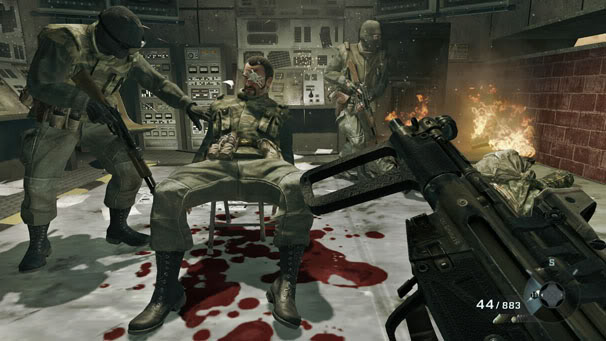
In terms of graphical fidelity, Black Ops portrays warfare well -- perhaps a bit too well. Ten years ago, the war games I played were more fantasy than reality. Syphon Filter, with its penchant for espionage and terrorism, never left me frightened for my own life. It was great fun. I liked the guns, and blowing up people was pretty entertaining. I embraced the game, but the character models and level designs lacked the depth and detail needed to truly draw me into its reality. That's probably why I carried my childhood love for guns and blowing things through my adolescence and into my early twenties.
Developer Treyarch makes gunplay hard to watch by creating a game that is as visually true to life as possible. Black Ops has detail and depth, from the design of the weapons to the forests of Vietnam to how the characters interact with their environment. I can understand why: They have the technology to create such a game, and it adds to the believability of the story.
Could anyone take Black Ops seriously with blocky caricatures like Gabe Logan? If Treyarch developed Black Ops with the design and physics of Syphon Filter, would it affect the player in the same way?
I've hear reports about murders and violence, but I rarely give a thought to passing ambulances. I pull over and let them by, but my heart doesn't exactly reach out to the person inside. Everything is fine as long as trouble doesn't come knocking on my door. Syphon Filter is sort of like that. I understand the dangers of guns and the physical and mental damage inflicted upon soldiers, but I'm distanced from it. Sometimes it takes a certain level of realism to draw an emotional reaction to these problems.
With Black Ops, the campaign immediately drew me in, and as I led Mason from mission to mission, I started thinking about the situations he got into and how I would fare under similar conditions. Later in the game, the Viet Cong capture Mason and his team. Mason awakens to a game of Russian roulette with one of his teammates. Mason's friend refuses to play, and his head is immediately smashed in. The guards toss him aside and sit a second squad member down. He reluctantly takes the revolver, puts it to his temple, and pulls the trigger. He lives.
Then, it's Mason's turn. He puts the revolver to his head while his friend asks him to come up with a plan. A guard moves too close to Mason, and at the last minute, Mason turns the gun on his captor. Miraculously, the bullet is in the chamber. The team escapes to fight another day.
I would pee in my pants. I don't have the reflexes to shoot a guard standing beside me. I would stupidly play Russian roulette until everyone died. You can be detached from the happenings of the world until they affect you -- a loved one is hurt or you yourself are hurt. Black Ops simulates this feeling pretty well, and it can be exhausting. Trouble didn't actually come knocking on my door, but after playing Black Ops, it certainly feels like it did.