Home
Home

I love Flash games like To What End -- tiny, poetic experiences based around a single thought or concept. Here, Michael accurately describes what makes these games work.
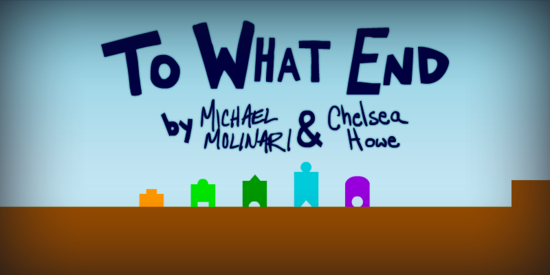
To What End is a game made for the 2012 Global Game Jam by Michael Molinari and Chelsea Howe. You should probably go play it before you continue reading; it should take you less than five minutes.
Finished? OK.
The most notable thing about To What End is not how it manages to convey a story through the actions you make as the player. It's how it tricks you into creating a story based on your actions through the use of abstraction. The game contains scripted events of a sort, but their significance -- and any sort of personality or humanity you place on these shapes -- are merely your own creation.
The reason this happens is because of something comic-book artist/writer Scott McCloud talks about in his book Understanding Comics. Essentially, the human brain is designed to look for faces. That's why when we look at an emoticon like : ) we see a smiling face and not just random punctuation.
Comics take advantage of this through art style. The more realistic the character appears, the more we think of them as a different person from ourselves. But when we see a more simplistic face, we see our own selves reflected in the character.
Like the smiley-face emoticon, we want to assign some sort of personality to it, to anthropomorphize it, so as to give it meaning and make it more real to us. This in turn makes our connection to that character more personal; to a certain extent, the reader is creating aspects of the character.
This is what happens when you play To What End. Neither the object you control nor the other figures have personality. There's nothing remotely human about them.
But in your mind, as you play, you construct a narrative through the patterns you see and experience -- the way they each hope a little differently or the way the cutout at the bottom of each object fits the shape protruding from the top of the figure to its left.)
So you start to see them, not as five shapes moving through a space, but as five friends on an adventure, or five people trying to get through life, or something else entirely. Something more than just shapes.
Then, as you begin to progress through the game world, you create meaning to explain what is happening. Perhaps you chose not to leave one of the shapes behind, because you wished not to abandon it. Or maybe you made it all the way to the end with your one object, and you feel accomplished for doing so even though you left those other figures behind.
And this is perhaps the true brilliance of To What End. No one narrative fits your experience playing it. In fact, the game itself really has no meaning at all. Instead, the story is created by the person playing it.
This makes the meaning you come to at the end something very personal -- perhaps reflective of your personality or how you see the world.
And it's all made possible by the abstract presentation of a few shapes.