Home
Home

Have video games felt a little too "on rails" lately? Brian argues so, with great insight, and segues into a thoughful discussion of the drab, colorless worlds that we're no longer given the freedom to explore.
The myth of an 8-Bit Eden
Plenty will share these thoughts, maybe even accusing me of beating a dead horse. On the other hand, I know that many other readers will feel the opposite, saying the only problem lies in my examples.
For instance, to address the latter, yes, one might assert that the 8-bit era was saturated with Mario clones. This is largely true. Yet, whereas the side-scrolling platformer was a new genre in those early days, the current console cycle is swamped with a game-style that was born in the '90s. And as NES developers, both first and third party, turned the genre that Mario made famous on its head, side, and back again, getting the most out of every vibrant pixel, today’s polygonal worlds are stuck in neutral.
The ability to render such a close approximation of reality seems to not only have fenced off the boundaries of modern game worlds but seems to have numbed our craving for departures from them in the process. Limitations are often said to stimulate creativity, and that was clearly the case in the early days, where the artistry of developers in turn sparked the imaginations of their audience.
Today, however, we’ve witnessed a reversal -- the limitations of current video game environments have dulled rather than goaded the desires of modern adventurers.
Mostly charted, completely scripted
That said, I’ll volunteer my own hypocrisy. I’m certainly part of the problem, having played and enjoyed many of the above games. Nevertheless, the titles that I typically gravitate toward hold another promise. Take, for example, a game like Uncharted: Drakes Fortune. On the surface, this game would seem the antidote to all that ails our industry. The very title evokes a quest to exotic locales in search of trials and treasures.
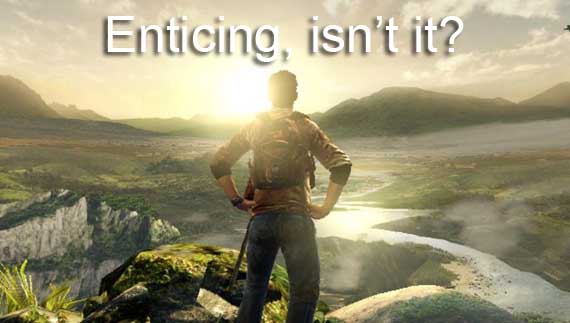
Too bad so much of Uncharted is unchartable.
However, the actual gameplay does little to fulfill this promise. Instead of a wide-open adventure full of danger and reward, the game shepherds the player along a tightly scripted path, muting the menace of pitfalls with simple redos and rigid handholding.
While the environments are wonderfully detailed and -- at least with latter entries in the series --splashed with some color, they are no less than mirages. Their very existence makes the rigorous tunnel-vision of the gameplay all the more painful. The desire to open that door or climb that mountain is worthless unless it’s the door or the mountain dictated by the game’s script. And despite all of the production values and graphical panache, for those in search of so heavily scripted a journey, any one of the Indiana Jones films offer a better -- not to mention more original -- story.
Perhaps it’s this very ability for modern games to resemble movies that has caused the experiences they present to also mimic cinema. Neglecting the interactivity of games renders moot the medium’s greatest strength.
While, yes, there is a vicarious, if more voyeuristic, delight in filmgoing, it’s the draw of filling the shoes of the hero and making choices with real weight that give video games their advantage if not their central raison d'être. One might go so far as to blame this tendency to funnel players along a predetermined course as one reason for so much topographical retreading. Why construct unique worlds if they can’t be fully combed and conquered?
Perhaps this is the reason -- despite the comparative limitlessness of modern storage formats -- that the experience of too many of today’s games is akin to those chase scenes in old cartoons with the same backdrop playing in a loop. Did they think we would be so hypnotized by the clichéd narratives and so distracted by our itchy trigger fingers as to quell that urge to burst through the repetitive artifice?