Home
Home

Have video games felt a little too "on rails" lately? Brian argues so, with great insight, and segues into a thoughful discussion of the drab, colorless worlds that we're no longer given the freedom to explore.
Late for the sky
Enter Skyrim. Here is a game with virtually limitless horizons and the unshackled freedom to discover them. For an adult gamer with many things more crucial than math homework to ignore (or deface), games in The Elder Scrolls series can be daunting in their scope and autonomy. To a great extent, these adventures are the culmination of early infatuations with The Legend of Zelda and its ilk.
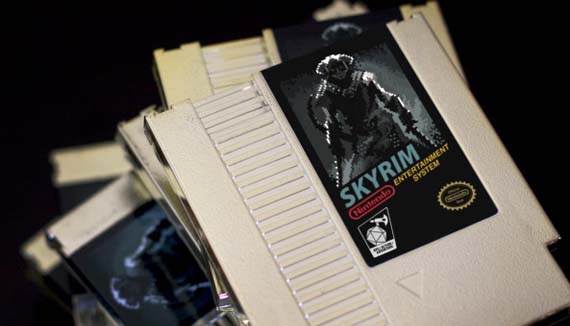
A modern classic ... with a touch too much of both. [Source: 72 Pins]
As the NES gave way to the 16-bit era, and the 16-bit to the 3D dominions of the PlayStation and N64, gamers had tangible -- if shoddily textured -- fodder with which to begin fathoming the arrival of an adventure of this magnitude. Skyrim is a landmark success for us would-be explorers.
But, as much as I adore developer Bethesda’s magnum opus, it can’t be given a free pass, either. In many ways, it violates the core principle of this article. Various shades of manure continue to be the palette from which Skyrim’s graphical style is drawn. Of course, the landscape’s pervasive blanketing of snow conceals much of the standard browns and grays. This element, however, only further robs the game of color.
Fans may argue that the desolation of Skyrim is dictated by its location on the Tamriel atlas. Conceding this point does nothing to elevate the game’s aesthetic above its contemporaries, however, as the look of every title should more or less match its setting. The pervasive ugliness resulting from these choices is in large part what we’re protesting. Whatever the reason, the end result is a game that -- while vast and free -- strictly adheres to the monochromatic trend.
Stepping away from Skyrim’s drabness, the visual nods to Norse mythology do help the game stand slightly above the threadbare façade of most examples in the genre. Yet, when it comes down to it, the game does too little to distance itself from its sword and sorcery heritage to truly feel fresh or mysterious.
And while this thematic baggage wouldn’t have given that pie-in-the-sky lover of Link’s first outing the slightest qualms, his spoiled and jaded descendant has had the misfortune of 25 years of déjà vu to color his views. These quibbles notwithstanding, our world is truly a better place with Skyrim than without.
Is our die irretrievably cast?
So here we approach what may be the crux of the argument. Does the heart of the problem lie more in an inability of the medium to transcend its roots? The traditions of comics, sci-fi, and Dungeons and Dragons have stamped an indelible mark upon the look and feel of video games. Of course, those hallmarks may have appeared somewhat fresh during gaming’s formative years, but they have since become increasingly humdrum.
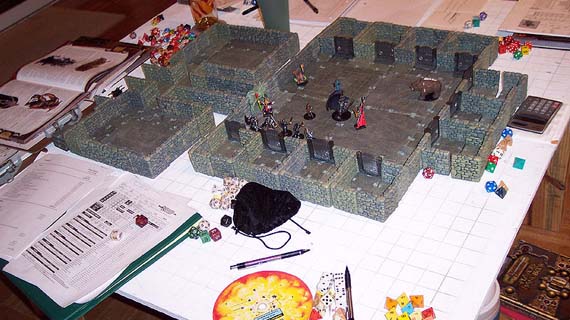
Do the hang-ups of modern games stem from the sins of our fathers?
Regardless of age, it’s an aesthetic with a loyal band of adherents. Having grown up on Tolkien myself, I admit to a weak spot for castles, magic, dragons, orcs, elves, and all the tropes of his worlds and their descendants even if they wear their influences too baldly, displaying little inventiveness of their own. Nor is it a milieu I would wish to disappear entirely. A twinge of nostalgia still hits home no matter how many fire, water, or ice terrains I traverse.
At the same time, this decades old recipe has become both a crutch and a roadblock for the creation of more imaginative and original worlds. This, of course, applies to other overly familiar settings. Be they your garden-variety battlegrounds and post-apocalyptic wastelands or the trappings of the latest outerspace adventure -- whether featuring a Star Wars or Star Trek skin or some drab mishmash of the two -- these are bankable landscapes ground into staid similitude by too many years of repetition.
To some extent, any game in a given category has become more like a sequel or side story of its genre-mate, visually speaking, and, too often, in its fundamental mechanic. By this estimation, Skyrim, a high-water mark in the series, would make sword-and-sorcery, high fantasy-themed adventure part 20XX. Overly reductive? Definitely. But less and less so as we descend further into these cut-and-paste times.