Home
Home

"Don't waste your day...in front of the computer just because the game is there...crack is out there on the street. You might as well smoke that.", Dan B. says as he nervously paces back and forth in his nephew's empty living room, his last resort after leaving a half-way home run by Online Gamers Anonymous (OLGA). His story is one of many that the gaming media and average consumer have marginalized, having a laugh over, since the dawn of the MMORPG. Second Skin is a documentary that focuses on the lives people live outside the synthetic world of online gaming and shows how inseparable the two worlds are. It makes no grand claims about the positive or negative effects of gaming. Its presents us a new world that gives many hope and joy, but too often traps players into cycle of depression and addition.
I always thought the birth of synthetic worlds would be more widespread and take place in a Philip K. Dick-esque society with Total Recall sex machines located on every block. As life always is, we got a scent of the truth early on through fiction but somehow reality still managed to sneak in by us. Make no mistake, we are forming a new world--one with its own economy, relationships, marriages, and even a slave trade. The reason of it sneaking by us is intrinsically linked to the lives that these gamers live--they cut themselves off from society and live in fear of being evaluated by co-workers and family. Its no wonder we haven't heard of the inner-workings of MMORPG communities; they practically cease to exist in the real world.
I've dabbled in MMORPGs with a skeptic's curiosity, over the years. The games I've played in the genre can be counted on one hand: Asheron's Call, Anarchy Online, and World of Warcraft (one day out of the 10 day trial, mind you). I've always found MMORPGs to be terribly janky and not very engaging when it comes to gameplay, which always made me curious why 50 million people seem to disagree. As Second Skin tells it, people with addictions to these games aren't committed to them because of gameplay but because of the social interaction. "I'm too fat", "I have a bad personality", "I'm poor", "I have no future" are some of the complaints of any unhappy members of a society. MMORPGs give the player an opportunity to leave this world behind and step into one of equality where life's unfairness and our own history are left behind. Once you are in a world where fun, loyalty, and accomplishment are only a couple clicks away why would you ever want to leave?
Dan B., the saddest subject of Second Skin, couldn't come up with a reason and decided to leave his family and job behind for a couple more hours in World of Warcraft. He eventually became obese and isolated, spending one hour sleeping a day and urinating into a bottle to save himself the trip to the bathroom. It's the sort of behavior we usually laugh about when we see gaming anonymous ads in magazines or hear about someone who died of hunger while playing WoW in some Korean cafe. Call it a knee-jerk reaction to something we can't understand, but there is an increasing amount of responsibility on society and developers to recognize these players and their addictions.
It's not all bad, the film also shows us how guilds give isolated members of society a place where they can belong and that many couples have found their spouses through online gaming. The most positive stories can be found in those of life's most challenged individuals, the handicapped and mentally-ill. Games give them a place to walk on virtual legs, leave a first impression they are in control of, and make relationships that they can know are based solely on admiration. No matter who you are, MMORPGs give you a place where you can be yourself and find others that will embrace you for it.
Unfortunately, the synthetic world is not a self-sustaining one and real life will eventually effect your virtual one. Dan B. had committed social suicide by cutting all ties to life for the sake of his gaming addiction, while others had felt their self-worth and image drop so low that they decided to leave both worlds altogether. This isn't to mention the increasing amount of gold farmers, Asian based and run companies that hire children to work 18+ hours a day to earn virtual gold that can be sold to other users for actual money. Like many elements of the synthetic world, it seems so cute and interesting from a distance but there is a reality behind that we'll be ignoring if we only stand still and laugh.
Second Skin is a film that left me heartbroken, , mostly because I can see a part of me in all of Second Skin's subjects. I too have compared settings in my real life with those I've visited in games and have thought how easy it would be to live in a state of arrested development, grinding away in synthetic worlds as my mom cooks me dinner. I've ignored online gaming mostly out of caution--reaffirmed after seeing the lives portrayed in Second Skin. Make no mistake, online gaming can be an addiction just as much as any drug.
If you distill why we take drugs it boils down to three things: they make us feel good, they make us forget our problems, and they make socializing easier. Online gaming fits this description 'to a T', and it shouldn't come as a surprise that OLGA's primary reading material is the Alcoholics Anonymous handbook with the references to drinking swapped for gaming. After watching Second Skin, it made me wonder what is the true value of living in a synthetic world over our real one. Ask yourself this: If you could game all day with no worries about finances and career would you? What would you be missing?
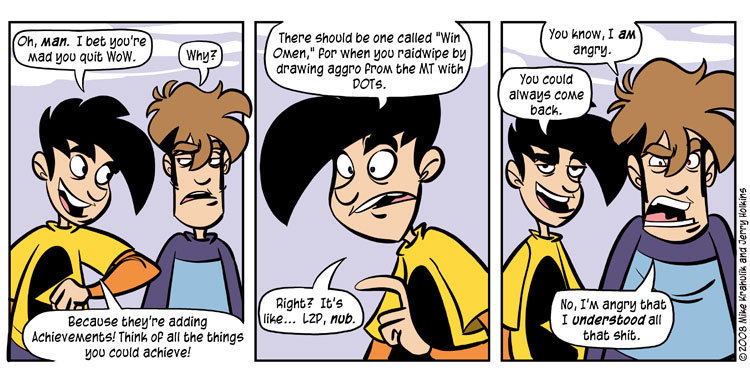
The most important thing to take away from all this is that we can't simply stand still and laugh. Gaming addiction is something that needs to be addressed--its the worst kind of an addiction, one that you can't find many people to share with or help you recover. There needs to be more supervision of players in these games, along with more communities to help recovering addicts and more journalists acting as a watchdog to the underbelly that these games grow. For the time being, our lives can't afford the luxury of complete escapism. It's time we stop gawking at gaming's more unfortunate enthusiasts and try our best not to create a virtual world of suffering that reflects and increases the problems of our own.
Second Skin is now streaming from Netflix. You can find more info on the film's site. If you feel you need a wake up call from your own gaming addiction or are curious about others', you should take a glance at the OLAG forum. And, remember, all good things in moderation.