Games need a stronger sense of "place"

Default_picture
Wednesday, May 30, 2012
EDITOR'S NOTEfrom Jason Lomberg

Jon's point is well received. Gaming's storytelling techniques have improved substantially, but most titles still have trouble creating a believable, lived-in world.
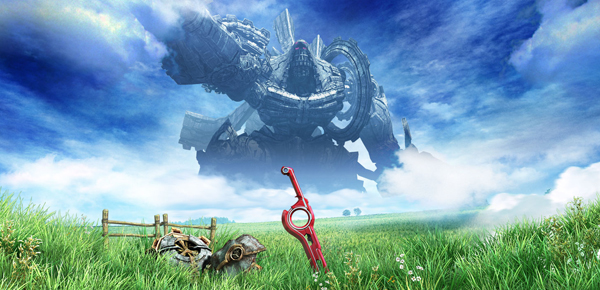
Xenoblade Chronicles

A giant finger stretching miles into the sky, faithfully refered to as "Digit One," was the point where I submitted entirely to the game. I heard the name and was confused for a moment, but when I understood what it meant, I hit myself. Of course it was Digit One; how could it ever have been anything else?

Trudging my way through the epic Xenoblade Chronicles, it's hard to make the argument that this game is immersive in the traditional sense. The graphics are subject to the Wii's hardware, so textures are muddy as hell, faces are straight out of the early PlayStation 2 days, the game likes to stop every half-hour for 10 minutes of cut-scenes, and the characters have about half an hour's worth of combat dialogue for a game which goes upwards of 60 hours (If I hear anyone say "What a bunch of Jokers!" in real life, my fist may uncontrollably drive itself into their face).

What the game has, though, more than anything I've ever had the chance to play, is a sense of place. To briefly summarize, people live on the bodies of two giant gods who died fighting each other. Sounds about right for a JRPG -- ridiculously fantastical -- and that could be the end of it, but Xenoblade is persistent.


The story does an amazing job of bringing you to accept that this is just the way things are -- characters always talk about locations in respect to the body, as do the maps. You begin to ask how could it ever be anything else. But there’s more.
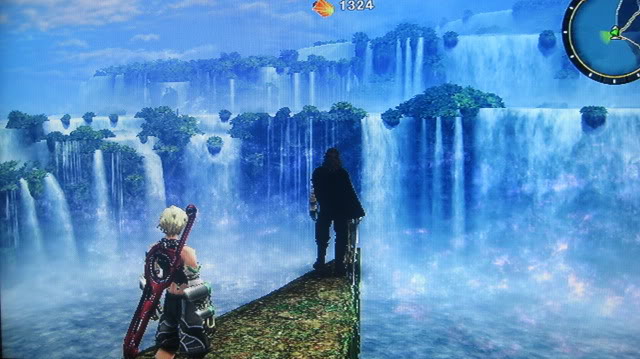
Huge waterfall

This game is huge. Huge in a way that is often only expressed by schoolboys making snide remarks about each other's mother. There's no invisible walls, and nobody stops you from trying to jump off a cliff; sure you'll die, but nobody stops you from trying. The world begs to be explored by collecting rewards and waypoints. When your little expedition finally comes to the last dead-end, you feel enormously satisfied.

"Oh," you think, "that's all of the arm I've just ran across." It feels both unimaginably huge, as you spelunk and mountaineer across the sweeping landscape, but totally tangible when you put it into perspective. Yes, that was a mighty big forearm, but you've met all the people who live on the elbow, and it's time you made your way up to the head.

It's a simple appeal to the suspension of disbelief: The longer the developer can prevent the player from seeing something that makes them sit up and say "oh, right, I'm playing a game," the stronger bonds players will build with that world. But why are these important?


Take a look at everybody’s favorite, Call of Duty: Modern Warfare. We know this is Paris because you see the Eiffel Tower. There is no subtlety and no "experience" of place. You get the same impression of Paris you get from a children's picture book. I could play that level a hundred times and still know nothing of what it's like to live in Paris.

I know exactly what it's like to live on Xenoblade's Bionis. We power our stuff on something called Ether, which we mine but don't really understand how it works. We build colonies and keep to ourselves. The north -- no, sorry, the head -- is dangerous and uncharted. We've never seen snow down by the legs, though travellers say it appears in the mountains of the right arm. We train defence forces but hope never to use them. It's a beautiful place, but it's dangerous.

I guess you could say that this is the reason for role-playing games: to create a world. But I don't see why we should leave it at that when Valve has been building totally immersive worlds in FPSs since 1999. Portal proved that Valve mastered the art of immersion...to the point that mass-media audiences identified with the game's world (you know, that friend who was never into games and still says "the cake is a lie!" to you, because you like games so it must be funny).

Film directors have been doing this for decades. "Mise en scene" they call it -- the components of a scene. Most games manage half of this. Everything in the scene is considered, and nothing is there without purpose. What we have to work on is filling the scene with everything it needs to tell the story. That's when our stories will become the ones that people live in...the ones they never forget.

 
Problem? Report this post
JON SOLMUNDSON'S SPONSOR
Comments (11)
Default_picture
May 30, 2012

Nowhere is the worlds of Xenoblade Chronicles more lively than the sidequests: the easily forgettable things that you'll spend so much time on due to how much information they reveal about how people have inhabited their lands during the main story's war. Best part about all the quests in Xenoblade is how it ties into to gameplay as well and its not just more XP: it's a chance to build better relationships between your party and those towns to get better gameplay enhancements and find more secrets.

Default_picture
May 30, 2012

Great points Jon. Also, the two best FPS are Half-Life 2 and Bioshock. Both games you play a character who do not speak. One could argue that City 17 and Rapture were the true characters of those games. Both these developers knew what they were doing, it is the world surrounding the characters that make the story believable.

Default_picture
May 30, 2012

I'd agree that the close-ups are kind of ugly, with horribly pixelated textures (especially as often as they do facial closeups), but the locations are gorgeous.  I remember stepping out onto the Guar Planes after you get to the leg and it suddenly opens up and going 'ahhhhhhhhhh!'  It's like when you get to the beautiful open area of FFXIII, except it's only a couple hours into the game.

Though the 'you're ON the body of a giant god' didn't really kick in for me till Sword Valley.

I've sunk about 80 hours into the game so far, which I only know because the save game tells you so. I'm treating it as the single player MMO it plays as, so there's no hurry, and the amount of content is absolutely insane.

Most gorgeous place so far - on the Distant Finger at sunset, looking down at the Fallen Hand (and realizing you can go to all those places, and that I'd already been to quite a few). The outdoor engine is amazing, especially for the Wii.

Default_picture
May 30, 2012

I thought the locations became extraordinary when I took in the entire view from afar. Up close, the polygons show the limitations of the Wii. When I finally made it up the leg, the entire scope of everything blew my mind.

I mean, I go through a similar out-of-this-world experience when I play Battlefield 3. However, I often feel like I've seen this environment before. The only map I truly appreciate is Operation Firestorm, which looks oddly similar to some of the deserts in Southern California. It's really a different type of experience.

Default_picture
May 31, 2012

Oh, I totally agree. I don't think it made it in to the final copy but I wrote a couple paragraphs about how impressed I was with the landscape design (weird angular hills aside) and how much my Wii was crying trying to process all of it.

Traversal often looks down right gorgeous, but the textures - faces especially - are a little offputting during cutscenes. It's not a great harm to the quality of the game overall but in the back of my mind there's always a little voice asking; "Ooh, fancy, but how would this look on 360/PS3?"

Robsavillo
May 31, 2012

You should try out Dragon's Dogma, which similarly has a sense of space. More specifically, I attribute this to the near-complete lack of fast travel, which forces you to actually walk from place to place in the game world.

I think the Souls games accomplish something similar with the lack of a minimap on the screen (not to mention how intricately connected all the stages/areas are). You really come to learn and recognize every little piece of those games' environments.

Default_picture
May 31, 2012

Admittedly the fast travel occassionally totally breaks immersion, but I was happy that a Japanese developer was gutsy enough to implement such a system. That's where you see a juggle between what services the narrative and what services the gameplay. For me the narrative was strong enough that these concessions were totally worth it.

Along with the ability to save anywhere and never having to turn in most quests (that one in particular was mindblowing, so simple yet the game improved so much for it) it made playing the fetch quests a thousand times more tolerable. I can definitively say I would've put it down after a few hours without it. I'm not usually a fan of JRPGs.

Default_picture
May 31, 2012

Xenoblade has /so much/ content that it doesn't need to inconvenience you just to stretch the game out. Some of the optional collection things are a little work to find (upgrading Colony 6) but I think at that point they decided you needed to work at it at least a bit to feel that you accomplished something. Another trade off.

Rob, I agree with you about Dragon's Dogma and the sense that you were Somewhere, but for me personally the thought of yet another trek back to town was not a positive experience even if I know that terrain very well by now. At that point I usually end the session.

Default_picture
May 31, 2012

Never played Xenoblade. Though I have played its spritual predecessor, the immortal "Xenogears"

That has sense of place in bucket loads, and bucket loads of places, 8-)

Until the second disk comes in and almost ruins it. .

Default_picture
May 31, 2012

Great writing Jon! Keep it up!

Default_picture
June 01, 2012

Shadow of the Colossus, and ICO previously, gave gamers the first glimpse at virtual landscape majesty.

ICO blew my mind away but it was limited to corridors, it was an Ocarina of Time limited to a giant fortress.

Shadow of the Colossus brought down the walls of the castle and gave us the first open virtual world to explore. My dad, who was raised in the country, used to sit next by me when I played it and watched me ride Agro across the giant fields of the Wanderer.

The sense of "real" space of the game definitely triggered something in him, the sense of wonder.

So yes, games need a stronger sense of "place" but  developers are getting there, fortunately.

You must log in to post a comment. Please register if you do not have an account yet.