


Editor's note: Daniel argues that developers motivated by something more than just the desire to make a fun game are the ones who push the medium forward. -Demian
Whenever gamers get into a discussion about the relative importance of story versus gameplay, gameplay tends to come out on top. It seems that we don't care very much about stories in games, maybe because most of them aren't very good. The never-ending games-as-Art debate runs into a similar stumbling block: Most games don't aspire to be Art.
The source of the problem -- assuming you agree with me that it is a problem -- is the motivation driving our game developers. Most developers today are not storytellers by profession; they are primarily engineers, and to a certain extent, entertainers.
Back in November, Chris Hecker, a former designer at Maxis, spoke in front of the International Game Developers Association about how games are in danger of ending up in the same cultural ghetto as comic books. The first point he brought up (according to Chris Remo's Gamasutra recap) was the reason most developers get into the business in the first place.
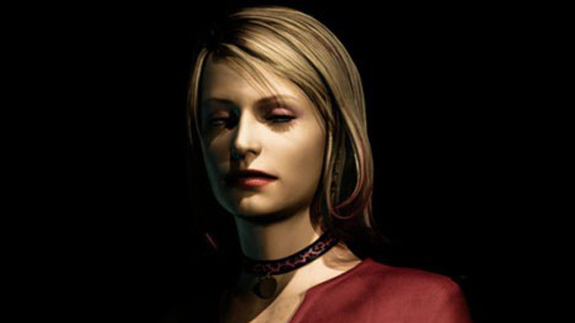
Silent Hill 2's Maria, looking pensive. (I'm going somewhere with this, I promise.)
Well, it does in the case of Braid...which, conveniently, is one of a handful of examples gamers always point to in the games-as-Art debate. Most developers' motivations are far more pedestrian -- and so are most games.
Early Silent Hill-series developer Team Silent is one of a few devs able to make games that truly speak to people with subtlety, and in ways unique to the medium. Another Gamasutra article pertinent to this issue comes from Silent Hill 2 Character Designer Takayoshi Sato.
Sato is one of those people who really believes that games can be more than just fun. His article at Gamasutra outlines creative techniques that are probably well-known in film, but seem almost alien to game designers. Specifically, Sato spends a lot time discussing visual language as it relates to facial animation -- in order to create characters that are not just realistic, but also believable.
In fact, Sato points out that most designers, when creating characters, don't even draw faces in initial renders; they choose to focus on costumes, guns, etc., instead. He covers things like eye movement and mouth muscles -- subtle cues that can describe a person's history and personality.
Sato emphasizes the importance of lighting and how it affects the appearance of a person's expression and mood, and also goes a bit into what should motivate characters in stories, how deep most games go in that regard, and where most games stop.
Ico and Shadow of the Colossus Director Fumito Ueda is another designer who pushes the artistic edge of gaming. His games don't excel solely in the fun department; they actually attempt to evoke moods. All of that comes from Ueda's particular history -- one that isn't filled with just games.
Ueda's primary education is actually in fine arts, and he's said himself that if he weren't a game designer he'd probably be a classical artist. It was only after his art career failed to take off that Ueda put his prior computer knowledge to work as a game designer. Apparently, when not working on games, one thing Ueda likes to do is watch movies in languages he doesn't understand and try to discern all he can from them. I think that comes through in his work.
The last guy I wanna bring up is Prince of Persia creator Jordan Mechner. In my personal opinion, Mechner represents the magic that Ubisoft has been trying to recapture with that franchise ever since the last game he was involved with, Sands of Time.
That game's successors, Warrior Within and Two Thrones, shared its extremely polished platforming and adventure gameplay, but lost most of the soul in the narrative and art style. Superb writing and a finely tuned visual style set Sands of Time apart; the narration successfully drove the story in an engaging and non-intrusive way, while the dialogue captured the spontaneity of real conversations.
As a screenwriter, filmmaker, and author, Mechner has worked in mediums where narrative is the overarching component, and he knows how to properly translate that into interactive entertainment. Personally, I think it's sad that he doesn't make more games, and that more people like him aren't in this business.
Basically, what I've observed here is this: For the most part, the games that actually manage to have good stories were made by people who aimed to do more than just engineer a fun game, and actually had the skills to execute on that plan.
Heavy Rain Director David Cage put it pretty nicely in a recent interview with the Guardian: "The first movies were made by technicians building their own cameras," he said. "Movies became an art when technicians worked on the technique and artists took care of the content."





I like this article and thanks for sharing
Jim Sterling of Destructoid.com has taken some flak recently over comments that Heavy Rain should not be comparing itself to cinema, as that somehow denigrates the quality of Heavy Rain as a game by implying that cinema is better than gaming, and that gaming should therefore be trying to emulate cinema rather than appreciating itself as its own art form.
Unless we want to hold Jim as a complete outlier in the gaming community, ostensibly there are those who agree with him past the positive comments he received on the article.
I think that the sort of infusion of artists you are asking for here is something that's on the horizon...but speaking as someone who has worked in the film industry as a screenwriter, I can tell you that I never looked at video games as a medium for storytelling for a couple of reasons:
1) How many game design companies do you know who are advertising "Looking for screenwriters?" How does someone even break into writing for games? Beats me.
2) It's much easier (though not actually easy) to raise the money for an indie film to tell your story than it is to try and produce a game around it. I could shoot a 90-minute feature for a couple hundred grand, maybe. How much is it going to cost me to hire programmers and make a game with cinematic quality?
3) Cinematic storytelling, what film accomplishes and what some video games aspire to, in large part depends on the quality of the acting. What you hit on the head here is the importance of character design insofar as subtle movements of the face. Body language tells you a lot about how a character is feeling...but you may not understand just HOW subtle a good performance can get.
In acting, it's called "subtext." Maybe you know what that is already but others may not...subtext is the internal dialogue an actor may go through while playing a role. It's "thinking" the character as well as "acting" the character. It's something that method actors often do when they sublimate themselves in a role. It is something that audiences pick up on.
It's also something that video games really don't do yet. It's a minutiae of graphic design and production that would take a very long time to get right. That said, I have yet to play Heavy Rain, and am on the verge of purchasing a PS3 specifically to play this title, because with Peter Molyneux calling it "the way forward to a new form of entertainment," perhaps Heavy Rain is getting there. If so, it's an outlier.
The fact is that if I had to bet why Jordan Mechner isn't making games anymore, it's precisely because he's a screenwriter, filmmaker, and author. If he truly cares about storytelling, and characterization, and drama, he knows that there are better venues for his content than video games.
Now, with games like Mass Effect 2 putting the "role-playing" back into RPGs, and games like Heavy Rain breaking ground, give it a few years and you might see more storytelling in gaming like you want. For now, the technical limitations of video gaming versus the way screenwriters and authors tend to envision their narrative are going to keep those sort of people out of the gaming industry en masse. There are faster and easier ways for them to try and tell their stories rather than having to sit on them for the rare opportunity to find a developer who actually wants to tell a story as much or more than to provide a gaming experience with familiar mechanics.
That's taking a big risk, and just like Hollywood, all it takes is one big-budget, colossal failure to scare the gaming industry away from making another attempt for years.
While I agree that there's much value in quality story-telling for video games, I feel that the medium can evoke emotion and offer artistic messages in other ways, specially through gameplay mechanics. Heavy Rain is sort of a blend of both methods, and I think it largely works well.
I can't think of any games that really succeed in using game design beyond dialogue and narrative to say something meaningful to players in big-budget, triple-A titles.
But I've seen this accomplished on a smaller scale, like this little game called Police Brutality:
Added a fitting quote to the tail end:
Heavy Rain director David Cage put it pretty nicely in a recent interview. "The first movies were made by technicians building their own cameras," he said. "Movies became an art when technicians worked on the technique and artists took care of the content."
Real cool article. I was actually just thinking about this sort of thing how the people excelling in math and science are by far in control of the gaming industy, whereas the pure artistic mind is kind of out of luck.
Video games are so far behind in turns of dealing with real pure emotion as seen in other creative endeavors like film, novels, and music it's not even funny. I never play video games for story ever, because I'm just gonna be let down. My favorite game of all time is probably Super Mario 64 and the story of that is a joke, lol, but I don't care. For as of now games really are first and foremost about gameplay. That's why I stick around and I'm a huge fan of the arts, devouring films, books, and music voraciously. That's where I get my emotional fix, along with my lover of course. And I'm the opinion that games are not art. But why must everything be art in order for it to be meaningful to us?
I think we got to realize that software (which video games are a part of) is still in it's infancy state. I don't think it's gonna come soon, but one day the tools for game development are gonna be so smooth and refined that anyone is gonna be able to do it like filmmaking. The film director Orson Wells once said the it only takes three days to learn the filmmaking process, and it's true, there is only so much going into making a typical film, it really just comes down if you just have the natural talent to make a film. A particular vision, etc. Once the game production process gets down to being able to know about it in three days, then we will start seeing some really interesting video games.
"The remaining question is how is the game industry going to call more of these people out? Will the industry ever try to train more people with these skills and backgrounds, or attract more creators from other media? Will the industry even allow more people like that to rise to prominence in it?"
For creative people who love games but want them to evolve and mature, the dearth of good storytelling and artistic meaning isn't a problem; it's an opportunity.
Awesome article. I do want to say, though...I imagine that, if something happened in your life to motivate you to want to tell your story through an interactive experience, the barrier to entry is MUCH higher than writing a book. Not everyone's a writer, but anyone can *attempt* to write a book. Or maybe a poem. But making a game? You're going to need some serious technical training.
But the idea of pairing up with those "technicians" is right on.
I'm on the other side of the fence in this argument. The gameplay and fun of a game are, to me, what makes games artistic. I wrote an article arguing as much a while ago: http://bitmob.com/articles/narratives-qnarrativesq-and-playing-to-our-strengths
Though I agree with many of your points regarding what keeps storytellers from their goal in games.
Thanks for the link to your article Suriel, I really enjoyed it -- and I totally agree.
Heavy Rain's not perfect, but it does some bold things with traditional "game" values. Specifically, it allows you to "beat" the game whilst achieving something that would be considered a "failure" by traditional game standards. In fact, there is an argument (which I won't go into now for fear of spoilers) that the more negative endings are more appropriate, given the tone of the game for the most part.
I agree with the idea that developers pushing the boundaries with emotions - particularly negative ones - have got a good idea. Silent Hill 2 was so much better for the fact it didn't pull any punches and didn't end up being OMG MAD GOD at the end. Yes, there was a final boss, but that was almost incidental to what happened just before it.
I'm not saying every game should become a miserable experience - we'd end up with even more brown games than we have already - but I do think there's scope for making the player feel things a little more profound than "YES! I beat that level!"
So long as the industry doesn't see the need for scenarists, screenwriters and even dialoguists (yes, those exists nowadays, people who only write dialogue without doing the scene-to-scene nor even touching the scenario, mostly in TV writing though), you probably won't see this happening.
I've often internally compared game development to TV writing (as I am in a TV writing course at the moment) and other than game writing generally being atrocious as opposed to TV writing (and I don't even like TV!), the comparisons tend to be spot on. When gaming manages to create a narrative space that is good, it knocks everything else out of the park. The thing is, in order to create a great game with a great narrative, both the interactivity and the narrative have to feed off each other and become more than just the sum of it's parts.
heavy rain is a step forward, but not in the direction toward proving game as a form of art, if anything, its taking the idea of an adventure game and taking it to the extreme but its still something thats trying to be a movie and not be a game. the storytelling doesn't make heavy rain art, it makes it a game thats trying to be a movie in the most enjoyable way possible. to make a game thats a piece of art is to make something that uses the gameplay mechanic to illustrate the idea the story would normally try to do in a movie. its the symbolism between the controls and the action on screen, not the story thats being told and its definitely something thats possible from the nes to ps3 and doesn't require scenarists, screenwriters or a film degree.
Your article was well written, but I would argue that your perspective is a bit narrow. Game design is an art form unto itself. It can integrate with visual art or stories to create amazing experiences, but it can also stand on its own. Speaking as a game developer, the idea of "game designer as auteur" is pretentious, IMO. It doesn't mean I don't appreciate the way people like Kojima and Cage move the industry forward; ego combined with talent can create magnificent works. I merely see that as one path among several for the medium to advance
As an enthusiastic wanna be writer I personally started out wanting to work on games. When I went into a community college for programming on a limited scholorship the experience of being taught basically to work on bank software completely and totally killed my creativity. I failed out of some of my classes because of a deep depression and lost my scholorship money. That combined with problems at home ended up with me never going back to college and severely skeptical of the roads I was expected to take to succeed.
I still really want to work on games, but I want to be responsible more for the design and writing and creative direction then on an engineering level. Since I don't have the money to go to a school that would be an inroad to that, I basically just had to give up.
Now I'm working on various forms of Internet writing (stuff here, trying to get a web site for nerd video style entertainment and web comicry off the ground) and trying to find a reliable artist to work with me on a comic book.
The problem with writers making it in any creative field is for the writers to convince people who would be responsible for executing their ideas to give a crap about what the writer wants to make a story about.
I could write a book but I would have to convince people to publish and advertise it.
I could write a comic book but I would have to convince people to draw and ink it, then publish and advertise it.
I could write a film but I would have to convince people to act in it, shoot it, edit it, distribute it, and advertise it.
To produce a video game that I would like to make I would have to convince an entire game development studio of animators, programmers, artists, creative minds from inside the industry, publishers, and advertisers to believe in my vision.
I can't even get people to read short stories, their is no way in hell an uneducated and untested quantity like me will ever make it in video games.
To be a successful writer you have to be lucky enough to have people believe in you. To have an entire game made based off of your vision requires that a metric ass ton of people believe in you. As far as I can tell the only people who get that chance have been in the industry since before it became such big buisiness. I'm sure the next generation of talent will come from the inside of the industry as well, which I think is a shame because it's hard to be brought into working at a game studio just because you have spiffy ideas. You have to have technical knowledge that some creatives (like myself) don't have and aren't at all interested in getting.