Home
Home

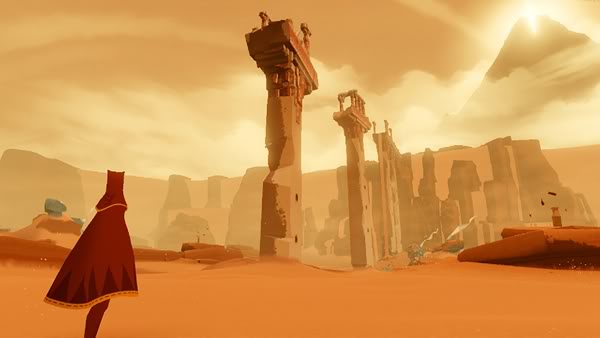
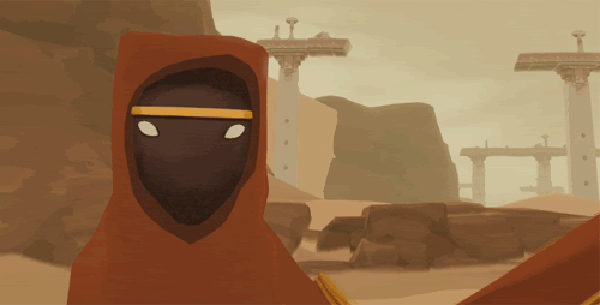
A veiled stranger stands on a sand dune in the middle of...nothing. An endless desert surrounds him. It's unclear what he should do until a shining beacon flashes far in the distance. It could take weeks to reach that light. Maybe years. Or a lifetime. No other course suggests itself, so the stranger begins his journey.
He doesn't get far before noticing a break in the sand -- a small stack of cut stones. It's one piece of a half-buried ruin, nothing more, but it's close...and therefore worth investigating.
Huh. Well, lucky thing I've got this frankincense handy....
Jenova Chen doesn't always make games. I'd equate much of his work to something more like interactive poetry. His team at Thatgamecompany only just tips over the dozen-person mark, but they consistently deliver visually stunning and emotionally evocative work. You don't just play Flower, Cloud, or Flow. You feel them. File their latest mini-opus, Journey, right alongside those other artistic endeavors.
Unfortunately, that makes for a really bad 15-minute demo during a rushed E3 schedule, even with Executive Producer Robin Hunicke occasionally skipping the game forward for me. I ended up sticking with it for 25 minutes. Hunicke hinted that few others spared her game so much time, what with Uncharted 3 multiplayer matches playing a few feet away. Since I'd journeyed further than most, she asked for my impressions.
Here's what I told her.
First and foremost, I don't ever expect to reach that far-off beacon. I might even be disappointed if I do. More than anything, Journey feels like a good travelogue reads...the destination is incidental. The real story lies in what you experience on the way. It didn't take long before I'd completely lost track of the beacon, instead going from interesting distraction to interesting distraction. These take the form of puzzles that, at least in the first 25 minutes, weren't tough but give an impression of what these ruins must've been long ago. The stranger's intentionally limited move set includes singing a musical note to activate glyphs carved into the stones, setting ancient technologies -- or magics, or both -- in motion.
Those notes also catalyze living fabrics you find in the landscape, and they become part of your journey as well. Some attach to you as a flowing scarf, allowing you to fly for limited distances. Others act as guides, casually leaping and diving through the sand, leading you to the next curiosity. At one point, I found a mass of floating red cloths by a huge wall. I sung my note, and they swirled around me like an oddly gentle tornado, lifting me high up into the air. I couldn't say why (Hunicke did admit that area wasn't finished yet), but you're not required to solve everything -- or anything -- to move on.
Dude. Tusken Raiders totally jacked my Sandcrawler.
Make no mistake, Journey's a very linear game where you're led from one event to another, but it's done in a way that makes you feel like you've discovered these things all on your own. You find them. You explore them. You experiment with them. You play with them.
Thatgamecompany pulled all this off with one very simple trick -- coincidentally, the same thing that worked against their game during a marathon-sized sprint like E3. They merely slowed everything down.
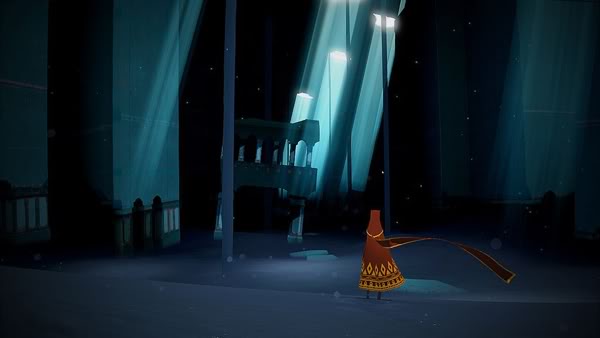
Journey sets a very deliberate pace. Where a lot of games aim to punch you in the brain during the opening seconds and ratchet up the adrenaline from there, Journey wants you to breathe. Outside of a few tutorial button prompts, it never tells you what to do. You're not rushed or pressed to find the next door and go through it. You're invited to linger. I often found myself stopping to look around (done by tilting the Sixaxis controller, which feels a bit loose and gimmicky), doing a full 360-degree spin to check out my surroundings, and seeing if I could find something new to sidetrack me.
Is this the part where the Phantom of the Opera drops a chandelier on me?
You don't have to worry about striking off in the wrong direction, either, because in a clever variation on the invisible wall, a strong gust of wind pushes you back until you get the message (though an even more clever solution would be to generate the linear events in whatever direction the player took for an even greater sense of exploration).
And this game celebrates the wonders of pure, unhurried exploration like no other. Journey's not about getting there; it's about going there. What you discover -- about the places you visit or even about yourself -- makes the trip worthwhile.
Once you get that, you get Journey.