Home
Home

I'm a huge fan of Bastion's integration of play mechanics, story, and setting. Here, Giancarlo gives us an example of how greed can be good -- at least in the ruins of Caelondia.
When you find yourself alone at the end of the world, not knowing what sort of catastrophic event destroyed nearly everything and everyone you knew, wondering about how much money you have should be the last thing on your mind.

Thankfully, the developers at Supergiant Games avoided resorting to simple monetary values that would clearly have no worth in Bastion’s post-Calamity Caelondia. Instead, they incorporated bits and pieces of the old world into the new one. Known as Fragments, these small blue stones are relics of the past that act as the Kid’s primary form of currency throughout the game.
Unlike other adventure titles or role-playing games, where money is used merely as loot dropped from fallen enemies or found in treasure chests, Fragments are inextricably tied to the plot in Bastion. Spending them on new weapon upgrades or stat-boosting spirits are part of your quest to restore the land of Caelondia to the way it once was. When you’re out vanquishing the wild beasts that hinder your progress, or when you find yourself in an area with destructible objects, you feel compelled to collect these Fragments. The fact that you can use them to upgrade your stats and abilities is almost an afterthought.
As the player spends more and more of these Fragments, the hub-world of the Bastion sanctuary is slowly restored. Structures like the Forge, the Arsenal, the Distillery, and others can be rebuilt. These buildings in turn allow you to manage upgrades for your weapons, purchase so-called “secret skills” that can enhance a variety of stats, or honor the memory of the lost world through in-game challenges.
In the Memorial building, for instance, players earn more Fragments by completing these specific challenges. In terms of the plot, these categories are linked to various sects of Caelondia citizens and their occupations. They also feature more esoteric goals, like collecting items called Lost Mementos that give the player a sense of what the world was like before the Calamity.
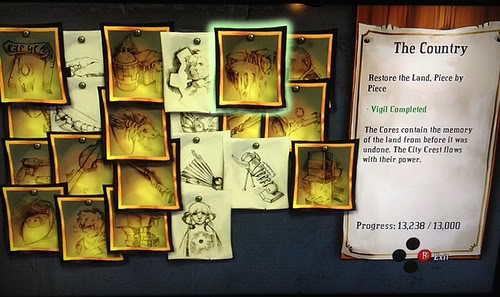
"The Memorial. Here the Kid can pay respect to the old world, and earn it in kind."
Spending Fragments isn’t just a frivolous activity to earn more powerful weapons; it’s a way to literally rebuild the world from the ground up. Every Fragment you collect has a purpose and meaning, and though at times it may feel like you’re not earning enough, the distribution never becomes too unbalanced due to the game’s numerous ways to reward you just for playing through the story.
Bastion further reinforces this notion through areas known as the “Who Knows Where” levels, which are dream-like sequences that pit the player against wave after wave of enemies. In addition to the hundreds of Fragments received for completing these challenges, the ubiquitous narrator also offers pivotal plot points or backstory of a character’s past. These levels can quickly become frustrating at first and thus require the player to level up their weapons near their maximum upgrade tiers, which can only be done after further exploration through the dilapidated countryside.
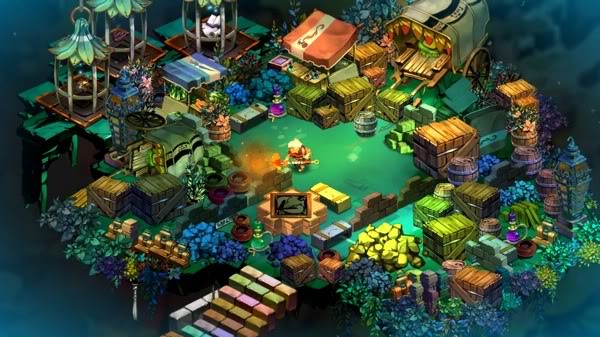
The cycle of collecting Fragments, spending them in the shops to create better gear, then being rewarded with more Fragments for using that gear creates a positive feedback loop that allows the player to feel empowered. Personally, it was very satisfying to see that my actions were actually having an impact on Bastion’s world, even if it only meant restoring a single building.
In other games, various forms of currency exist solely for the purpose of upgrading your characters or spending them on better equipment and perishable items. Unless a particular venture rewards players with a ton of money, it can often be a chore just trying to farm extra cash. But in Bastion, these problems disappear, as the game actually encourages you to seek these pieces out.