Home
Home

The secret to calming the chaotic nature of Spelunky is to understand the extent of the hero’s abilities and the general flow of the game. This 2D Xbox Live Arcade platformer/adventure/treasure-hunting title will actually teach those things to you, but you’ll have to die plenty of times first. Plus, it has an old-school difficulty where when the player dies, he ends up right back at the beginning of the game.
Spelunky is essentially the Tiger Mother who believes that mastery comes through practice and repetition, and only then does the experience become fun and rewarding. In this case, once you begin to really get down the basic mechanics, it becomes a lot less wild and unpredictable. Even though the levels are randomly generated, you begin to feel a little more in control.
In the comments section of his review, GamesBeat/Bitmob writer Jeff Grubb noted how he felt that many of the deaths he experienced were not his fault. I disagree. Instead, I would argue that at that time he was probably still learning the flow of the game. I’ve read another critique where the reviewer felt that, in fact, every death was his own fault. That guy gets it.
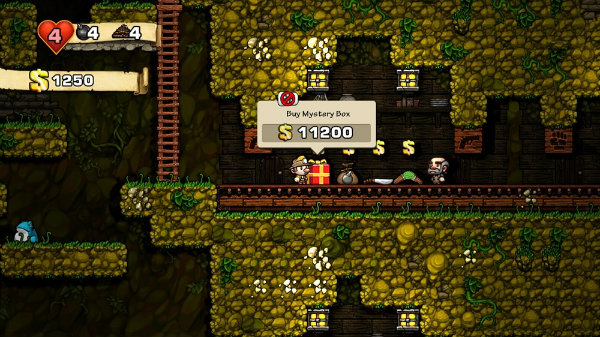 After playing Spelunky for a while, you start to pick up on the little yet incredibly critical things. You learn the blast radius of the bombs, bat and spider movement patterns, how high you need to climb to avoid the runaway boulder, and that one shotgun blast isn’t enough to kill the shopkeeper (who will then whip out his own firearm and quickly murder you).
Typically, the player learns these ins and outs through trial and error. After each failure and subsequent return to level 1-1 the only thing that carries over from the previous session is the knowledge that whatever you just tried to do didn’t work. As unforgiving as that sounds, Spelunky is still fair. Each death is a critical lesson of how the game’s world works. As surprising as some of the interactions and outcomes might seem, all the elements behave in a set way.
That arrow-shooting statue that nailed you on the ladder did exactly what it’s supposed to. It’s your own fault for accidently climbing down and activating the booby trap instead of tossing the pebble first to set it off.
Spelunky also has an incredible risk/reward system, and it benefits players who understand what is and isn’t worth the effort. The hero has a limited number of bombs and ropes to help navigate the levels. So is it worth setting off one of the explosives to access an area with only a little bit of treasure? Probably not. If that area also has one of those boxes with extra supplies, however, I’d say yes.
Is it a good idea to backtrack and find the damsel in distress (who can also be a dude or a pug) for one extra heart in the next stage? It could be, assuming you don’t lose any health on the way. But what about when that instant-kill ghost is about to show up and chase you? I say, forget ‘em.
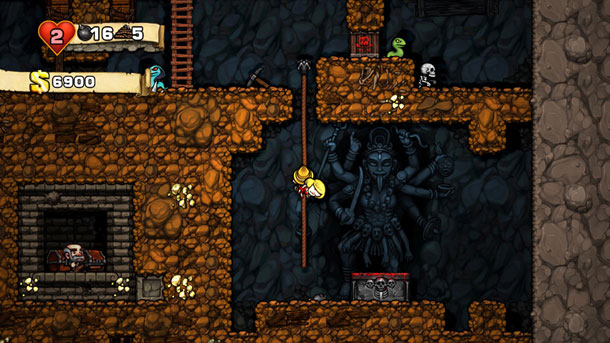
It’s really up to the player to learn and remember Spelunky’s lessons. When playing, I could see the benefit of doing so. At first, I had a lot of trouble beating the first stage. Then I learned to not run all the time, break pots (many of which house snakes) from a distance, and look before I dropped down from too high. Now, I can easily sail through 1-1 with most of my items and health intact.
Even though the levels are different every time, the difficulty and variables remain somewhat constant. This way, I know I’m actually getting better instead of just memorizing the layout like I would in other platformers. I do remember, however, all the foolish things I did to kick the bucket the first 50 times (I know the number because the game keeps track), and I try to not repeat the same mistakes. Try to.
But I’m doing something right! Now I can sometimes even make it to world two, the jungle.
Spelunky definitely has a tough-love approach to teaching players, but once you learn the language, the game becomes incredibly fulfilling. It won’t give you a cookie or gold star for making an effort. That kind of stuff is for losers. Instead, the thrill you get from improving your skills and making slow, steady progress through the solo campaign is the ultimate reward.