The greatest game never played: Robert Coover's The Universal Baseball Association

Scott_pilgrim_avatar
Thursday, August 18, 2011
EDITOR'S NOTEfrom Demian Linn

Ben looks at Robert Coover's ahead-of-its-time 1968 novel about an obsessed gamer and how it still resonates today. I love seeing a post like this on Bitmob, because I know it probably wouldn't show up anywhere else!
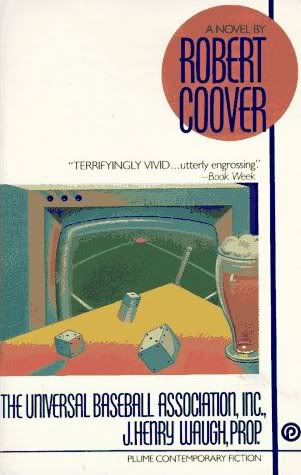
Henry Waugh created an awesome pen-and-paper baseball dice game. He was the proprietor of a baseball league and played through every game in a standard season on his kitchen table, rolling dice for strikes, doubles, stolen bases, and more.

His detailed rule set even accounted for extraordinary occurrences, such as when three dice hit ones or sixes three times in a row. Anything could happen then: The pitcher could bean and kill the batter, the batter could bean the pitcher, or the crowd could riot and delay the game, possibly injuring or killing even more players.

And if players gained enough experience and had a little luck, they could move up to Ace or even Star level and juice their dice rolls. But it wasn't too luck-driven -- Henry was a brilliant statistician, and he'd made all the necessary calculations to ensure that each roll of the dice was as real as every play in an actual game. He was completely obsessed.

Now here's the bad news. Henry Waugh was a fictional character from experimental writer Robert Coover's second novel The Universal Baseball Association, Inc., J. Henry Waugh, Prop. The game only existed in the piecemeal descriptions given by the author.

Still, Coover came up with the idea in 1968. Let me break down how incredible that is -- Coover concepted a sports-management game at a time when complex games relying on statistical analysis, digital or analog, were unheard of. And he did it three years before the text-based Star Trek game, six years before Dungeons & Dragons, and fifteen years before Intellivision World Series Baseball. But even more importantly, in his own way, Coover wrote the first (and perhaps only) novel about what it is to be gamer.
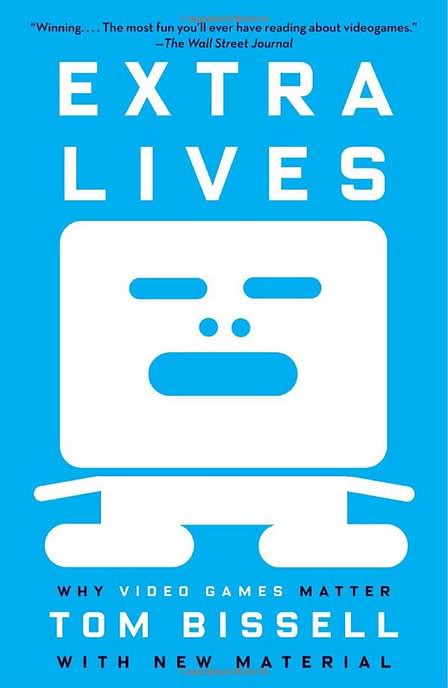
 

Extra Lives

Last year, Tom Bissell's gaming memoir Extra Lives came out, lauding not only his gaming experiences but some that belong to all of us who play. Granted, his cocaine/Grand Theft Auto addiction and tours of/interviews with high-powered developer studios might be a little removed from the average gamer's experience. But Coover's novel (aside from the completely surreal ending, which I won't spoil here) speaks to the more common quirks of the hardcore gamer -- the playing-till-dawn, edge-of-your-seat-office-clock-watching, sleepless-night-next-move-planning, and meal-skipping. There's even a great scene about the completely nerve-racking but entirely self-inflicted task of trying to teach someone else how to play a game when they aren't really invested in it.

I'm a gamer since childhood with parents who've long ago given up the hope that I'd "grow up," and Coover's novel struck quite a few chords with me. I related not only to Waugh's obsession but also the emotions of his wins and losses, the impatience for the next game, and most of all, the feeling that others would not understand his passion.

As I mentioned earlier, games like Waugh's simply didn't exist in 1968, real or fictional. Sure, wargaming has been around for centuries and even garnered a large fan base in the late 1800s and early 1900s. H.G. Wells is renown for writing War of the Worlds -- the tale of Martian invasion -- but few know he also wrote Little Wars, a rule book for war games using toy soldiers. But these didn't satisfy Waugh, and his gaming community rejected his attempts at codifying more realistic rules to take into account the global economy, troop morale, and other variables that you don't find in classic Risk.
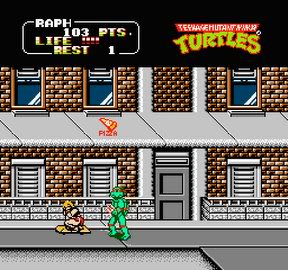
This is where I related most to Waugh. As a kid, I had lots of friends who played video games, but trying to explain the difficulty of finding the Red Ring in the Legend of Zelda's Death Mountain to my friends, who just liked attacking the skateboarding chick in TMNT II: The Arcade Game, always made me feel a little silly. While my pals enjoyed Clue or Monopoly Junior, I'd play Stratego or HeroQuest. Waugh reminds us that the rift between the "casual" and the "hardcore" gamer isn't new.

But while gamers these days don't have to worry about being ostracized for the hobby nearly as much as Waugh in the late '60s or even me in the early '90s, he's an easy character to relate to anyway.

I taught The UBA in my literature course this past spring, and I was surprised by how much my students (most of whom played video games as kids but are now "too grown up for that") could understand Waugh's connection to his fictional baseball players through their own bygone days of Pokemania. Discussing Waugh's paralyzing depression over the in-game and irreversible death of a player, one of my tough, student-athlete types compared it to when her little brother accidently saved over her game, deleting her team of six unstoppable Pocket Monsters -- which was traumatic enough to turn her off from the game, her Game Boy Color, and gaming forever.

Therein lies the value of Coover's book, lost in the annals of sports literature despite Sports Illustrated placing it at the respectable position of 61 on their Top 100 Sports Books list. Yes, it is a book about baseball, but it's also a book about playing games, beating them, and being beaten by them. It's a book waiting to be rediscovered and find a new audience. And in this age of gaming, we are that audience.

 
Problem? Report this post
BITMOB'S SPONSOR
Adsense-placeholder
Comments (25)
Scott_pilgrim_avatar
August 18, 2011

Thanks for the props and editing, Demian--it reads much smoother now!

Default_picture
August 18, 2011

Nice piece, Ben. I'm going to check out this book for sure. I hate to split hairs with you but there was a baseball game called Strat-O-Matic Baseball (http:// data-scayt_word="en.wikipedia.org" data-scaytid="15">en.wikipedia.org/wiki/Strat-O-Matic) that seems somewhat similar, although not as detailed, as the game described here.

Scott_pilgrim_avatar
August 19, 2011

I was going to mention that and it's modern day remakes, but they didn't quite fit. There's apparently a Facebook ESPN game and a new Out of the Park for the iOS that work very similarly.

It's definitely an interesting book; I was surprised at how well my students tolerated it, haha!

Bithead
August 19, 2011

HeroQuest! That was a good game.

Although I take a bit of umbrage with the idea that you have to skip meals and stay up till dawn to be a gamer. That sounds more like unhealthy obsession. (But hey, I understand your point. Nice piece, and I love seeing good, off-the-beaten-path book suggestions.)

Scott_pilgrim_avatar
August 19, 2011

I really wish I had my HeroQuest set; it's somewhere in my parent's attic. HeroScape's not bad, though, and came from the same creator...I'm a board game nerd.

You're right about that idea of the gamer, and I unwittingly made it. What I was suggesting is that at some point, I think most of us have done that at some point or another.

Avatarpic-l
August 19, 2011

Thanks for the heads-up.  I wanted to write a book review on Extra Lives a while ago but have been too busy.  One of the things that troubled me was the cocaine/GTA-induced frenzies Bissell describes.  I just started reading Ready Player One.  It's been an interesting read so far.

Scott_pilgrim_avatar
August 19, 2011

What troubled you about Bissell's GTA/drug addiction? The addiction itself, or the nonchalant way he describes it? For me, it was the later. He seemed to be writing as if that was just another one of those "crazy gamer cliches, lol." I did worry about the picture that painted of our community to outsiders reading the book.

Ready Player One's synopsis sounds awesome! I'll try and get my hands on a copy!

Avatarpic-l
August 19, 2011

I wondered to what extent could Extra Lives have any crossover appeal to a non-gamer, in particular, would I be able to recommend the read to my wife so that she could see a little into the world and joy of games and gaming?

When I read the chapter of how GTA gripped his life, I thought it best to not venture into the "gaming as addiction" characteristic of my pastime.  Like you, I don't believe that is representative of the gaming community though many of the other experiences described in the book are similar.

Scott_pilgrim_avatar
August 19, 2011

I've been considering using parts of it in a class I teach, and as I mentioned above, most of my students aren't "gamers." I think a similar approach would work for your wife--maybe share a particular chapter that resonates especially well.

Default_picture
August 19, 2011

I agree with Bissell's predilection for story-driven games. And yet, I wonder how his drug addiction influenced his gaming preferences.

Scott_pilgrim_avatar
August 19, 2011

He makes it sound like his gaming preferences influenced his drug addiction, since he didn't start doing cocaine until he got into GTA, and he only did it for as long as he was playing the game.

Avatarpic-l
August 23, 2011
I finished Ready Player One and am wondering on a book review: how far, if at all, should reviewer go with respect to spoilers?
Scott_pilgrim_avatar
August 23, 2011

My rule of thumb is to avoid spoilers if it's relatively new or unheard of. But if I feel like I'm just weighing in on something everyone's already familiar with, I just warn that there might be spoilers.

Default_picture
August 19, 2011

Howard Greenberg's "All Your Base Are Belong To Us" and Jeff Ryan's "Super Mario: How Nintendo Conquered America" are two newer books that are worth checking out as well!

I found Coover's book on Ebay for $4...looking forward to checking it out. Before the 2600 came out I was a Strat-O-Matic fiend and I still own a couple of the board (i.e. real) versions of the game itself.

Scott_pilgrim_avatar
August 19, 2011

I've heard that both of those books are excellent, so they're already on my reading list, as well :-)

I'd love to try out Strat-O-Matic; as I mentioned above, I'm a table game nerd :-)

Default_picture
August 19, 2011

"Everything that's bad is good for you" is a terrific read, and you can't go wrong with classics like "Game Over" or "The First Quarter."

Scott_pilgrim_avatar
August 19, 2011

Thanks for the recommendations!

Default_picture
August 19, 2011

Srat-O-Matic is still fun after all these years. If you live on the East Coast, I'd challenge you to a game and/or show you how to play.

37893_1338936035999_1309080061_30825631_6290042_n
August 19, 2011

As both a gaming and baseball fan, I'm definitely planning on finding a copy of The UBA. Nice piece and good points.

Default_picture
August 19, 2011

I got one on Ebay for $4. There were several others available as well, Chase.

Scott_pilgrim_avatar
August 19, 2011

I'm a casual baseball fan (love playing catch and going to games, but don't watch it on TV or follow specific teams), and I loved the book.

There are indeed plenty of cheap used copies out there, but I just realized a new edition is coming out next month! Not sure if it'll have anything extra in it, but the new cover's cool :-)

Default_picture
August 23, 2011
I found this book at a used book store a few years back and read it because of my fascination with sports simulation games. Several people have mentioned Strat-O-Matic Baseball which has been around since 1962, but APBA Baseball is a statistical simulation game that was first published in 1951. Personally, I prefer Strat-O-Matic, but that's probably because it was the first one I played. There's an interesting book about the history and influence of Strat-O-Matic games called "Strat-O-Matic Fanatics". It's available on Amazon.
Default_picture
August 23, 2011

Yeah, my dad bought Strat-O-Matic Baseball for me in the mid 70's and I played it incessantly until I got an Atari 2600 in '79. I'll have to check out that "Fanatics" book as well!

Scott_pilgrim_avatar
August 23, 2011

1951?! It's amazing what you learn in the comments :-)

Default_picture
August 23, 2011
The big difference between UBA and Strat-O-Matic/APBA is that the UBA simulates an imaginary league populated with imaginary players, while SoM/APBA model real players using stats from the previous season. In that sense, UBA is unlike anything other than newer simulation video games that don't license MLB players and instead create full leagues of simulated players.

You must log in to post a comment. Please register if you do not have an account yet.