The price of doing business: Mass Effect 2's hidden DLC costs

Default_picture
Monday, April 09, 2012
EDITOR'S NOTEfrom Rob Savillo

We celebrate annual Steam sales that drop prices down by 75 percent or more, but that's for PCs, an inherently open platform where competition can exist. What about consoles, where publishers and hardware manufacturers hold a monopoly on content?
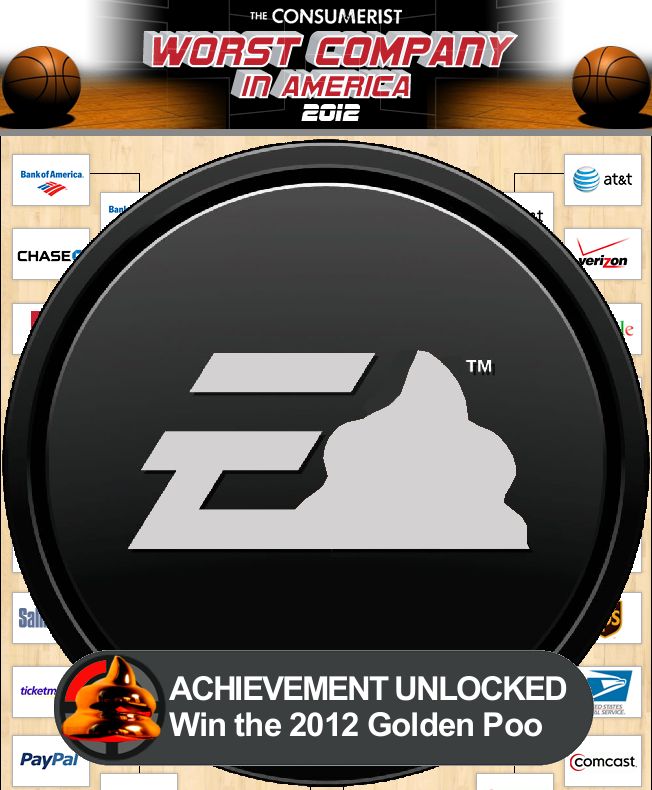
Last week, in a ridiculous ruling, Electronic Arts won the even more ridiculous honor of the Worst Company in America.

The Consumerist, a site I respect a great deal but which has clearly lost its mind, allowed the public to determine the winner of the award. Nonetheless, it offered the following explanation for the public's decision:

To those who might sneer at something as "non-essential" as a video-game company winning the Worst Company In America vote: It's that exact kind of attitude that allows people to ignore the complaints as companies like EA (continue) to nickel-and-dime consumers to death.
 
For years, while movies and music became more affordable and publishers piled on bonus content -- or multiple modes of delivery -- as added value to entice customers to buy, video games have continued to be priced like premium goods.
 
Like several commentators I follow on Twitter (Arthur Gies, for instance), I became briefly enraged, shook my head at the stupidity of the Internet en masse, and moved on, vowing to exact my vengeance on any fool willing to admit his part in this tomfoolery.
 
While my stance hasn't changed, my wrath toward the anti-EA movement softened considerably when I finished Mass Effect 2 on Thursday and looked into buying downloadable content (DLC). In the past, I've ignored DLC with few exceptions (my Rock Band library says, "Hi"), but ME2 was outstanding enough for me to consider ponying up a little extra cash for more game.
 
What I discovered was far worse than I expected.
 
 
As a bargain shopper, I picked up ME2 from Amazon's Warehouse Deals subsidiary for $15. That purchase earned me about 25 hours of gameplay so far, including the main storyline, 11 possible party members (not including Shepard) and their loyalty missions, and a variety of side quests scattered throughout the in-game universe -- most of which I've not yet played.
 
I expected to take a loss on new content, but what I discovered was more unbalanced than I could have imagined. Not only would I need to spend $30 (twice as much as I paid for the two-disc package) to access the remaining fraction (a couple hours of new main storyline and two new characters with loyalty missions), purchasing any DLC for a used copy of ME2 incurs a $15 setup charge.
 
Unlike Consumerist writers (and possibly readers), I don't entirely blame EA for this; there's a clear precedent for this kind of pricing, whether they set it or not. The problem is that DLC operates outside a normal economy where supply and demand result in Mass Effect 2 hitting $15, and more importantly where DLC can never be resold.
 
I'll probably make my money back on Mass Effect 2 if I sold it; on its DLC, a sliver of the overall experience, I would take a $45 loss. Digital content simply needs to be legislated differently for this problem to go away.
 
I'm left, then, with my final Paragon/Renegade decision of the game. Do I thumb my nose at EA, Xbox Live, and the game industry at large and take my $45 and walk away? Or do I spend my money, consider all of Mass Effect 2 a very worthwhile $45 experience, and become part of the shenanigans?
 
I still don't know. Perhaps after I've beaten both Mass Effect and Mass Effect 3, I'll decide to invest in the additional gameplay hours for the sake of completion. I doubt it, though; I've beaten each Assassin's Creed game for Xbox 360 but never paid a cent for its DLC.
 
That decision, sadly, leaves me feeling manipulated. Yes, I experienced most of Mass Effect 2. Yes, I very much enjoyed it. No, I can't talk about it with the authority I'd prefer, and as long as value is a criterion, I never will.
 
Maybe we can give The Consumerist's award to DLC, instead.
 
Problem? Report this post
BITMOB'S SPONSOR
Adsense-placeholder
Comments (9)
Default_picture
April 09, 2012

"Digital content simply needs to be legislated differently for this problem to go away."

While I don't politically agree with this statement, I feel your pain regarding the DLC.  This poor business model certainly hurt EA in this case.  Maybe you felt that the add-on scenerio was still worth $30.  But what happens when you decide that its not worth $45? -- you don't purchase it. 

Default_picture
April 09, 2012

Gamers need to move away from entitlement culture and towards a supportive culture if anyone is going to respect us as an educated consumer group. 

The fact that you got the game secondhand is completely skewing your sense of value here. You got one of the best games of this console cycle for $15 bucks. Even if you buy all of the DLC, you're still paying less than retail price for the complete experience. If you value the complete experience, why are you entitled to get it without sending some of the money towards the publisher and developer? 

The DLC missions are long and clearly took a fair amount of production resources to develop–while I'm not a fan of being nickeled and dimed (ahem, day one DLC ME3), I made an informed decision as a consumer that the ME2 DLC was worth the cash, so I picked it up. Do it or don't, but don't whine about how things cost money and that annoys you. 

Default_picture
April 09, 2012

His sense of value isn't skewed simply because he got the game for less than its full retail value. The simple fact is that while the price of the ACTUAL game the DLC is a supplement to went down, the price of the supplements, themselves remained the same.


You can say that you made the decision that it was worth it, but there is more that goes into a decision of value than just how much it costs. As the author mentioned, there's the possibility of regaining SOME money from selling ME2, but there is NO renumeration possible in the slightest for the DLC. It would be like buying an old car, and then parts for the car, and yet only being able to resell the car and not the parts you bought.


This fad of "gamers are too entitled" also needs to stop. An educated consumer group, as you put it, does not simply accept whatever practices happen in a given industry. An educated consumer group knows the scored and is respected by the industry manufacturers to the point where consumer complaints result in a change in industy standards.


That's something we definitely don't have today. Instead, we have too many people saying things like, "Get over it. It costs money, so you shouldn't complain about having to pay for it," as if that's the entirety of the issue. That's honestly only one aspect. As mentioned in the article, other industries are at least attempting to give the consumer the impression that they get more bang for their buck. But in gaming, we are increasingly being charged full retail for less content, and then being charged further for content removed and sold at a later date. And, as in this case, additional content does not depreciate accordingly with its source material. 


Therefore, I can buy Valkyria Chronicles for 20 bucks or even less, but I'll be spending more like $30 (if not more; it's been a while since I last checked on all the DLC) if I want the full game. Granted, I wouldn't be averse to paying full price for the core title, as it's a game I absolutely love. But none of the DLC adds the same amount of content as the game itself, which sells for a fraction of the total of the DLC.


It is, strictly speaking, difficult to justify paying $15 for two hours of additional content when you paid $25 for 30+. That initial investment is easy to see as money well spent, but the DLC cost in comparison is rather steep. And unlike the money you forked over for the ME2 game, there is no way to recoup the losses of the DLC.


Am I repeating myself yet? I hope so, because maybe it'll get through that way.


We ARE entitled, within reasonable parameters. And we are entitled moreso than in any other entertainment industry, because only gaming has this level of interactivity. Only in gaming does success hinge so heavily on the satisfaction of the consumer... or it would, if so many people weren't so keen to just lay down and say "Whatever" to everything the industry gives us.

Default_picture
April 09, 2012

We definitely agree on one point–the economics of digital goods, IE, the price never, EVER goes down, needs to change. But we're talking about two seperate things here. Publishers are dicking gamers over because they're trying to extract value from the secondary market. 

Here's a hypothetical: what if used games were abolished, but it meant that publishers felt comfortable decreasing the price of games as time went on? I feel like that would be a worthy trade-off if publishers can be trusted to keep their end of the bargain, but that's a big if. 

The TL;DR of this whole argument: we need the economics of Steam on consoles–the money goes directly to publishers and developers, without a middleman to muddy up the waters with diminished disc prices and an excuse to charge for online passes. We certainly don't need to take whatever publishers give us, but we should give the industry an opportunity to present a fair value proposition in which we give them money for the games we want to play. 

Default_picture
April 10, 2012

It's not just a big "if." It's a MASSIVE "IF." Not only that, but this would still all be predicated on the guarantee of a quality product, something which simply CAN'T be done. We all thought Brink and Dead Island would be great out-of-the-box experiences, and we were sorely wrong; there's nothing to stop that from happening with ANY game, even from much anticipated titles like The Last Guardian. Still, with the current used game market, we can do something with that copy of a game we don't like. Without it, even if we only paid twenty bucks, we're still SOL.


Which brings me to the core of my point on the lack of a used game market: what do we own? If we buy these games and have no ability to resell them, it can be argued that we don't even own them. As opposed to PC games(licenses that are usually something like lifetime warranties, in that you get to play as long as you hold the software; or as long as the servers are up for online games, which tends to be a VERY long time on PC), in which the majority contain an EULA which outlines that the purchase is of a license and not the software itself, most console games are the property of the person who paid for them.


I, for one, would not be happy with the proposed hypothetical for the above stated reasons. The longevity of online games is at the mercry of the game makers: whenever they like, they can shut down servers and effectively diminish the value of a recently made purchase. Online passes are a joke, a giant cash grab in an attempt to generate revenue from sales they have no right to be a part of. And there's absolutely zero promise that game prices won't simply rise in the wake of an erased used game market: what would keep them from charging whatever they wanted?

Default_picture
April 10, 2012

We could probably go back and forth on this forever if I had to guess, but my main point is that we as gamers (and more broadly, as consumers) need to give these game companies a financially viable alternative to the things we hate so much. Personally, I think digital distribution with more variable, experimental price points (a la Steam) could be the answer–as long as platform holders make it as easy as possible to get games on their service, the sheer number of games available will drive down prices as time goes on from the release. The economics affecting game prices needs to move away from the used game market and in to the digital goods space.

As more games move towards service-based revenue models, we gamers are going to have to do more than complain when DLC seems overpriced. We need to judge the total value proposition of each big release and decide if what they're offering is worth the cash–we can't just buy the next big thing and then pour our rage on to the Internet, because then the Next Big Thing 2 will just come the following year in all the same annoying trappings. 

We have to vote with our dollars, not with forum complaints. We can't simply say that online passes are shit–we need to suggest a different model that we'd be more inclined to put our money into. Don't buy DLC season passes without an announcment explaining EXACTLY what you will eventually be getting ("four new pieces of DLC" is not even close to good enough). 

100media_imag0065
April 09, 2012

I can't remember the last time I bought any DLC. I look at all of it as a scam. I can't help it. I just can't help looking at downloadable content as a scheme to to get more money from my wallet, and nobody does it more than EA in my opinion. Their online passes scam you into thinking buying games used is wrong, and paying the publisher (not the developer) for the "right" to play huge chunks of the game is the right thing to do...It's not.

I pretty much buy every game with an online pass used. And when it comes to buying new, I keep close attention to what is on the disk itself. I buy plenty of games new, as long as they meet my criteria. Which is as follows.

-No online pass

-No Micro Transactions

-No manipulative DLC practices (meaning, they aren't going to try and sell you a "real" ending later, or important story related content like Alan Wake, Asura's Wrath and Mass Effect 3 did)

-The DLC must be priced reasonably and contain a reasonable amount of content (unlike, say, Infamous: Festival of Blood)

Since most devs announce their DLC plans before or near launch of their game, I can pretty easily tell if their going to try and pull a scam or not. An example of a few games with amazing DLC is Borderlands, GTA4, Red Dead Redemption, and Fallout 3. And example of a few games with abysmal DLC is Saint's Row The Third, all Assassins Creed games, Resident Evil 5, and pretty much any Capcom game really. As a matter of fact, Saints Row The Third by THQ, and any Capcom game ever made this generation, is a great example of how to guarantee I won't buy your game. They always break most or all of my rules.

Some may say they have a "right" to this kind of anti-consumer business practices because I have a "right" not to buy it. To me, that is so absurd it's scary. It truly scares me that some people actually think like that. "It's OK that they are scamming us, since we don't have to buy it if we don't want. They aren't forcing you".

Yeah, let's put that logic up against some other scenarios.

"It's OK that Bank of America and the Bush Administration played a large role in tanking the economy, since I didn't loose as much money as many other people"

"It's OK that the Supreme Court has taken away my right to class action lawsuits against many corporations, since I really can't think of a reason to sue them anyway"

Default_picture
April 09, 2012

ME2 is still a good price. Arguing that the DLC (released 2+ years ago) is now ~2 times the cost of the game is just going out and looking for a fight. If you buy the GoTY edition at Gamestop for $20.00 and tax, only one DLC isn't available (Arrival if I remember right.) For less than $30.00 you get the entire ME2 game and all add ons. That's actually a great value, especially if you continue into ME3... Arguing about DLC being over priced doesn't make very much sense most of the time. Kingdoms of Amalur Reckoning came out with 1 expansion since it's release date (Dead Kel) about a month or so later. Game was $60 +$9.99 DLC. Game was already 100+ hours of entire play through and DLC added ~15% more land mass, a shit load of armors/weapons and quests. Some DLCs may not be worth it in price if it adds 1 character for $5, but honestly, if you went shopping for Mass Effect 2 the "smart" way, you would have gotten a 70+ hour game and all DLC for $30.00 and would have had an import for ME3. Learn from your mistakes before blasting companies that are trying to sell a damn product.

Default_picture
April 10, 2012

I think the point was that there would come a point in time where the cost of the DLC (in the author's example, for Mass Effect 2, a years-old game) would be higher than that of the game, itself. He's not arguing the value of Mass Effect, but rather that the price of the DLC doesn't reflect its value in relation to the primary game.


Potentially hundreds of hours of gameplay for $20=value.

An extra 5 hours for $10= not so much value.

You must log in to post a comment. Please register if you do not have an account yet.