Home
Home

A story is always a lot more effective when you can see something of yourself in its characters, but as James wonders, can anyone really see themselves in today's cookie-cutter video-game heroes? I can, but that's because I'm a bald space marine in real life.
I originally sat down to write an article about the lack (and mistreatment) of certain demographics in video-game protagonists, the obvious examples being the almost nonexistence of homosexuality and the borderline disrespectful way this medium treats females. Then, a new thought occurred to me: Are any of these heroes actually speaking to me? When I play a game is the main character supposed to be someone I see myself in? Am I really supposed to relate to these people?
I am a white, straight, male. The only reason I tell you this is to show that I am as far away from any major minority group as possible, which, right or wrong, apparently makes me a lot like most video game protagonists. The problem is that I’m not. I love Gears of War and Uncharted, but I am nothing like Marcus or Drake...So why are developers trying to make me think I am?
You could argue that the aim of the main character isn’t to mirror the player but to represent ideals that we strive for, to be the superheroes we wish we were. That’s a fair point, but if that’s true then why do they have to be so uniform in appearance? If Marcus Fenix is supposed to represent strength in front of tremendous odds and the perseverance of will, then why does the color of his skin or his sexual preference matter? Would he be any less of a badass if he were black or a woman?
Cole MacGrath, the main character in the Infamous series, has the same issues as Marcus. He’s white, he has little hair, and he has never left an impression on me. He’s a cool character, but why does he have to look just like Sam Fisher (Splinter Cell), Nathan Hale (Resistance), Alec Mason (Red Faction: Guerilla), and Alex Mercer (Prototype)?
I think I’ve been dancing around the issue enough, so I’ll just say it: We need to move beyond this tendency for everyone to be white, male, and straight.
Please do not take what I just said to mean that I think every game should have a rainbow of characters that sit around a campfire solving their issues through healthy discourse. It would be nice if the real world worked that way, but not all my games. I still want to shoot bad guys, fight aliens, solve mysteries, and get in car chases; I just think the characters performing these actions don’t have to be copies of the character that did it in every other game.
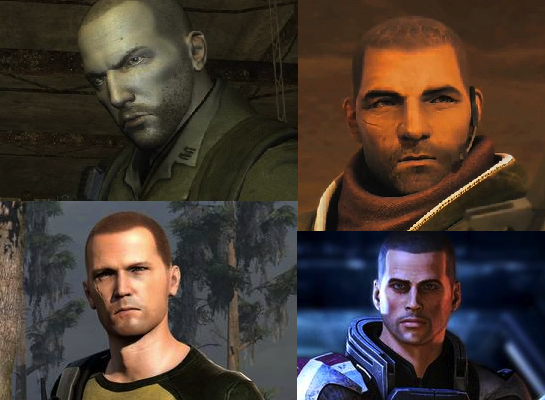
One of these guys is...exactly like all of the other guys....
More games are now allowing for character creation, which is a step in the right direction. This way, all players can be given an outlet to put themselves into the experience. The Mass Effect series is a good example of this. However, the public face of Mass Effect is still a problem. The Commander Shepard that’s on the cover and in all the commercials is another generic, bald, white guy.
I really do not want to belittle the hard work that people put into making games and crafting their stories, but this medium has to evolve. Maybe we, the consumers, are not totally blame-free in this. Maybe we haven’t proven that we’re willing to play a game with a protagonist that may not look like us.
Either way, I don’t want all my video-game characters to be white, straight, males. I want them to be complete people with dreams and desires. If they have those things, then their skin color, sexual preference, and gender won’t matter. Then we’ll have characters that not only speak to me, but to everyone. Hopefully we can get to a point where this industry doesn’t just celebrate a black protagonist or a gay protagonist...because it will just be a protagonist, and more importantly, we will be able to see parts of ourselves in any of them.