

 Home
Home
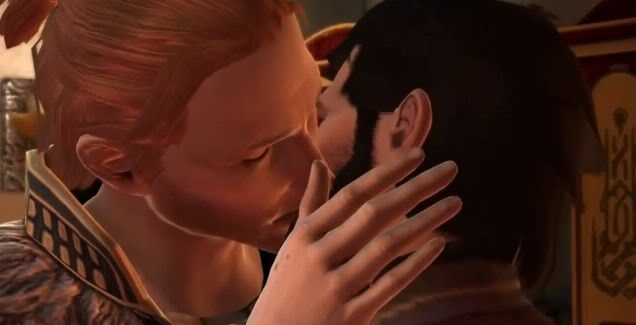


I do agree that video game romances are still mostly corny and end up being wish-fulfillment fantasies in some part. We laugh at the guy who married his copy of Love Plus in a real wedding ceremony, but that's not really that far off from how some people treat some of their favourite BioWare characters. For better or worse, I doubt these romances are going away any time soon.
Regarding Dewan's comment, the problem comes from the meta-textual issues that arise with gameplay. VorpalBunny raises the issue in his article as well - maybe in that specific playthrough of the game, Anders (or any character) is gay. But as a player, you know if you start a game as a female character, Anders is straight. The fact that you, as an external reader to the text, know that the characters have been written to essentially fall in love with the main character regardless of their gender is what ends up being problematic... to both gay and straight gamers alike.
It's also certainly difficult to apply "our" social standards to a fictional world, but it's also important to remember that these fictional words are created and exist in the context of our world. They speak our languages, they share our histories, and they share our social codes. As such, Thedas (and Westboro and any other fantasy/science fiction universe) are, if even subconsciously, allegorical depictions of Earth."
As for Sterling - he's the perfect troll and he wants your clicks. It's just easier to ignore most of his attempts to draw your attention... chances are, you'll be better for it."
His book is divided into Politics, Advertising, and Education though, so that should give you an indication of the types of games he directly addresses in his book."
Then, of course, Metroid: Other M was released and many, many gamers felt betrayed by Sakamato's portrayal of Samus not only through her depiction on screen, but through the game design. Because the game takes abilities away from Samus at key points and because this is framed within the context of Adam giving Samus impossible and incomprehensible orders, the game play itself reinforces the idea that Samus is weak and has abuse issues. That's why reviewers like G4's Abbie Heppe reacted so negatively toward the game, regardless of its other merits.
Games are powerful because we know that behaviour can be conditioned with reward systems. Anyone who plays an FPS knows that headshots are automatically better than any other kind of hit against an opponent because of years of constant "headshot feedback". It's only a matter of trying to apply that same type of design to social causes (if that's what a designer intends to do with his or her game)."
The flip side is that the commentary is picture in picture, but I'm not really sure you gain anything by seeing the developer talking though."
On to your point though, I do think there are male characters written for women, if not even designed to be appealing to women. David Gaider writes for women and Alistair is a perfect example of a character who is an idealization of both the male physical form and the male personality designed to appeal to Dragon Age's female fans. From a game outside this particular genre, Nathan Drake (excusing the fact that he murders hundreds of innocent Russian mercenaries who just want to feed their families!) is another good example of a character that is designed to be appealing to both genders.
But more often than not, male characters are designed to fit into male wishfulfillment fantasies and we project the desires of men onto women. I would argue that Kratos is an ideal man for a man. Yes, he is physically attractive, but his almost parodic virility and his penchant for gratuitous violence are male power fantasies. Add in the fact that the God of War games constantly rely on the male gaze to project Kratos' desires onto the player - usually during the sex scenes - but that there is not corresponding 'female gaze' shot to reflect how his impending sexual conquests might find him attractive, and I think that Kratos is designed as a male fantasy first.
I'm sure in the design docs of most games, very few male characters are designed to be objectified by women. At least I find it hard to imagine that a group of men designing Marcus Fenix suggested that Fenix have "tight ass" in order to make him look sexy for the straight female gamers who might play Gears of War.
Don't get me wrong. I'm not saying women don't find these characters physically attractive, it's just that this is a happy accident rather than authorial intent. But if you move beyond appearances, you'll find that these characters are usually devoid of any real personality that could be appealing to women because they are simply filled with thoughts of violence and revenge.
That's where I'm coming from when I wrote that sentence anyway. I hope that makes sense!"



