|
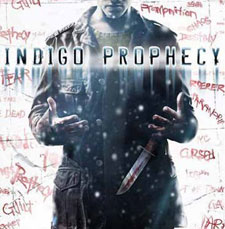
The opening sequence of Indigo Prophecy is perhaps the greatest experience I have had as a gamer. Indigo Prophecy was released in 2005, but the first time I ever "experienced" Indigo Prophecy was earlier this year. I say experience because it really is that. If Indigo Prophecy is judged from a pure gameplay standpoint it fails miserably. The controls are clunky and unintuitive and actions are handled through quick time events that are reminiscent of Simon Says. The reason why I was interested in Indigo Prophecy at first was because 1UP FM had recently done a backlog segment and I had felt the urge to join in on the fun. I purchased the game used at my local Gamestop. They didn't have the case or the manual so they just sold me the disc, but that was really all I needed. I got home, popped it into my Xbox 360 and couldn't stop playing. The main thing that drew me in were the choices that I, as a player, was given. At the start of the game, you, playing as Lucas Kane, are a murderer, only you don't know what happened. Lucas is in a restaurant bathroom with no recollection of his heinous crime. When Lucas breaks out of a hypnotic state, the player is given the choice of what to do next. The murder can be covered up. Lucas can buy himself time by putting the victim in a bathroom stall, hiding the knife, and cleansing his hands of the bloody mess. You could also do none of that. Maybe you just want to get the hell out of there without even paying your bill. It's all about decisions. Indigo Prophecy is the most ambitious game I have ever played. It tries to do way too many things and, ultimately, that is it's downfall. The twist with Indigo Prophecy is that Lucas isn't the only playable character. Detectives Carla Valenti and Tyler Miles spend the course of the game trying to find the mysterious killer. It's interesting to see the perspective of not only the killer, but also the people working to track him down. When playing Kane, you spend the entirety of the game covering up your tracks. When playing as a detective, who you can switch between at will, you are searching for evidence and interviewing people for clues. Indigo Prophecy has an interesting way of showing how a character is feeling in a mature fashion. Each character has a Mental Health Meter. If a character gets too depressed they may commit suicide, an instant game over. Lots of conversation topics are given to the player, providing possibly the best dialogue system before Mass Effect was released. Another cool thing about Indigo Prophecy was the use of split screen cameras. Knowing you only have a certain amount of time to make a decision before trouble arrives provides a sense of tension. It's unfortunate that after the first third or so of the game it starts to fall apart. Unnecessary stealth segments and a bizarre turn of events involving supernatural occurrences made me almost turn off the game for good. The conclusion of the game was very unfulfilling and felt completely rushed. I wish that the same level of polish given to the first few hours was given to the last few. Indigo Prophecy is relatively short, but the game seems to drag on after a certain point. Choices are important in games and Indigo Prophecy provides them by the boatload. Indigo Prophecy displays amazing potential. If only the game was given a little more development time it could have been something more, but the things it did well worked better than almost all other games. The thing I disliked the most about the game were the supernatural elements and Quantic Dream have already said that their next game, Heavy Rain, will not feature them. Will Heavy Rain reach the potential Indigo Prophecy never realized? One can only hope.
|
