Home
Home

Is violence in games a lazy design practice or a crutch that too many triple-A developers lean on? Jonas argues that we diminish the power that such carnage should have through its overuse.
I stomp my boot against the head of a zombie and feel its skull slowly pressing in and bending. A split-second later, it explodes in a visceral show of blood spatter and brain matter. My pants are soaked in it.
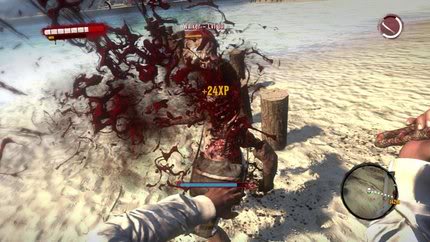
Yet I laugh. A real, hearty belly laugh. Some form of relief, I suppose. Another reason comes from pure excitement. I truly enjoy the carnage despite the awful mess it creates. I take pleasure in feeling the skull buckle under the pressure. Having been straggling around Banoi for the past many hours, I have ordered myself to commit that act a great many times since it’s the fastest way of disposing of the buggers.
Or rather, the character I’ve been controling does so.
Perhaps because I’m indirectly implicated in the brutality, I can’t help but feel somewhat distanced -- even if sickened -- by what I’m seeing. And believe me, the Internet has -- willingly or not -- exposed me to a lot of sickening things (don’t click links that you aren’t sure where they’ll lead you!) that have probably hardened me against such brutality -- at least so long as it is on a computer screen.
What I’m repulsed by in Dead Island -- and in a number of attitudes to what games are -- is their embrace of violence as the focal point of the game. Whenever you do something remarkable in-game, you are rewarded with gore.
Personally, I have nothing against violence in video games -- admittedly, I did actually enjoy parts of Dead Island’s brutality -- but it is rarely used in the same way as it is in, for example, the world of film, where it is a natural extension of the environment the film describes.
Take, for instance, this scene in Martin Scorsese’s The Departed. The grueling amounts of blood and the characters’ coarse way of dying in general shows how quick, ungraceful, sometimes shocking, and surprising death can be...it is the absurdity of just how fragile a human being of flesh and blood really is and how little is needed to destroy one.
Or in the fairly recent film Kick-Ass, which was based on a graphic novel, where the violence can be said to be merely satirical...perhaps even a faint nod to the violence-centric entertainment industry and the desensitization to violence in society.
This is particularly true in one of the climactic scenes where everyone (if not for an intentional mechanical failure) is able to watch Big Daddy get burned to the death. Did they enjoy it? Probably not, but they didn’t make any effort to not watch it. They willingly exposed themselves to a live execution.
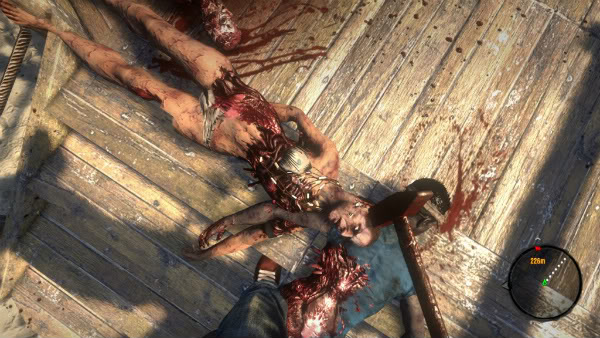
A game like Dead Island, however, completely lacks this element of purposeful violence. To return to the wallowing in violence once more, it is always possible for the player to completely hack the vanquished zombies to bits and arrange them in little adorning piles. I’ve even hacked both arms of a live Thug only to watch it try to bite me instead. Oh, the joy! This is the apocalypse, sir; we ain’t got time for laughs!
Another game that takes the same uninhibited approach to violence is Prototype, which made matters even worse by pretending like the protagonist was a hero. Surfing the body of a random pedestrian across the curb isn’t heroic in any way -- no matter how hard you may try to justify it. Sure, the guy would probably turn into one of those zombie-like things later -- or get killed by the notoriously evil PMC -- but that doesn’t change the fact that you just surfed on top of a man’s back, dragging his body into bloody rags across the black asphalt. You’d make even Jack the Ripper feel repulsed!
This is a discussion I don’t think is had very often within the video-game community: the question of the necessity of violence in games. Instead, the violence is often celebrated. Take this article frm IGN, for example. It’s a list of "best gore effects" and mentions the following from F.E.A.R.: "Every time [Alma] shows up in the game, people tend to explode with a surprising amount of urgency [...] and often leave the screen dripping with high-resolution innards and vital liquids. Gleefully disturbing."
Gore in video games isn’t something morally reprehensible -- few things in the realm of fiction are, really -- but combined with some games’ incongruous tone, the violence is trivialized. Maybe the intent of the violence was never to make the player feel repulsed or that the violence had a satirical point. Maybe the coating of story and similar things was just a snare to take players in and let them find enjoyment in the gore.
I doubt that (well, at least, for most games); instead, the problem is to be found in you. Yes, you, dear reader! Well, maybe not you specifically, but you, like me, fall under that arbitrary term "gamer," a person greatly interested in electronic entertainment.
The reactions I’ve seen from gaming sites and blogs, as well as their users, are rarely condemnatory in nature. More often than not, the reactions are like that of IGN’s: "Gore is fun!" Any game that happened to feature easily-detachable limbs would instantly fall into the gore-fest category and be used and abused by people who do not grasp the tone in the game. Which makes any game trying to show the sober brutality seem both unserious and immature.

Again, Dead Island can be brought up as I remember seeing from a Let’s Play where a player approaches a weeping man. The man is sitting in a bloodied pool with bodies all around him. The player shows absolutely no response to the man’s sorrow and mocks him instead.
Naturally, you could say that he is just a fictional, digital character, so why bother feeling anything for him? Honestly, while the entire scene might be a bit cheesy, it’s still a great imitation of how such a horrifying scene could play out in reality. That’s what good fiction can do. It instills emotions that lie close to reality. While I try to see the humor in the situation, it’s really hard. Now that there’s actually a brief moment of emotion in the game, nobody actually seems to notice it.
However, things do not appear to be that simple. According to a study by a graduate student at the University of Rochester, gore actually makes playing video games less enjoyable. Instead, what attracted gamers to violent games was "...the feelings of challenge and autonomy they experience while playing." While not explaining the downright disturbing actions of the aforementioned Dead Island players, it does at least suggest that it is very possible to create engaging, non-violent games.
So, is it merely unimaginative game developers we have to blame? Richard Ryan, a motivational psychologist involved in the study, suggests that it might just be the case, saying that "Conflict and war are a common and powerful context for providing these experiences...." And in this short article on the author’s pacifist run through Mirror’s Edge, the viewpoint that violence isn’t needed in games is presented. The author seems to have had a far more engrossing experience than if he’d chosen to shoot everything in sight; however, this immersion is quickly shaken out of him as he is forced to use a sniper rifle in one of the missions. In other words, the game didn’t deliberately try to diverge from the violence-centric nature of the industry, it was merely a coincidence.
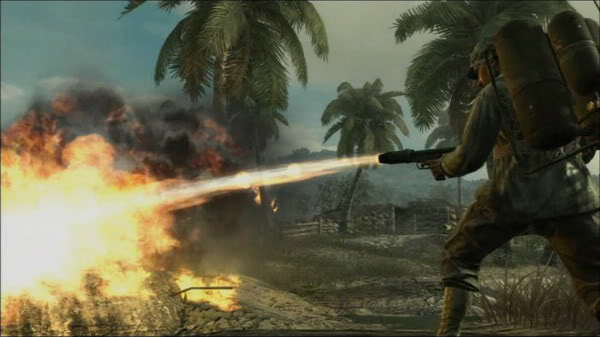
One game that approached gore correctly, at least in the way I perceived it, was Call of Duty: World at War. There were some deadly close-up fights with enemy Japanese that involved sharp bayonets and guts and allowed you to look your enemy in the eyes as you stabbed him. He gurgled a bit, his eyes began to roll over, and then he slumped down, dead.
Another evocative moment was when I was crouching in the cover behind a bombed-out building. A massive explosion rocked the ground, and a blown-off foot fell down in front of me with a bit of bone sticking out. I was stunned for a moment before the battle scene tore me back to "reality," and then I continued on fighting. But that moment of reflection in the gore is a sign that it worked with success. Instead of egging on the player to continue on in the carnage, it forced the player to reconsider his role in the war and his past deeds during the battles.
Violence and gore in games is a tricky subject, and no matter how it is depicted, it will undoubtedly draw a lot of flak from journalists who don’t have anything more interesting to write about. I'm not saying that violence has no effect on the individual, but that the discussion often ends up being rather shrill with critics and defenders talking over each other’s heads.
Instead, we should have a discussion that, in my experience, is far rarer: Is violence and gore necessary in games? Gazing over a list of high-profile games releasing this quarter (Battlefield 3, Arkham City, Saints Row: The Third, to mention but a few), I certainly see a pattern in that high-profile games generally feature more violence.
Combat is often a main selling point of games. I’m not proposing a moratorium on violence in general -- that would be silly. I’m merely saying that we should not fall into a pit where violence is equal to "mature," particularly in the action genre. Maybe we could actually see some more clever and original mechanics in the future than shoot shoot, kill kill.
And finally, some gore for the masses!
Suggested further reading on the topic: Benj Edwards' "Opinion: Can Games Become 'Virtual Murder?"; Leigh Alexander's "Opinion: On Making Game Violence Work"; and Harry Slater's "Why Video games Haven't Grown Up Yet: Violence."