


“What are you playing?”
“The UnderGarden.”
“What’s it about?”
“I don’t know....”
“What are you?”
“You know, I don’t know that either.”
“Are you underwater?”
“I...don’t know.”
Such was the conversation between my wife and me when I booted up Atari’s latest downloadable game, available on Xbox Live Arcade, PC, and soon, the PlayStation Network.
The last question stuck with me. With no clear answer within the game, I hit the promotional site, which bills the game as “an underground world,” but the press email I received uses the word “underwater.” My character, some sort of biological Sackboy, shows no evidence of its provenance, and his movements could either be a quick swim or a slow motion flight. I simply do not have an answer.
Game: The UnderGarden
System: Xbox 360, PC, PlayStation 3 (available in December)
Price: $10 (800 Microsoft Points)
Atari is pushing this game as a palate cleanser, but I find that this marketing is more a commentary on its release date during the Triple-A-heavy holiday season than what the game actually is -- a clever puzzle-platformer.
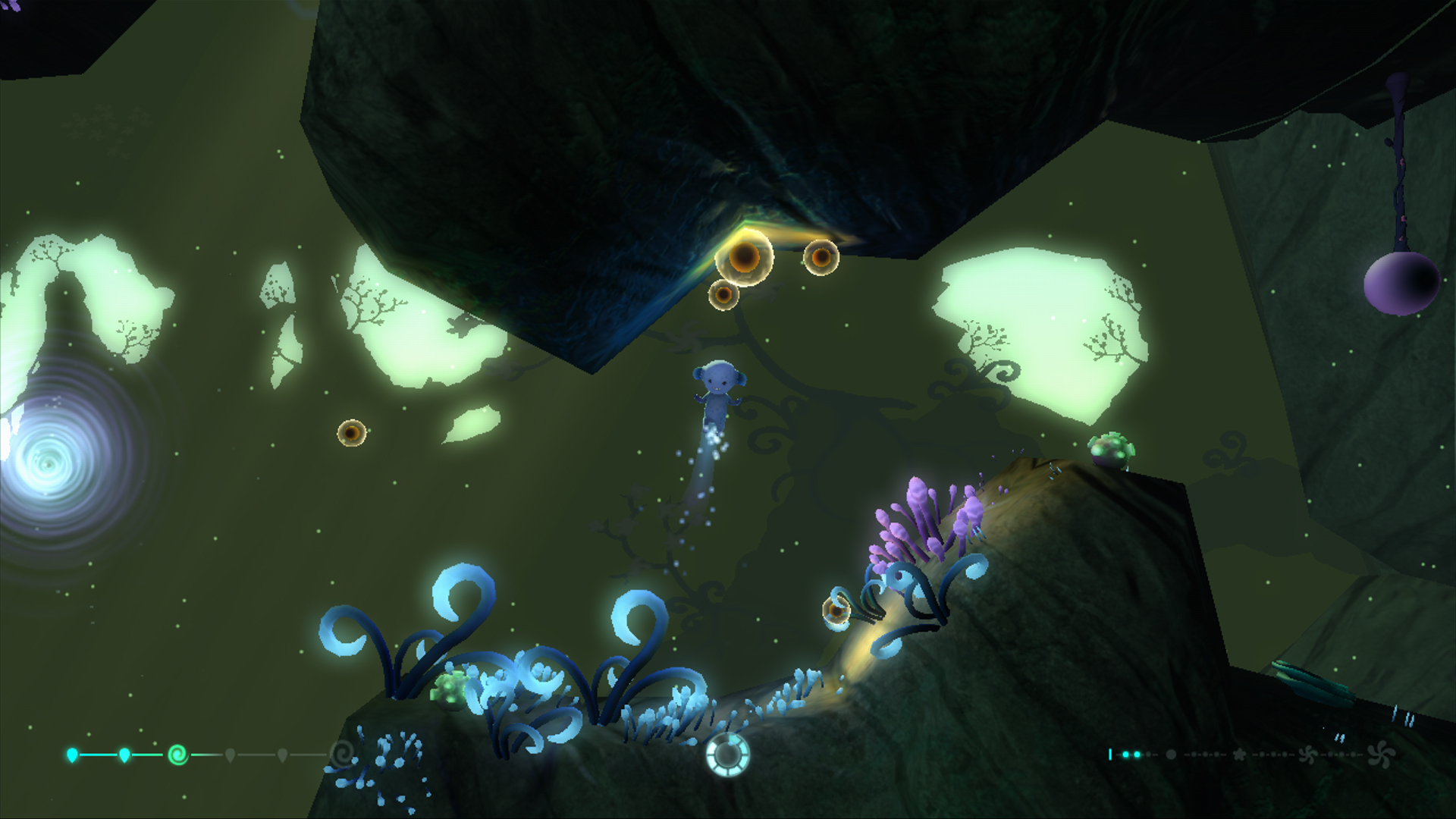
Does it work as a palate cleanser? I suppose it could, but one’s enjoyment of the game should not be predicated upon whether you’ve been shooting generic soldiers and space marines in the head for hours on end before booting it up. Its ethereal atmosphere easily captures the imagination -- dark tunnels are lit by blooming, luminescent flora lights the dark tunnels, and musicians scattered throughout the levels play a song that will stay with you for days. For aesthetics alone, it's an easily justifable purchase.
That said, the most engrossing element of the game is its mystery. In a day where games suffer from over explanation and patronizing tutorials, The Undergarden fosters a sense or discovery. Critics often claim that games do not trust their players’ intelligence, whereas The UnderGarden not only relies on its audience smarts, it demands a level of curiosity from the player that is hard to translate into rat-maze-like achievements. In fact, the only thing it makes obvious is that nothing about the game is obvious -- a tad gauche perhaps, but you have to smack modern gamers over the head with something.
In a good way, the Undergarden harkens back to a time when we didn’t need all the answers, and the ones we got weren’t delivered on silver platter.