Home
Home

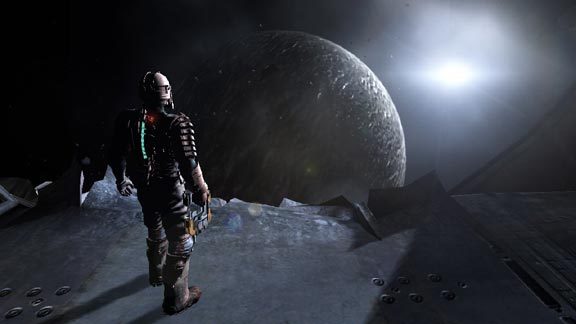
Half-Life, Ico, Braid, Uncharted 2, BioShock, Portal, and Dead Space: These are important, landmark titles that share a peculiar and seemingly ineffable quality. You may have sensed it. In fact, if you're a fan of any of these titles, I'm almost certain you have. They are experiences that sublimate: games that transcend what you thought the medium you adopted in your childhood could achieve.
Visceral Games' Dead Space 2 clarifies this odd connection. It's a weird opus that recombines the tropes of the third-person shooter with the conventions and directorial acumen of classic narrative-focused filmmaking. Like the titles listed above, it's a game that elevates itself above the rest: It doesn't rely solely on its twists and turns to leave an indelible imprint on your brain. In fact, the story isn't even that interesting or novel. Instead, it's how Visceral delivers the story that is of special note.
Dead Space 2 and its pioneering contemporaries share an almost imperceptible "it" factor having to do with their narrative delivery method. But what is it that makes these "important" titles so important? The answer is simpler than you might think.
It seems to me that the commonality between them is that they all contain diegetic elements. These features have, in some great or small way, moved the effort of narrative-based gaming forward.
OK...so maybe it's not that simple. But once you get your head around the notion of "diegesis," it's not too bad. I promise.
For the sake of clarification, here's how the Yale Film Studies website defines the term:
[Diegetic elements] include objects, events, spaces and the characters that inhabit [the narrative], including things, actions, and attitudes not explicitly presented in the film but inferred by the audience. That audience constructs a diegetic world from the material presented in a narrative film.
More simply, diegetic elements are fictive components that explicate a world within the confines of a story's "narrative bubble." Film critics often employ the notion to talk about a movie's music. A simple example of diegesis would be the use of an on-location jukebox to score a scene, rather than the non-diegetic overlaying of an externally evocative orchestration.
Diegetic explanations create seamless fictional worlds. In essence, they allow a medium to get out of its own way. They reduce viewer distraction because they eliminate the need to muse over the origins of a sound or a text overlay. Fortunately for books and movies, non-diegetic elements do very little to intrude upon a viewer's suspension of disbelief. Chapter titles and film scores can even add to the tone of the piece as a whole, thereby enriching the experience. This isn't the case in video games. Health meters and item screens do very little to further the aims of the creators' narrative vision.
Dead Space 2 uses diegetic displays to convey key info: health, stasis, air, and ammo.
With this explanation of the value of diegesis in hand, I would like to present a claim: Within the popular culture, Dead Space 2 does more to advance the cause of narrative-based gaming than any other title before it.
Why Dead Space 2 fits the bill
First, I would like to offer a disclaimer: This is in no way meant to be a comparative review of Dead Space 2. I think it's an excellent game. But by my estimation, it would also place last after every title listed above, up to and including the original Dead Space, which laid the groundwork for many of things that its sequel does.
Also, before I continue, I would like to point out two considerations to keep in mind as I make my argument:
- A game that significantly advances the cause of in-game storytelling must have the potential to imprint itself on the larger popular culture (i.e. culture outside of the medium or, more simply, high sales numbers and a high profile).
- A title that meets the first criteria must deliver the majority of its information utilizing diegetic strategies.
As you can see, titles like Ico and Braid fail to meet the first consideration, while Half-Life and BioShock fail to meet the second. The original Dead Space and Portal are arguable candidates for this accolade, but I'm of the opinion that the former did not sell well enough to fulfill the first criteria. Portal, on the other hand, meets both criteria, but I am inclined to disqualify it due to its limited scope and its station as a part of a larger compilation of games. (Call it a technicality if you like. Also, Portal 2 looks like it's doing a lot of interesting things with diegesis, but unfortunately, it's not out yet.)
Dead Space 2 fits right in there. It's a title whose profile is large enough that casual gamers are likely to be aware of it. On top of that, Visceral Games has found a host of impressive solutions to the problem of communicating vital information to the player.