Home
Home

I haven't cared much for survival-horror games lately, and Joe's explanation here gives a good reason why: They've forgotten what used to make them special.
A recent foray into PC gaming has reignited my frustrations with survival-horror and convinced me that stagnation has crept its way into the sub-genre.
You see, a few weeks back, I came upon the YouTube channel of one MarbleHornets, the creator of a fake reality web series (ignore the oxymoron) based around the Slender Man legend. I have always found the concept of a faceless, malevolent entity stalking mankind since time immemorial to be a genuinely unnerving concept.
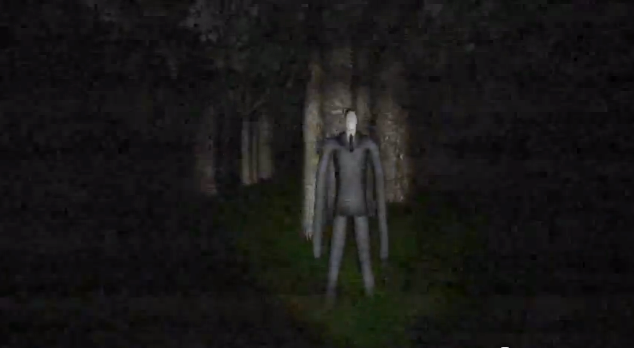
After spending far too much time watching and reading about the Slender Man, I learned of Slender: The Eight Pages, a game based around the entity.
Parsec Productions’ indie hit is nothing short of amazing considering the minute budget it was created on. The premise is brilliantly simple: You are placed in a deserted and eerie forest and are tasked with collecting eight randomly placed pages from landmarks scattered throughout the area with nothing but a flashlight. It sounds rather bland until you discover that you are being constantly watched and followed by the game’s titular character (who can literally appear right in front of your eyes or directly behind you at any given moment). With nothing to defend yourself with, the possibility of being caught behind any sharp corner or dimly lit narrow tunnel genuinely creates a tense atmosphere.
Now, it would be too easy for me to say that Slender has singlehandedly restored the survival-horror genre in terms of being able to evoke the emotion of fear and anxiety in the medium of video games, but it has reminded me of how much the genre has changed in recent years.
The Resident Evil series has historically been considered to be the pinnacle of the horror genre, yet with each release, the iconic franchise has diverged from tight, claustrophobic corridors and sparse lighting to become what Capcom (the publisher) has deemed “Action-Horror.” It's debatable that the series has had to naturally evolve to cater to a wider audience, but Resident Evil 6 feels more like a spiritual successor rather than a direct sequel. I should clarify that I thoroughly enjoyed the game (despite the wildly varying quality of the four different campaigns), but I never experienced any horror.
It's hard to feel scared when a developer puts you in a world where you are never alone. Although co-op has become a popular mechanic, I feel that for an interactive experience to be truly unnerving, it needs to be experienced alone.
Visceral’s Dead Space series has retained some of the genre's conventions, but even Isaac (the protagonist) apparently needs a friend, as the inclusion of co-op in the upcoming third installment has proven to be a controversial decision. The simple fact is that games are just not as scary when you always have a teammate holding your hand around every blind corner and conspicuously broken air vent.
It's impossible to pinpoint one single change that has diluted the survival-horror genre, but if the inclusion of co-op is one of them, there is another equally important factor: the degree of power afforded to the player.
Just as Slender has done with its basic premise and simple controls, Frictional Games’ Amnesia: The Dark Descent has also caught onto this fact. That title proves that if you make the main character a weak and visibly scared conduit for the player as opposed to an ex-special forces operative armed to the teeth, you can create an experience that is genuinely intimidating.
This inability to defend yourself -- with the only options being to run from confrontations or assume the fetal position in a closet -- almost bends the rules of what a game should be. Of course, fun is subjective, and fun can just as easily be found in being terrified as it can in being a mercenary badass able to gun down an entire onslaught of mutants. I just hope that more developers of triple-A titles realize that the fun in survival-horror comes from simply surviving by any means necessary.
Maybe, for the survival-horror genre to continue, it needs to get back in touch with what made it great in the first place. Sometimes, you need to return to the roots of something in order to re-discover what made it so special.