


The problem with personal politics is that they're always personal. They invite the criticism of others. Unfortunately, today's polarized political environment is making it more and more difficult for developers to keep their opinions to themselves. Should we tolerate (or even encourage) political discourse in video games, or should developers learn to keep quiet?
No art form is neutral. For that matter, no medium is neutral. A part of the author's views always bleeds into his work. Even if there is no single author, the social context in which the game exists will affect the message it passes: No forms of expression exist in a void. Whether it's social, politic, economic, or personal, a context surrouds every artistic creation. Games are no different.
Sadly, a lot of developers do their best to eradicate any form of subjectivity from their work. Video games are, in the view of most, a product that should pander. The belief is that a developer's opinion might cause potential customers to turn away because its message is controversial. Sometimes writers can get away with opinion-making by tackling a subject that is new to the social consciousness or extremely limited in terms of controversy. A great example is 2007's Bioshock. Ken Levine, creative director of Bioshock and its sequel, was able to explore Randian Objectivism without creating too many waves because it's not a subject that gamers frequently discuss. Bioshock helped tow philosophical thought back into the pop culture of video games and had the side benefit of teaching gamers.
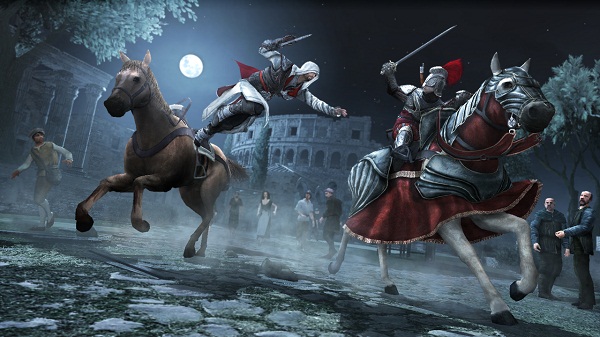
I'll be the first to admit it: Objectivism, while an interesting subject to debate, is not totally relevant today. Health care reform, on the other hand, is a hot-button topic. Aside from a few indie games here or there, no one really touches topics like this -- except Assassin's Creed: Brotherhood.
Hidden in Brotherhood are a few puzzles you must solve in order to unlock "The Truth." These puzzles combine well-known historical events from around the world in order to provide a backdrop for the game's complex conspiracy theories. From the Crusades to World War II, the Templars had their hands in every major world event.
One particular puzzle in Brotherhood attracted attention for its contemporary subject. As you complete the puzzle, you learn that influential political and judicial figures, including Chief Justice John Roberts (of the U.S. Supreme Court), are working for the Templars and that the controversial Citizens United case was orchestrated by the "bad guys."
Saying that Hitler, a man generally hated to say the least, was a Templar is one thing. Casting a real person -- particularly a man seated atop the American justice system -- into the same nefarious role is a different matter altogether. The subject of Justice Robert's career is a current issue. What we have here is a politically charged jab from Ubisoft in retaliation for some unknown political or judicial decision. But one jab wasn't enough! The developer strikes a second blow against the American health care system. The developer makes its opinion clear in a building description.
To be fair, the position isn't a surprising one: Ubisoft is a French-Canadian developer. (I should know. I'm a Quebecer.) These political opinions are hardly overt or important in the grand scheme of the game. Both the puzzle and the building description are not only optional, they are difficult to reach. Ubisoft still ensured that Assassin's Creed: Brotherhood would be a sellable product, not a work of total personal expression, but the political statements are both still there. Ubisoft took a risk by including the opinions of its employees in their game. If the comments on the Kotaku forums are any indication, gamers have noticed this stuff.
I think that a bigger issue remains: A lot of gamers feel that political discourse has no place in their medium. I disagree. Games do not exist in a void, and people should realize that they are products of their context. Even though most developers are doing their best to remove contemporary debates from their games, they are still subject to the pressures of the environment they occupy. Take a look at Call of Duty: Black Ops: The choice to include some events and exclude others results in historical and political subjectivity. The number of people playing the game indicates how players have received it. It's all around us; we just need to be aware of it.
By observing art, how it's created, and how it's perceived, you can determine a lot about the society that creates it.