
Separator
"Einsatzgrieffen": Human Nature and Online Gaming
Why__hello
Tuesday, June 30, 2009
Einsatz

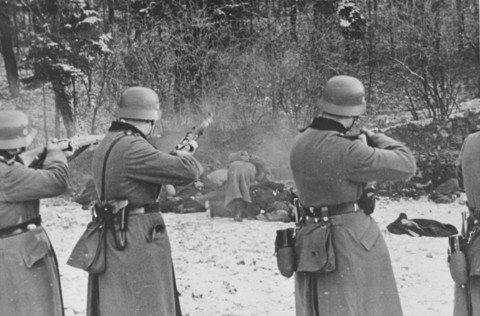
Gas chambers and server browsers. Summary executions and spawn camping. The Holocaust and griefing. What do any of these things have in common? At first glance, nothing. The calculated extermination of Jews and other Untermensch throughout Europe seems antithetical to the irritating antics of bored teenagers on the Internet. So why would I choose to compare them?

Whether we enjoy the notion or not, human beings are horrible creatures. Our history is rife with violent tales of betrayal, subversion, and destruction. While I'm sure that you -- the reader -- are an open-minded person, equity and tolerance are the exception in human history, not the rule.

It's an elemental debate we struggle with all the time: Are humans essentially good or bad? The answer isn't simple. We all respond to external social forces -- our identities emerge from the environments we're exposed to. The more extreme that environment is, the greater the permutational difference becomes. Radical contexts force people to resign their moral proclivities and pursue their own, selfish goals.

But, not all is lost. As we congregate in groups, we establish laws in order to stave the strong, natural desire to ignore morality and seek self-interest. Without these laws, the most abrasive side of humanity shows itself.

Allow me to explore the connection between some of the world's most characteristically uncontrolled environments. Trust me, there is a link!


During the preliminary hearings of the Nuremburg trials, the public imbibed the gut-wrenching truths of the war. Tales of vengeful officers and morally oblivious conscripts haunted the imagination of the world. It was difficult to consider these criminals as humans. The average tax-paying, law-abiding citizen found very little in common with the villains he saw on television.

However, in the '60s, sociologists like Philip Zimbardo and Stanley Milgram performed experiments which indicated that practically anyone was capable of such severe violence. They found that accountability and peer pressure were the two most socially coercive tools. Remove the former and apply enough of the latter, and an ordinary person will commit acts which go against his moral customs.

Much like during war, individuals rarely face judgment for their actions on the Internet. In these contexts, you're rarely reprimanded for shooting a civilian or blocking a doorway.

So why do people behave more belligerently online than in person? Because on the Net, we aren't subject to ordinary social parameters and consequences. I would give you the same answer if you asked, "Why were Nazi officers so cruel and inhuman?"

It's paramount that we all understand the power which external social forces have on us. Anonymity and freedom from liability can make us do things which we word normally consider "immoral."

Take me for instance: I'm a regular guy. I play multiplayer games with my friends. We cooperate and help one another for the sake of achieving our assigned objectives. But every once in a while, especially when I'm playing with strangers, I like to fool around. In Left 4 Dead, I'll throw Molotov cocktails at my fellow survivors. In Counter-Strike: Source, I'll shoot all the hostages. In Halo 3: ODST's Firefight mode, I like to horde all the ammunition. It's not because I'm a bad person -- boredom, lack of accountability, and unfettered freedom are the causes of this behavior. Since online games rarely impose social administration, we resort to our primal instincts. We amuse and gratify ourselves at the cost of others.

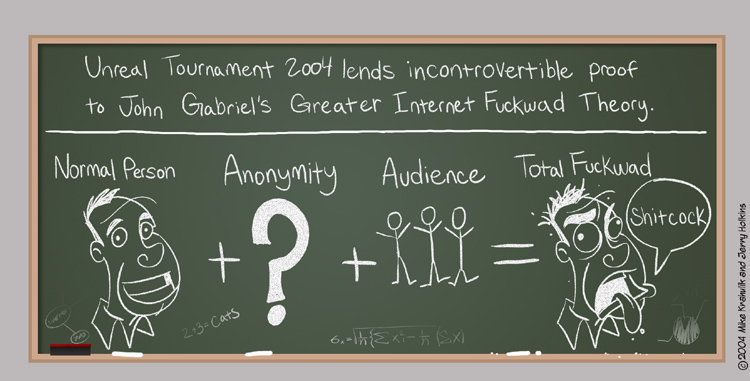
This conclusion inevitably raises the question: Does this mean humans are naturally bad? Are we naturally inconsiderate, childish, and short-sighted? Is there some component of human nature which compels us to take advantage of the absence of consequences and pursue desires otherwise looked upon unfavourably? Mike Krahulik and Jerry Holkins of Penny Arcade put it best in a comic of theirs:
Gabe

The Internet undeniably proves neo-Classical political theories. Hobbes' famous "state of nature" is a perfect example. Human beings will act without regard toward others when given the opportunity. I'm certain that Machiavelli would be pleased to observe how perfectly the Internet proves that we, as a species, are "nasty" and "brutish" given the correct environment.

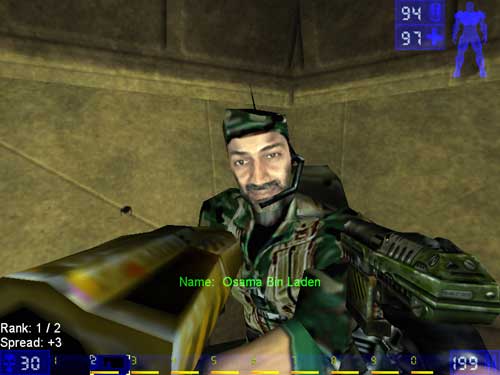
Griefers confirm that the only element preventing human beings from treating each other callously is social organization. While they may not know it, griefers shed light on a very interesting -- albeit depressing -- truth concerning human nature: We are quick to abandon the ethical ideals we hold closest in lieu of self-satisfaction.
Be careful who you grief

As Thomas Hobbes maintained, we require a "Leviathan" to enforce legal and moral conventions on the population. Perhaps online autocrats that regulate behavior are the only way to keep insensitive opponents from screaming the word "nigger" at 100 decibels in to your ear. Net Neutrality is very important to me, but the notion of an idiot-free Internet is very attractive.

While I may have provided more questions than answers, it's my belief that human beings are far too complicated to simply pigeon-hole with terms like "state of nature" or "universal morality." I won't pretend I've never mic-spammed or intentionally pulled mobs in World of Warcraft, because I have.

At the same time, I have no desire to belittle the suffering and anguish which the Holocaust has caused and, no doubt, still causes. I simply wished to indicate that the absense of blame, guilt, and liability are responsible for humanity's most atrocious as well as our most mundane ones.

 
0
BITMOB'S SPONSOR
Adsense-placeholder
Comments (19)
Default_picture
June 30, 2009
IN--CREDIBLE.

I completely agree... Very eloquently put. Could you also see the Internet, and online multiplayer gaming with it, becoming one large social experiment?
Why__hello
June 30, 2009
I think that the internet is probably the most powerful research source which sociologists possess today. The way in which guild-communities deteriorate with time, or the comparisons between real-life conversations and forum threads all provide insight into the way in which human beings conduct themselves in different scenarios. I'm glad you liked the article!
Alg_halo-reach-beta
June 30, 2009
Jesus I love articles like this that you can only find in the mobfeed at bitmob haha
Default_picture
July 01, 2009
nice article.
Default_picture
July 01, 2009
The article was a bit short. You probably could have done introduced the normalization of certain practices and sub-sub-cultures on the internet that people would otherwise find abhorrent when confronted with in day-to-day life as made obvious by SomethingAwful's weekend web. But that might be too far away from games.
Default_picture
February 20, 2010
two thangs:

first: I wouldn't want to say Humans are good or bad. To judge humanity you have to first remove yourself from them, which is a) impossible, and b) if you're going to try, you can't really use words like "good" or "bad", they don't really have any meaning at this point.

b)that's part of what makes the internet special. I would never take extra special enjoyment hunting down a little douche bag if he never was a rocket whore to begin with.
Where
February 20, 2010
While I was worried to begin with, you surprised me once again. I thought you were going to really tread on some sensitivies there -- but you behaved with professionalism. Great article. But let me add a few points of my own!

1. I think you underplayed anonymity. In the Einsatzgruppen, for examples, many of the soldiers' identities were kept secret -- a very compelling detail which exists on the Net as well.

2. Reading some of Rousseau's earlier works, he mostly agrees with the Hobbesian state of nature. I think that the Internet is the only intact arena of "natural" human activity left in this world. Most of the forums, online games, and chatrooms have no tangible supervision and so gamers behave in the most immature and shortsighted ways possible.

3. Don't wars create a Leviathan instead of removing one? Maybe you're placing added emphasis on the lack of liability and the futility of court marshaling, but I had to point that out.

Again, great piece. Keep em' coming.
Why__hello
February 20, 2010
@Rob: I agree that "good" and "bad" are morally relative, but I was taking the position of the archetypal Western moral thinker. I.e. killing is wrong, griefing is wrong, and causing people any form of tangible discomfort is wrong.

@Keith: Great points, all! It's nice to see someone else appreciate Rousseau. Concerning your last point, however, I was just having a conversation on that very subject. During all human interactions, there exists a social maelstrom. From imposed authority to peer expectations...there are dozens of factors which influence the actions of an individual. I didn't mean to deny them all -- instead, I merely hoped to explore the overriding importance of accountability and anonymity: Two forces which are VERY important in both war and on the internet.
Where
February 20, 2010
Understood. But does Net Neutrality necessarily entail a lower number of morons and trolls online? I would think that AT&T; would change broadband discrimination before they got read of spammers on CSS (not that they really cool).

I'm kidding of course, but I think the point remains: We'll never be able to get rid of the imbeciles who disturb most online games. But thanks to you, we can at least understand them!
Why__hello
February 20, 2010
@Keith: No thanks required. Consider it a public service announcement!
Default_picture
February 20, 2010
First off, great article. I'm glad somebody is writing this type of stuff, and you're doing a damn good job at it Omar. Keep it up! Now, an anecdote.

This past fall, I was in my world literature class, and we were reading Frankenstein, or some other such novel, and soon came up the timeless argument of nature versus nurture. The class soon devolved into me falling on the side of nurture alone, bitterly trying to defend my own arguments, and everybody else believing in some combination of the two. I believe that their are certain un-articulate-able fallacies of the mind, beyond our comprehension, that account for nature of humans as a whole (human nature is kind of a vague term when you think about it...) but I most certainly do not believe in individual nature, that people are spiritually or chemically pre-ordained to follow a certain path in life and have certain characteristics (beyond physical ones of course). Like Hobbes says, we'll take the opportunity to hurt others because it benefits our mind ever so minimally. That is human nature. People are not inherently bad themselves; a lot of factors contribute to certain people doing bad things or saying hurtful things. That is what these Internet folk do, and anonymity is a huge part of encouraging that.

My job in my life is to be the best person I can possibly be and try to make my way through the day happily. What it is not to do is to involve myself in understanding people's sometimes horrible mindsets because it depresses me. People invest themselves too much in the failures of others and the misdeeds of humanity when it only sees to bring them sorrow. It's just a subconscious way of inflating the Ego. We're all different and have different ways of thinking about things. Why wonder about why others are assholes, in the case of this article "Internet trolls" and "griefers", when we're not ourselves? Because it brings to us that minimal sense of subconscious self-gratification you mentioned in your article, even when we are decidedly more nicer and noble in our thinking. Thus is the foundation of opinion, and ultimately, argument and war. This is why I resent politics, organized religion, and the ilk. Not because I don't have viewpoints or strong opinions on matters, but because trying to defend yourself brings to us vanity and corruption and an egoic state of mind. The cycle of defense and attack with people like Internet trolls is not what I need in my life and getting personally involved in criticizing these people isn't doing anybody any good (not that you are Omar!). That's why I come to Bitmob, to just avoid that stuff altogether and be in a fun and encouraging community of good people. :)

I strongly recommend Eckhart Tolle's "A New Earth" as reading. Don't resent it simply because it was on Oprah's Book Club. For the love of all that is good, don't. Most of all, thank you for writing a thoughtful article that encourages this type of discussion. Hope I made a semblance of sense to anybody but myself.
Default_picture
February 20, 2010
To clarify a bit, these people are assholes for sure, but personally involving ourselves in their stupidity is completely unnecessary in the grand scheme of things. Don't depress yourself thinking about it, just try and avoid it if you can. You'll enjoy this place more.
Why__hello
February 20, 2010
Thanks for your comment Nick.

I agree with most of what you said, especially your opinions concerning ego inflation and self-gratification. Social organization breeds resentment. Whether you're talking about disenfranchised voters toward the administration, or a griefer attacking a group of mature players. It's best not to get involved with their moronic antics because it adds little value to our own enjoyment or experience.

However, understanding why people behave that way is important to me. Call it curiosity -- but when a human being acts inconsiderately, I feel compelled to find out why.
Redeye
February 20, 2010
While i would agree that an accountability free zone like the internet breeds a lot of assholes, when you force a person to behave right through society often times all it does is turn them into a different kind of asshole. More stealthy and subversive.

If a person does not genuinely WANT to be good to other people they will do whatever they can to avoid it even when society or peer pressure tells them otherwise. The only way to truly breed intelligent and good natured human beings is to create a society that rewards and cherishes such people properly.

Which i would argue, since America just spent a great deal of money rewarding banks that destroyed our economy, we haven't gotten quite right yet.

No society really has.
Default_picture
February 21, 2010
Why is a negative side of a species more real than any good side? "[...] we, as a species, are 'nasty' and 'brutish' given the correct environment." We, as a species, are also kind and generous given the correct environment; we're also indifferent, or compassionate; unthinking, or cerebral. Though in your article it's not explicitly stated, there's often an air of "humanity's true colors" to these sorts of things which I wish would be made clear is not the issue. Sorry about the babbling.

Anyway, great article. The connection (reptilian brain) is there, although they aren't to the same extent——in one you're ruining other people's fun, in the other you're ruining people's lives and families.
Why__hello
February 21, 2010
@Joshua: For a full minute I thought you had written "Omar, you are shit." Fortunately, I reread the phrase and I really appreciate the compliment. But I'm just a lowly intern. The community and the editors are really the ones who shape and make the website what it is. Keep posting and commenting and I'm sure Bitmob will turn out bigger, better, and....faster in the future!

@Pierce: I definitely sense the "true colors" sentiment you picked up. To be honest, there are days when my confidence in humanity is shattered and it upsets me. But then again, there are days when I'm encouraged by human kindness and compassion. I suppose I wrote the article on a bad day. Thanks for spotting that out.
Default_picture
February 21, 2010
Credit where credit is due, Omar. Your contributions at Bitmob are among the best.
Default_picture
February 21, 2010
The thing about the Internet is that you don't have to apologize or feel bad for comparing things to the Holocaust. It almost seems contradictory to your point to do so. Regardless, it's interesting to see the views of a so-called griefer from outside the context of his domain.
Dan__shoe__hsu_-_square
February 22, 2010
Great article!
You must log in to post a comment. Please register or Connect with Facebook if you do not have an account yet.