
Review Scores: The Death of 7.9's and 8.3's

Noctisavvy
Wednesday, August 04, 2010

Yesterday, IGN, one of the biggest gaming and entertainment news sites on the Internet, announced that they would be changing their 100-point review scale which they have been using for the past ten years, and replacing it with a 20-point review scale. In other words, gone are the days when IGN gave games 7.9's and 0.1's and 8.3's, and now is the time of 8.5's and 9.0's, without anything in between. The first example of this is the Starcraft 2 Review that they recently posted, where there is not a .1 or .7 in sight.

You may say "But there are a lot of sites who don't use that scale. Even Gamespy, part of the IGN Network uses a 5-Star Scale. IGN changing it isn't major." I'd reply that that is true, and that I'm not here to talk about IGN's changing ways, but rather review scores in general. You see, we have so many different scales, from stars to points and even no review scores on certain sites, its hard to figure out what means what. Is a 0.5 so different from a 1.0, or is a 1 Star game, so different from a 1 And a Half Star Game?
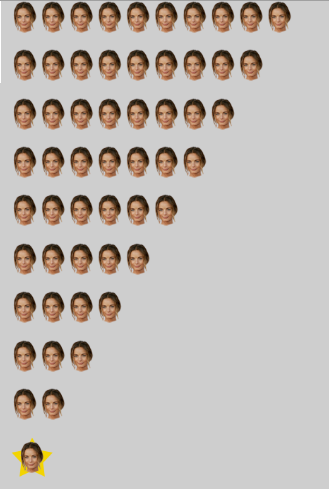
So let's take a look at the different review scales that you may find while roaming the endless expanse of gaming review sites. Gamespot uses a 20-point scale, from 0.0 to 10.0, with only .5 intervals in between. As I mentioned earlier IGN now uses a similar scale. Gamespy uses a 5-star scale, from 0 Stars to 5 Stars, with Half Star intervals. 1UP uses a Grade Scale while Giantbomb uses the same 5-Star Scale that Gamespy does. Of course, we can't forget the mythical, magical scale that certain fans of a certain podcast use. The picture to the right should show you exactly what this scale, only known as the Gabrielle Anwar Scale, is.

All these scales have one thing in common. They don't give a conclusive criticism for the game at face value. They never will, its just the way that works. Sites provide those scores so that their viewers can see the score, and decide to pick it up, or not to pick it up. Even the reviewers on the aforementioned sites have said that half of the visitors to reviews won't read the text. I'm guilty of it, and I would suspect that you the reader, is guilty of it too.

Its often said, "There's no definitive way to rate a game." You can give the Sound of a game like Starcraft a 9.0, but how did that score come to be? Why and how were the points deducted? Was that one missed note in the opening theme (Even though there most likely wasn't, I'm not saying that the Starcraft theme is flawed, don't eat me.), worthy of a deducted .1? There's no conclusive formula, no rule book applicable. Sure you can deduct points for graphical glitches and plain ugliness, but when you're talking about a top class game in terms of graphical presentation, how do you differentiate that 9.0 from that 9.1? I would suspect for any reviewer, since, to be truthful, I don't have experience in the field, that it's practically impossible. There's just so much to take in in any game, that its impossible to get that score exactly right, because there's no textbook or formula to help you along.

Of course, just having a scale doesn't help a lot either. No it does not. Or even doing reviews, that isn't a nice thing to do. That is all because of one word. One, dastardly word that every gaming journalist should dread...Comments *Shudders*. In the gnarly world of comments, there is this:

Then there is this:

And then *Sigh* there is this:

Ah review scores, spinners of chaos, and weavers of armageddon.


Stephen Barry is a fairly opinionated gamer with a yearning to write...and rant, or a combination of the two. He also tends to get angry at people who complain about Nintendo's trend of systems with not-so-great graphics. Take that how you will. So if you ever read an article by him, expect one of two things: A rant or discussion about a relevant gaming topic, or hating on Ninten-haters.

 
Problem? Report this post
BITMOB'S SPONSOR
Adsense-placeholder
Comments (12)
Default_picture
August 04, 2010

I say the main problem with reviews, and how people take reviews is that if a game is rated less then a 9.0 its called crap.

Remember when a game could get a 6.5 or a 7 and still be a great game? I think gamers are a bit spoiled these days with reviews.

Noctisavvy
August 05, 2010

I agree with you on that, Randy. People are synical about review scores nowadays, and since there's so much on the market that they have the opportunity to choose what they want and don't want, unlike eras like the NES and Playstation which didn't have such a massive collection to choose from as we do in the current generation.

I played Final Fantasy Crystal Chronicles: The Crystal Bearers, and that only got so-so reviews, and I enjoyed it. Having played it, I saw the flaws, but I saw things that maybe weren't as bad as reviews had said. Those gamers that say that a game under a 9.0 is crap, are often dissuaded from buying a game that they might enjoy.

Chas_profile
August 05, 2010

Yeah, the "average" is rising higher and higher each year it seems. Most sites claim a game scoring a 7 is average, but it would seem majority of people take a 7 as an insult.

Plus, saying 7 is average renders the rest of the scale useless because it's basically used to tell you precisely how bad a game failed. It's like giving a student an F- - - - - - - or a K on a test they bombed. What's the point in devoting more than half your scale to specify how bad a game is when you're recommending that most people shouldn't even play it?

Seems like it should be the other way around to me.

Jason_wilson
August 05, 2010

Games with scores of 6 are still good. 

Brett_new_profile
August 05, 2010

5 as average on a 10-point scale makes a lot more logical sense, and it gives reviewers more nuance as well. But with Metacritic dominating as it does, it'll take some sort of seismic shift to change things.

Jason_wilson
August 05, 2010

@Brett Nothing will change as long as we have Metacritic and readers who view anything lower than 9 as crap. 

Me
August 05, 2010

At another site I'm on, we sat down one day and went through all the review score scales that had text definitions assigned to them, on either print magazines or websites, put them into an Excel spreadsheet, and looked at them all very carefully. Know what we found? The spreadsheet made not a lick of sense. About the only place we found any sort of convergence was around the score of 7.5, which meant "Good" in most cases.

Our English writers didn't like that, because in their education system a 55 out of 100 is "average," the American equivalent of a "C," which is a numeric 75 in the States. I argued that most readers would see a 55 attached to a game and think that we had therefore rated the game poorly as that is what a score of 55 means on almost every other site, so we conformed to the norm.

We did go ahead and manufacture our own text definitions using ranges of .5 points in order to provide for consistency of results, but in the end we were forced to just try and play along with the rest of the industry simply so that readers could make sense of our scores. If most of the scores were arbitrary anyway, we couldn't see the point in beating our heads against the wall over it.

The best a site can do is look at other sites and try to figure out what the consensus is and play along, really; and no, reviewers are not critics. It's a big problem in video game journalism that "reviewer" are "critic" are used interchangable, because they are very different things. Ask anyone with an education in film theory. *cough*

Robsavillo
August 05, 2010

If we must have review scores, this is exactly why we need to ditch alphabetic and numerical scales and switch to a 4-star system. I think that's more universally understood because of the film industry.

Default_picture
August 19, 2010

I'd bet most people that read Bitmob don't like the review scores being used at many of the major gaming sites and magazines. I've no idea how they decide when to give a game .1 or .3. As others have said, a score of six shouldn't be considered a bad score and that's where I think most games fall on a 10-point scale. There are also a lot of 7s and 8s but there are very few 9s and almost no 10s released in any given year. Yet we see so many perfect scores awarded these days that it makes getting a perfect score nothing special.

Sometimes I also wonder if multiplayer should be scored separately. Call of Duty: Modern Warfare 2 is the easiest example of that. On Metacritic it has a 94 overall with 14 perfect scores. I played the game for the single-player which was a letdown, I wouldn't give that any higher than a six. I've no interest in the multi-player so most of those review scores are meaningless to me.

I suppose multiplayer has to be rated within the time period but I am bothered a little when a game is given such high praise like game of the year based on multiplayer that could be dead in a year because the series will get another game that will replace it. Multiplayer comes and goes fairly quick on the majority of games because when there is a hit publishers want to make another with minor tweaks. If a game is great enough to get game of the year I should be able to play it again in 10 or 20 years if I want to. Ok, I'm probably getting off topic now so I should end this. I've been annoyed at review scores for a long time though and wanted to vent some :)

Mario_cap_avatar
August 19, 2010

Scores shouldn't be looked at as a science because they're not. They're a rating, an opinion - just like the review itself. The purpose of a score should be to offer the reader a quick overview of the general pros vs cons feelings of the reviewer. And the scale needs to stop being 6-10 and try to be more like 1-10.

I have given a few games 4's in my time of reviewing (BTW I use 1-10, none of this decimal crap) because I felt they were actively bad games to a degree. But a 5 or six means average/mediocre. Nothing special, nothing horrible. 7 is good but not great, 8 is great, 9 is amazing, and 10 is about as realistically well-made as you'll find for the genre/platformer/etc.

Frankly, I kind of like the "Buy/Rent/Don't Bother" kind of scale most. No attempts at being scientific there.

5211_100857553261324_100000112393199_12455_5449490_n
August 19, 2010

I miss the days of PC Gamer where had-to-buy games were 90s, great games were 80s, good games were 70s, fair games were 60s, playable games were 50s, and anything below that was reserved for some of the most hillarious commentary on games that weren't any good at all.

Hughesd_2_
August 19, 2010

I agree with Eddy. All the reviews I've ever written end with the question: having played it, would you do it all again? Similar to the buy/rent/skip scale

You must log in to post a comment. Please register if you do not have an account yet.