Home
Home

90 minutes and 786 deaths later, I have finished VVVVVV. As much as my cramped fingers and brain-turned-mush are relieved, I'm a bit saddened by this. Like a rollercoaster that rattles you to the core and hurts your shoulder, I'm too thrilled by the experience to let the pain factor in just yet. VVVVVV is a burst of punk rock energy in game design. It takes elements of the things we love from Nintendo and Commodore 64 platformers, endlessly surprises with twists, and delivers each challenge at a rapid fire pace that leaves the player stuck in an endless loop of tension and gratification. If it weren't so brilliantly crafted, I would feel violated.
The game begins on familiar ground incorporating all the basic platformer essentials and surrounding them with a story that adds atmosphere but fundamentally doesn't matter. VVVVVV is a platformer in the truest sense, you run and jump. That's all there is, sorta. The player doesn't jump as much as he flips the vertical pull of gravity. This means when you 'jump' you are going to be pulled all the way to the ceiling or floor, unless there is something blocking your path--and, for better or worse, there is almost always something blocking your path. The seemingly nonsensical title is a visual representation of the game's (or all gaming's) worst enemy: spikes. Does the absurd death count makes sense to you now?
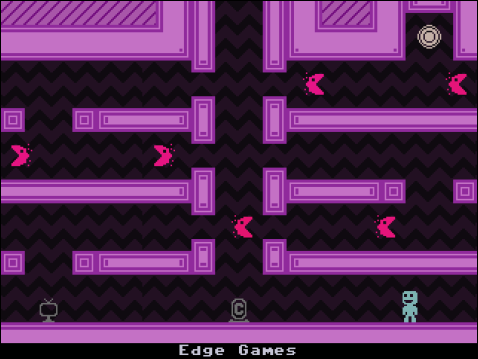
The game would be a rather joyless experience if it weren't for the endless continues, ubiquitous checkpoints, and non-existent reload time that surround the game's death traps. The game moves at such a quick pace that it's hard to gather the will to exit the game. Like a great punk rock show, you become enraptured by the noise and frenzy of the thing so much that you feel strangely empowered rather than humiliated by it all. Take the game's self-titled "The Final Challenge" room that I spent, according to the game's end screen, 100 lives on. t stopped having fun after 25 deaths, I stopped having hope after 50 deaths, and I stopped caring after 75. Somewhere between 75-100, I entered the zone, a place where the mind stops being aware of what the hands are doing and your awareness focuses on the next fives steps while your fingers automatically take care of the first. I'd hardly call the ending rewarding, but being forced into this bizarre adrenaline-fueled state reminded me of the allure video games had before scripted events and voice actors factored into the experience. The game allows you to achieve the feeling of having mastered a sport, something that takes years of training, within an hour or so. You'll be amazed at the things you're able to pull of with ease by the game's end. Don't worry too much, though, there are only three rooms that challenged me to this extent--a testament to the game's excellent pacing and variety.
After the elementary but nonetheless challenging first level, the game opens up to reveal a large continuous world representative of the Metroid series. You don't unlock new abilities but slowly coloring in the black spots of your map and finding new teleports lends the game a much more relaxed, controlled pace that wonderfully compliments the often linear, tense levels that fill the majority of the map. There are collectibles peppered throughout that act as an incentive to explore and help you feel you haven't wasted your time when you come across a dead end. These twenty collectibles allow the player to unlock new modes within the game's main menu--oooh, no-death mode. Gee, thanks!
The levels themselves are what makes VVVVVV so memorable. Each one has a unique identity delivered through their own individual mechanics, visuals, and soundtrack (more on that later). It would spoil the experience to reveal too much about what makes each level unique, but I haven't played a game since Braid that has left me feeling so out of control of my own perception. As much as the game is about well-timed jumps and feathering the left/right keys, you have to always be aware of your surroundings and think outside the box. This means logic-defying obstacles are to be solved, not as a platformer, but a puzzle. At times, the game seems to exist to make the player feel like a moron. That's not to say that the straight forward platforming sections aren't excellent on their own. My favorite moment of the game has to be the "Gravitron", a thin corridor of a room that locks the player within two bumpers that endlessly bounce the player up and down as he or she must dodge enemies for 60 seconds, thankfully giving the player a checkpoint every 5. It might sound simple in concept but in execution it offers one of the most visceral challenges I've had since Modern Warfare 2's snow ski scene; Keep in mind we are talking about a minimal platformer here.
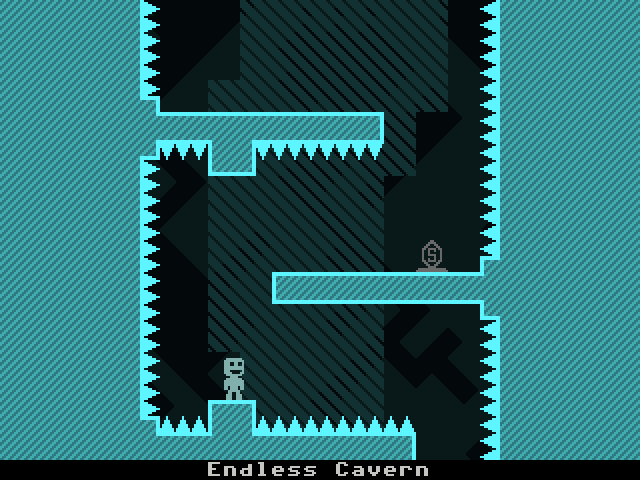
It's awfully difficult to conjure up an identity in the crowded and limited space of indie games. Thanks to the game's whimsical character design and Souleye's soundtrack, the game manages to find its own atmosphere and tone. The game begins with typical, cheery chiptune music, but the ambiance that fills the main hub and the individual themes given to every level lend each location a mood of its own. My favorite has to be the New Order-inspired underworld theme with its glo-fi synths and quaking bassline. Just as Braid's signposts subtly gave each location its own tone, each room of VVVVVV has a title (all named by fellow indie developer, Bennett Foddy) that delivers a hint, sets a tone, or makes a clever reference that veteran gamers will appreciate.
VVVVVV is Distractionware's (Terry Cavanagh) most ambitious and first commercial release. You might have seen Cavanagh's name thrown around along with other notable indie developers ever since he quit his day job at a bank and started renovating the games he grew up around with games like Pathways, Don't Look Back, and--a personal favorite--Judith. While those games shared similar visual aesthetics to VVVVVV, they focused more on storytelling than gameplay which only makes his latest creation more of a surprise. In an interview with IndieGames.com, Cavanagh cites prolific indie game developer Cactus' influence on the game as much as old favorites like the Dizzy series. VVVVVV is far less crass and crazy than the average Cactus title, but there is something refreshing about the game despite being so retro-centric. Cavanagh has chewed and spit out his influences like a rabid dog with a hunger for something more than reiteration of retro charm. The game might often make you feel trivialized in the wake of its many challenges, but, like a great Ramones song, it sinks its hooks into you and you can't help but sit in awe of all the bloody fun you just had. It's a 2D platformer for the jilted generation. ????
VVVVVV is now available on Distractionware's site for $15. There is also a demo available.