Home
Home

One of the most memorable locations in this series is Demon's Souls' Valley of Defilement. In this festering, poisonous swamp that prevents your character from moving agilely, you'll have to fight giant depraved ones, a menacing foe with unmatched strength. The pitch blackness and utter cruelness of these stages underscores an overbearing dread that few other titles have achieved.
Curtis' observation that these games show rather than tell is one of the many reasons I enjoy them so much.
This article may contain spoilers for Dark Souls.
You may have heard that Demon’s Souls and Dark Souls want to kill you, but did you know that they also have stories to tell you if you’re willing to listen?
All right...by "listen to," I meant "work for." Put away that bowl of popcorn.
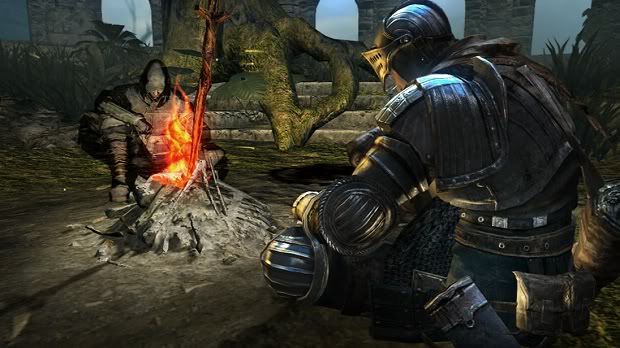
A thousand words.
The popularity and success of these games has been driven in large part by a reputation for punishing difficulty -- a reputation that was the crux of the marketing campaign for Dark Souls. A quick glance at the back of the game's box will helpfully suggest that you "prepare to die."
Although the games gleefully wave this badge of honor in front of the faces of masochists the world over, difficulty in the Souls series serves a less direct purpose than it does in the likes of Contra, Battletoads, and voracious, quarter-munching arcade machines of years past. Hardship is absolutely crucial to the identity of the worlds that developer From Software has built.
Demon’s Souls and Dark Souls portray universes that are separate but fundamentally identical; each features a broken, decaying land that has succumbed to a great force of evil, and those few who have managed to retain some semblance of their human form have forgotten what it means to be actually be one. These are cruel worlds where the mad greatly outnumber the sane.
Almost every one of the sparsely scattered people you speak with is a half-turn between neurotic and nutcase. Once-proud soldiers speak with tired, thin voices -- their mirthless chuckles barely disguising sobs -- while unsavoury merchants cackle and chatter gleefully about the new state of affairs bumping profit margins through the roof.
Some of the most memorable moments in these games involve crossing paths with some lonely, careworn soul who is trying to eke out a living in this world -- or indeed just simply trying to exist -- and hearing his or her side of the story. As you learn of the various circumstances that brought demons into the world, an unexpected tidbit of history may make you feel a twinge of sympathy for that archdemon you just destroyed.
Liars and layabouts aren’t your only source for information. Nearly every rare sword you plunder and every set of dusty robes you unearth offers its own contribution to the mythology.
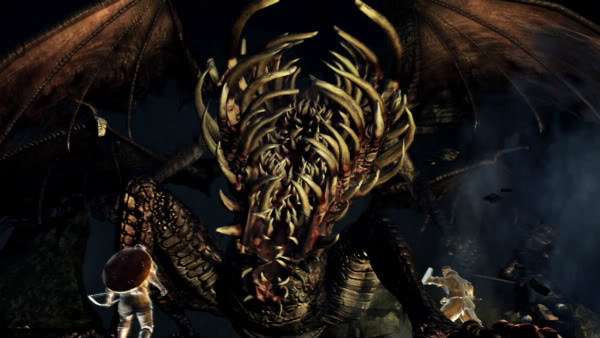
In Dark Souls, for example, you’ll battle a mutated dragon in a filthy sewer maze known as The Depths. While you savour your moment of victory, open your inventory and examine the key it has dropped: You’ll be informed that the town beyond the gate it unlocks has even the inhabitants of this disgusting little hellhole cowering in fear. It makes the prospect of opening the next gate just that little bit more exciting, doesn’t it?
But the environments and locations themselves might be even more adept storytellers than the characters and items that populate them.
With the exception of boss fights and a precious few other moments, you won’t get a beautiful orchestral score to highlight your exploits as you valiantly purge the land of evil: It’s just you, the soft crackling of nearby sconces, and the unearthly moans of that thing over there.
One hell of an exercise in wordless world-building can be found in the Tower of Latria in Demon’s Souls. The tower is a squalid, poorly lit prison featuring two distinct sounds: the tortured shrieks and yells (and creepy singing) of its inmates and the chilling chime of the bells carried by a host of monstrous prison guards.
You will feel like you’ve taken a turn into the yawning abyss of some Lovecraftian short. You will learn to fear and respect this place, and you won’t need Shakespearean lines read in Patrick Stewart’s soothing baritone to facilitate the experience: You’re seeing, hearing, and -- most importantly -- experiencing the misery firsthand.
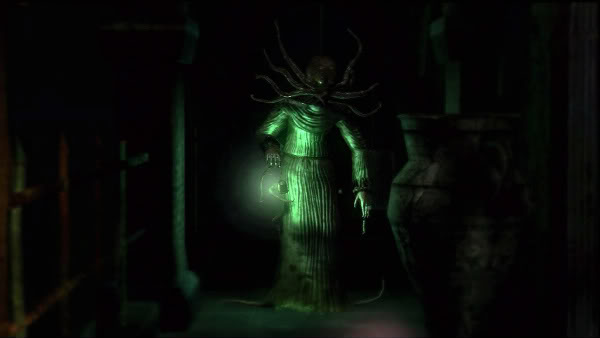
The most prominent nightmare for Latrian prisoners doesn't involve soap.
A similar sense of trepidation accompanies the slog through the knee-high filth of the aforementioned sewer maze in Dark Souls. You'll hack your way through squealing rats covered in crusty scabs and encounter frogs whose freakishly oversized eyes bulge and throb as they hop toward you spewing cursed vapours. You'll wish you were back in that doomed city above -- mobbed though it was with undead soldiers and thieves.
But just when you’ve finally begun to accept that you’re going to continue descending forever into the caverns below the earth and that you’ll never see the light of day again, you discover a hidden passageway.
Following it, you find yourself on a white sandy beach that stretches for miles, encircled by a seemingly endless lake dotted with spires that reach to the heavens. Suddenly, you begin to feel that everything you thought you knew about the scope and nature of this gloomy little world has been completely wrong. Perhaps there’s something here that’s worth saving after all.
The really amazing thing about it all is that scores of gamers will play -- and have played -- all the way through the Souls games multiple times without ever so much as glancing at the descriptions of the items they just found, enjoying themselves immensely all the while.
But every time I cue up my inventory and hit the square button on that rare item I found, I receive a little reminder of why I continue to play video games long after feeding my piggy bank to arcade machines lost its appeal.