

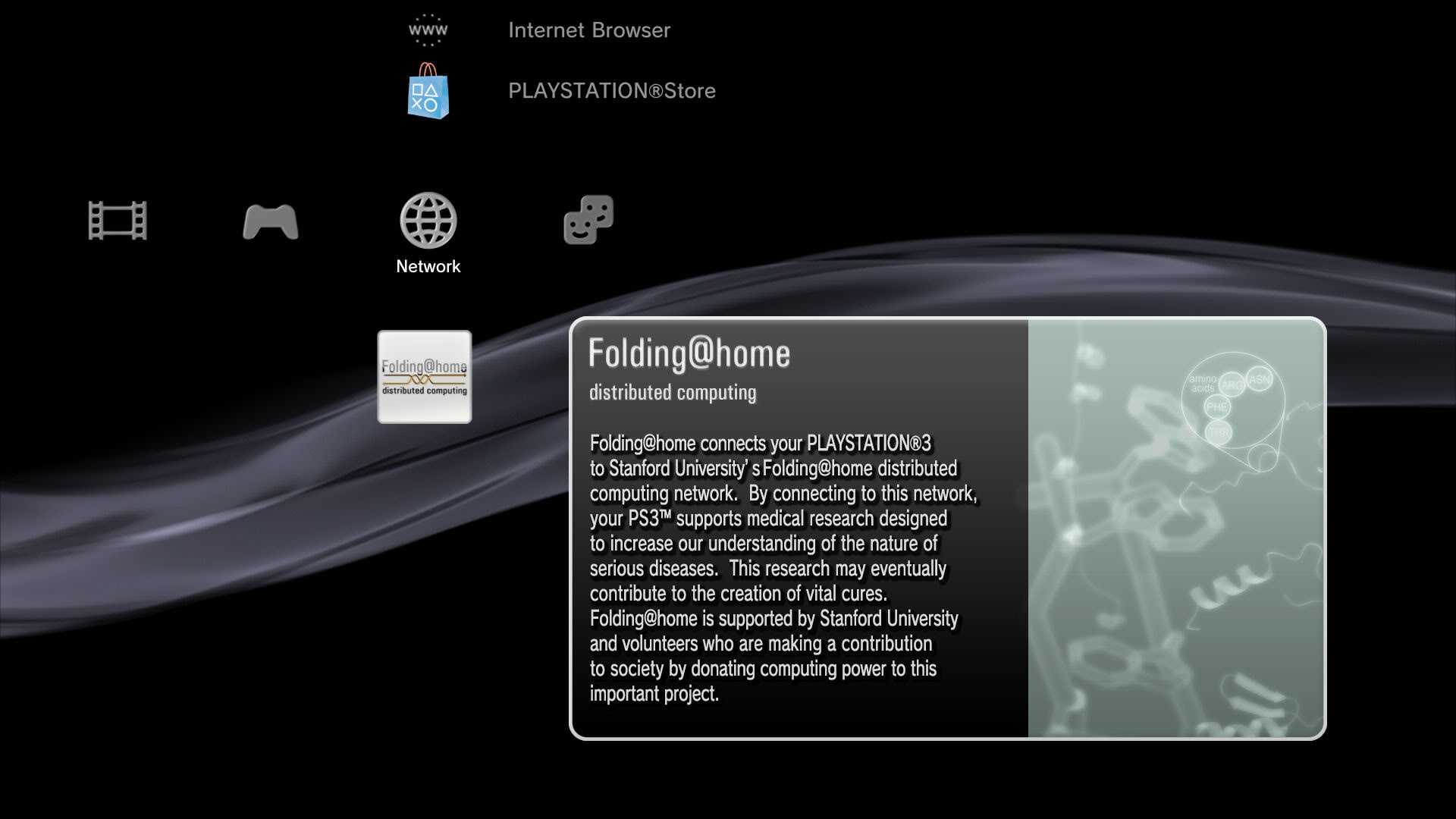
Evan relates a personal tale of deception and anger as a vigorous contest between him and his friends reveals something sinister about human nature. Do we need extrinsic motivation to act selflessly? Can we do good for goodness's sake? The lessons revealed in this Folding@home competition only reinforce my own personal and academic observations of our seemingly innate narcissism.
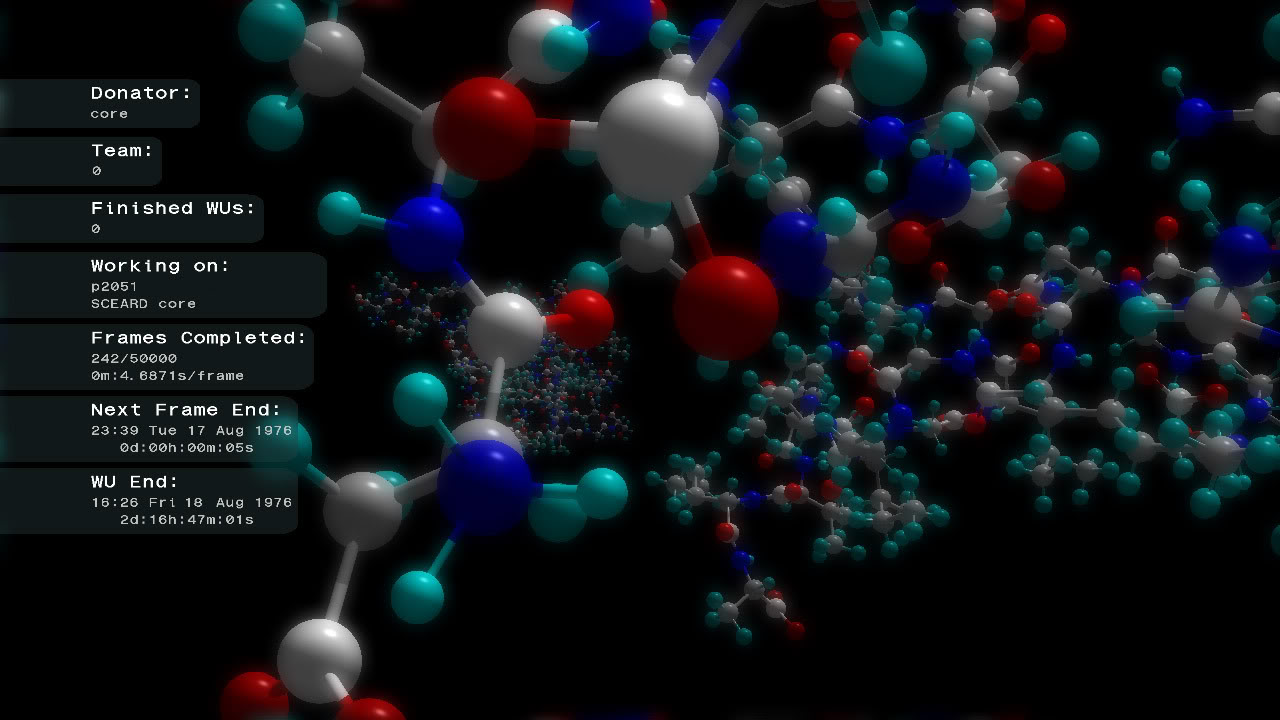
We descended into his dank, musty, spider-infested basement, a bunker where we routinely slept, drank, served in the virtual armed services together, and struggled to chase out the slimmest beam of invading sunlight with our Rickets-riddled bodies. As soon as we passed the sink filled with coke cans and rounded the corner, the T.V. was already ablaze with dancing proteins. I'm sure part of the disfigured burn-in brand that exists on the screen today belongs to an atomic shadow of those folding molecules.
That pocket of the room was distinctly warmer; the PS3 and T.V. had now become spaceheaters, but no heat distortion could obscure the number of work units we saw on the hardworking, light-blanched screen. We spied some dead pixels now visible like tiny marytyrs who dedicated their little lives to the cancer war. Reid's number of work units far surpassed ours.
Ben and I forged a temporary alliance to tackle this greater foe. In the face of defeat and swelling protein envy, we even contemplated enacting a scorched-earth policy to attain victory: to erase Reid's hard drive and possibly the cure for cancer buried deep within it. We settled for unplugging and powering down Reid's PS3 surreptitiously.
After some time, he would invariably notice, and -- in his passive aggressive way -- he would let out a great sigh and say, "Don't touch my PS3." Then he would boot it back up and resume his interrupted work unit.
Folding became our favorite game, but it wasn't a game at all...maybe it was some sort of a metagame. Halo, Battlefield, Call of Duty, Mary-Kate and Ashley: Magical Mystery Mall, and so on: We ignored all of these games that we played competitively with each other. We replaced them with Folding, the game that didn't require you to do much of anything besides dedicate time and energy in the most literal sense.
Things escalated to the point where it would require much deliberation and subterfuge to coordinate at whose house we would spend the night, since none of us wanted to fall prey to sneak attacks on our PS3s. Over the course of several nights, someone unplugged and hid my system's power cord; Ben's entire console disappeared for some time, which he later found in a linen closet; and Reid had become so wary and vigilant that his PS3 barely left his gaze while we were in its presence. After too many setbacks, double-crosses, and easter-egg hunts for console parts, we abandoned the blood feud.
Once the blinding haze of debilitating anger and dismay had subsided, it wasn't very difficult to pinpoint the origins of these absurd emotions. The series of numbers that constituted my completed work units wasn't unlike other numbers that wrapped me in a similar fervor in the past. Frags, headshots, flags captured, weasel pelts collected, and fake currency amassed are examples of just a few dominant game mechanics -- namely, defining proficiency and aptitude in terms of numerical value -- that are tried-and-true methods of getting people invested in a narrow task. Developers quantify players's dedication, skill, and involvement with their games.
You can't even play a leisurely song in Rock Band without receiving a post-song analysis of completion percentages and subtly condemning adjectives (I'm looking at you, "Spirited Survivor") that declare who was the weakest rhythmic key-pusher and who was the strongest. I also don't think that having a tense band meeting after someone misses an ending bonus is particularly enjoyable or team-building.
Competition has always encompassed games: contests with yourself, against the rigid confines of the game, or in opposition to someone else. Only fairly recently have some titles proved otherwise or at least made competition optional or subtle. But largely, it seems that the vengeful flames of kill counts and post-mortem teabaggings have tempered us.
If a game presents a clear and immediately visible metric of how good one is at something or how much of it they do (no matter how mundane the task) that also involves bragging rights, then we'll quickly convert controllers into triggers -- people will no doubt be gettin' the "C.R.E.A.M." (dolla, dolla bill, ya'll). We can even pervert a noble, philanthropic venture such as Folding into a pride-extinguishing weapon -- all in the timeless tradition of competition. Although, I can't argue that this isn't an effective tool to temporarily possess someone into action. Perhaps the Folding team should consider adding leaderboards, robust friend features, and unlockable trophies (e.g., Folding Under Pressure: Folded for 72 hours straight!).
Whether it was by design or accident, the work unit metric in Folding gave rise to selfish extrinsic motivations for undertaking what was to be a selfless act. Maybe that's the secret recipe behind most successful charities. Some people genuinely want to make a difference, but the majority of others take an egocentric stake in it -- like some wealthy philanthropists who dedicate wings to hospitals provided that their names are in clear view on a shining plaque and a statue of their likeness, a bronze avatar that gives off a carefully detailed smile of generosity, is visible nearby.
A lesser evil for the greater good, I suppose.
If you're interested in philanthropic apps/games, check out Folding@home and Free Rice.