The industry's war against consumer rights

Default_picture
Monday, September 19, 2011

The industry feels contempt for the average consumer. And why not?

We like buying used. We prefer to own what we purchase. Worst of all, we don't feel obligated to support the industry. And this drives them batty.

The industry has declared war on consumer rights. Their missiles -- always-on DRM, online passes, digital distribution -- run the gamut. But the intent is the same: to kill the secondary market, destroy the notion of ownership, and control all means of distribution.
PSN Pass

Publishers are attacking fundamental consumer rights. And we’re apathetic. We're lazy. Digital distribution is easier than a trip to GameStop, so we wave the white flag. Like hypocritical Star Wars fans, we bitch and moan about anti-consumer activities but enrich the publishers' coffers anyway. This has to stop.


When gamers say one thing ("Online passes suck!") but do another ("Here’s your $60, sir"), the message is crystal clear: You can shit all over us, and we’ll pay you for the privilege.

Quantic Dream cofounder Guillaume de Fondaumiere

Publishers despise the secondary market. Used games represent "one of the number one problems [sic] right now in the industry," said Quantic Dream cofounder, Guillaume de Fondaumiere. "On my small level, it's a million people playing my game without giving me one cent."

They don’t get it. They’re not entitled to one cent beyond the original sale. But publishers can’t change the law (as much as they'd like to). So they resort to extreme measures -- online passes, digital distribution, angry rants -- to circumvent the first-sale doctrine.

Online passes punish those who buy used. Digital distribution is stealthier: If brick-and-mortar shops disappear along with physical media, then the secondary market cannot exist (at that point, "used-game sales" really are equivalent to piracy). Gamers lose out in the end.

From a consumer standpoint, I see no gain. Convenience is a poor swap for the forfeiture of property rights. And I don't buy the reduced overhead crap.

According to THQ CEO Brian Farrell, all-digital game distribution "will result in a lower cost for the hardware manufacturer, which will result in a lower cost to consumers and therefore a lower entry point."

Based on what evidence, Mr. Farrell? Steam, OnLive, X-Box Live, and PSN charge full retail prices. Where's the savings? In Steam's case, prices can exceed retail.
Digital distribution assails the most fundamental of consumer rights: What's mine is mine. With OnLive, it’s more like what's mine is mine…temporarily. That’s right: You can purchase a physical copy of Deus Ex: Human Revolution for $49.99, or pay the same amount to OnLive for an extended rental.

E-readers tread a similar path. Nowadays, e-books cost as much, or more, than their physical brethren. We pay for the "convenience" of downloading books instantly. Publishers are the only real benefactors; the reduced overhead never trickles down to the consumer. Why should games be any different?

Here's the skinny: My prerogative as a consumer is to attain the best value for my money. All factors -- price, perceived value, and the qualitative difference between new and pre-owned -- must be taken into consideration. I feel no qualms about buying used games, nor do I feel obligated to support the industry. As far as I’m concerned, altruism plays no part in consumer behavior. The relationship between publisher and gamer begins and ends when money changes hands.

Publishers are overstepping their bounds. They treat their customers like thieves, and expect a warm and fuzzy rapport. The industry's soupe du jour, always-on DRM requirements, is but the latest overzealous anti-piracy measure. What does it accomplish? As night follows day, the hacking community will crack anything they deem obtrusive or costly. The rest of us suffer.

The free markets operate under the sacrosanct principle of choice and competition. Publishers are trying to close that loop. Piracy is a legitimate problem, so gamers must foot the bill and deal with the repercussions. And we're letting it happen.

Every time we reward companies for their oppressive DRM schemes, we embolden them. We sanction their anti-consumer activities.

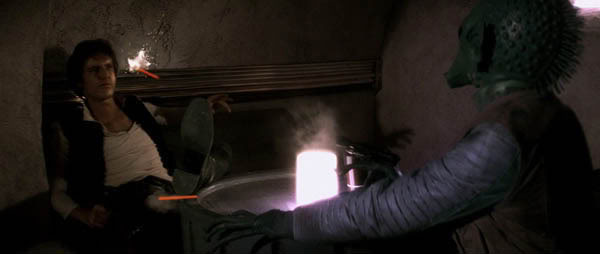
George Lucas has been mucking with Star Wars since time immemorial. But the same angry nerds who bitch about Greedo shooting first buy the movies despite themselves. As gamers, we cannot allow ourselves to fall into this same pattern of self-immolation.
Mario
Greedo has the distinction of being both ugly and blind as a bat.


Publishers must be held accountable. We mustn't sacrifice property rights at the altar of convenience. If DRM irks you, don’t buy the game in question. Exercise a smidgen of restraint. Otherwise, our opinions are meaningless: The industry enjoys total impunity while it runs roughshod over consumer rights.

 
Problem? Report this post
BITMOB'S SPONSOR
Adsense-placeholder
Comments (24)
Bruce
September 19, 2011

This article sums up how I feel about... A lot.

Excellent.

P.S. I wrote this article on the subject of cloud gaming:

http://blackmannrobin.com/2011/09/02/what-happens-when-the-rain-falls/

Default_picture
September 19, 2011

Jourdan, you ought to mirror that article on Bitmob :-)

5211_100857553261324_100000112393199_12455_5449490_n
September 19, 2011
Very well-written! I sincerely wish everyone working in the publishing field skims this article. I think many, many consumers, myself included, feel this way. The fifth chunk, everyone who buys games should take note. When you support these draconian (and ineffective) DRM systems, you are giving the publishers the green light to take a dump on you at their leisure. Check out Diablo 3, a series revered for both its online and offline gameplay has now become an online-only game, and they have nothing but excuses. "it was meant to be played online" (not if the first two titles have anything to say in the matter) and "this is an anti-cheat measure" (that will not stop the determined cheaters) have both been cited numerous times. Vote with your wallets. This will be the LAST time I will let publishers take away my ability to play their game. Even if I could somehow find some tertiary solution to play Diablo 3, I would still not buy it, mostly because I am sick of being locked out of my purchases. My steam library and Starcraft 2 are rendered useless with my newfound lack of home-based Internet. Never again.
Default_picture
September 19, 2011

I don't always agree with Jason, but I fully agree with his argument that this is an awful war for the consumer's dollar. I partly blame it on Gamestop's used game selling techniques and OnLive and a whole slew of other money manipulation methods.

In times like this, I just sit on my money and wait for the consumers to cry wolf. Someone's eventually going to call this foul play. I don't even buy that many games from Activision and EA, because I know the trick they're trying to pull on me. That, and I'm also sick and tired of their stereotypically violent blockbuster game trick.

If anything, I'm hoping that everyone will switch to downloading simpler games like Radiant Silvergun, rather than spending their money on this scheme. The video game industry isn't an oligopoly by any means, but their battle for dominance is starting to reach a breaking point.

100media_imag0065
September 19, 2011

Oh man, there is no way in hell that I could possibly agree with you more. You took my brain, extracted my feelings on this matter, and wrote them on Btimob...Stop messing with my brain!

Used sales and online passes are the things that drive me nuts. The industry likes to use excuses like "Servers cost money and people buying the game new aren't paying us to use the servers". What they don't tell you is this...In order to buy that game used, someone had to have bought it new. Whoever bought that game new paid for that server space. When that person then trades in their game and you proceed buy it used, you are using the server space that person already paid for.

What the indsutry is trying to do is force you to pay for something that has already been paid for. Not to mention, used sales are GOOD for the industry, not bad. When I trade in my old games, I use that credit to buy new games. When someone buys a used game and greatly enjoys it, they will likely buy the sequel, or other games from that developer as well. I know that I personally have bought games used, and then bought other games from the developer New simply because I was so impressed.

If they take away used games, they will take away New sales as well. A crap ton of people are not going to be able to afford the $60 price tag for all the games they want to play when they can no longer trade older games in order to afford new ones. Video game companies are so focused on short term gain that they are incapable of seeing how the used market helps them. The online pass scam specifically is going to do nothing but hurt them and us.

Jim from Destructoid said it best. He explains that eventually gamers are going to start noticing that all the used games they are buying for $50 is forcing them to pay an extra $10 or more to unlock the multiplayer. They will eventually stop buying games used. This will force places like EB games to drop prices quicker in order to persuade those people back. So now the video game companies have succeeded in LOWERING the prices for used games and offering more incentive for people like me to buy used and save even more money.

Default_picture
September 19, 2011

The secondary market cannot exist without new game sales. The industry tends to forget that last, salient point.

Wile-e-coyote-5000806
September 20, 2011

There is a flaw in your argument, though.  Server space isn't a one-time-cost item, it is a sustained expense that the publisher has to pay.  When someone buys a game new, some of that price goes toward sustaining those servers for an amount of time that an everage player is expected use the service.  As players lose interest in a game, they stop playing it and stop using that server space.  A secondary user, though, effectively doubles that expense for the publisher.  It is true that the secondary users do not increase the cost to the publisher, but they slow the rate that that sustained expense to the publisher decreases.  So, indirectly, the secondary market does cost them money beyond "lost sales".

To be clear, I don't have a problem with the secondary market.  As others have stated, other industries deal with it.  Video games are moving toward being more of a service than a product, though.  I think Publishers getting money off of the secondary market by using the "online pass" system is preferable to charging subscriptions.

Default_picture
September 20, 2011

What if, hypothetically, the original owner of a game with an online component played that game indefinitely? The original purchase has paid for that server space, and if that game's owner decides to sell it, it's simply a transfer of ownership. The expense is not being doubled because the original user is no longer using the service. This, by the way, is a great argument against piracy.

Some would say that the average person is expected to play X game for Y length of time. One could also argue that the average gamer doesn't play a title more than once (let alone finish it). So what's the problem with granting that player temporary ownership of said game if he'll only play it once anyway?

These concessions lead to the steady erosion of our property rights through death by a thousand cuts.

Wile-e-coyote-5000806
September 20, 2011

Very valid points Jason, but publishers deal with millions of users, so they have to look at the statistical stuff, not the outliers and special cases.  (Casinos don't base their odds off of the people with the worst luck, publishers can't base their expenses off of best case scenarios,either.)  The same argument can be turned around by taking a case where that second user plays for hundreds upon hundreds of hours.

I am only referring to online compononets of games, not offline stuff.  Again, I have no problem with the secondary market and agree with you about that, but online services do incur a cost to the publisher that the secondary market increases without compensating them for.  Sega should not have to right to the money if I were to sell my copy of Valkyria Chronicles (which I never ever will), but If I were to sell my copy of Medal of Honor, that secondary user playing online would be adding expense to EA, and I think EA has a right to get some of that money back.

Default_picture
September 20, 2011

Services are more easily regulated than products. Can you get a pre-owned haircut? You can get a shitty haircut, but there's no used vs. new dichotomy.

When publishers succeed in eliminating the secondary market by making physical media obsolete, choice and competition will vanish. At that point, we can either pay the publishers' prices or find a new hobby.

The secondary market gives consumers power. With digital distribution, the publishers/developers have all the power and control everything.

Wile-e-coyote-5000806
September 20, 2011

I'm not disagreeing with you.  In fact I largely agree with you.  All I am saying is that games that have an online component do cost the publisher money which secondary users do not compensate them for.  I am in favor of the online pass concept for those games and those games only.

Default_picture
September 19, 2011

Fantastic article. You're probably preaching to the choir since I believe that the majority of idiots who support DRM and the like are the industry uneducated that don't come onto websites like Bitmob.

I simply laugh at idiot publishers who complain about used game sales. I can make a list of markets that must be successful despite used sales: movies, CDs, cars, homes, furniture, books, computers, cell phones, ipods, TVs, on and on and on. Nearly all industries deal with it. Companies like ebay have built their businesses around the used market. They just need to deal with it. I sure as hell don't support their idiotic crying.

Mindjack
September 19, 2011

If I support the gaming industry, will it support me?

Default_picture
September 20, 2011

In Soviet Russia, games buy you!

Hypevosa_symbolsbig
September 20, 2011

I actually somewhat agree with the publishers on this one.  It isn't right that someone basically provides you with, depending on the game, dozens of hours of entertainment, and yet they don't see anything from it.  The problem I have is that, only sometimes is the digital option at all cheaper than the physical option.  If I buy a digital copy of a game and can never resell it, I feel I deserve more than a 5 or 10 dollar discount since I'm completely forfeiting physical ownership and the right to basically sell off my license to play the game.

Anyone who says that a developer doesn't deserve to see a single cent from the people playing their games is simply being a selfish twat.  Developers are people too, and giving them money doesn't just allow them to live, but to create more.  If you got some kind of enjoyment out of playing a used game, you should want to support the people who made that experience possible - not flip them the bird and say it's your right as a consumer.

I'm lucky enough to be able to afford to buy games new so that I can support the developers and publishers whose games I enjoy so much, but I understand why people buy used games when they can't afford to buy new.  As someone hoping to become a game developer eventually, I would rather they get that experience and I see nothing than they not have it at all.  However, that doesn't mean it's the perfect situation.  If developers/publishers even saw a 5% return when a used version of their game is sold at gamestop, it would be better than the current 0%.

I've always wondered how well having the ability to directly pay a developer would work.  So if I buy their game used and love it, saving 20 bucks or what, I could just simply send them what amounts to a tip for providing me with a good few hours of distraction.  I don't really know if this is feasible though since you'd have to set up a system of payment, but I think it might work to at least some degree.

Default_picture
September 20, 2011

Publishers would be the first to tell you that they're not running a charity. That sentiment goes both ways. Consumers are no less conscious of the bottom line than the industry is.

What you're describing, Evan, is more akin to a charity or political campaign. If you support Obama in his re-election campaign, you're welcome to donate money and receive nothing in return but the satisfaction that you've "supported" your chosen horse.

Publishers are absolutely entitled to a cut of the profits...from the original sale. But they have no right, legally or morally, to dictate what the consumer does with the game once it's purchased. Lest we forget, the secondary market cannot exist without new game sales.

Suggesting that individuals or retail establishments should have to pay some sort of "used game tax" is a very dangerous slippery slope. When companies can continue charging individuals for products they've already purchased (excepting items involving services, like MMORPGs), then individual rights will have vanished.

I didn't say that developers weren't entitled to a single cent from the people playing their games. What I said was the following:

"They’re not entitled to one cent beyond the original sale."

In other words, developers aren't entitled to earn anything from the secondary market. Once the original sale is complete, the developer/publisher's involvement in the transaction is finished.

Lolface
September 20, 2011

In all of these "we're at war, pick a side!" topics, I usually find myself falling somewhere in the middle. So, here is the middle of the road, moderate response.

I agree that some publishers take DRM a little too far. Requiring an online connection for an offline game, like Blizzards Diablo III, is a perfect example. Sure, I have a desktop, and I don't plan on not being connected to the internet, but what happens when there is, I don't know, a hurricane, and suddenly I find myself without a cable connection, and therefore no internet? Why shouldn't I be able to play an offline game offline? (I'm just glad that I'm not a fan of the click it-till-it-dies gameplay of the Diablo series.)

As far as used games go, I think that the industry is looking at it the wrong way. Quantic Dream's de Fondaumiere makes the assumption that everyone who played Heavy Rain and didn't buy it new must have bought it used. He clearly doesn't take into account rentals, or people who borrowed it. All he sees is 1 million people who didn't buy his game. But what makes him think that everyone would have bought the game new anyway?

Regardless, the biggest takeaway from de Fondaumiere's comments should be the fact they publishers are tracking trophy/achievement data, and this is where all of their used-game-panic-attacks are coming from. I don't ever remember publishers lamenting the sales of used games until this generation.

On the other hand, I don't see anything wrong with digital distribution. Yes, OnLive charges $50 for an unlimited license (or really long extended rental, if you will) to play new games. This isn't some scheme to undermine yours or anyone else's consumer rights, its just their infrastructure. Because they are a cloud gaming service, all they have to sell is the license, and that license is yours until the company goes out of business, which they really don't want to do. So,is buying a license preferable to buying an actual game? Depends on how you look at it. Technically, whenever we buy games, all we're buying is the license to use it (it says so in the fine print of those paper book things that no one looks at), and it's been that way since the NES days (which is why emulation is kind of illegal). Basically, if you don't like OnLive, you're not obligated to give them any money, and calling them out as anti-consumerist is like yelling "fire!" in the middle of a pool. OnLive gives consumers a unique choice in a crowded market, and there is nothing wrong with that.

As for online passes, they don't bother me. Not one bit. I see it as an entitlement problem. You are "entitled" to the game that you paid for. If you bought it second hand, then you aren't entitled to all of the features that the person who bought it before you got. Don't like it? Don't buy used. Wait until the game goes on sale and buy it for cheap (like Portal 2 and Deus Ex: HR. Both went on sale for $35 2 weeks after they were released. I think that's actually cheaper than used).

There are also some statements in this article that I find questionable. First is a statement you made about Steam. "In Steam's case, prices can exceed retail." When has that ever happened? In my experience, Steam generally offers games at retail, with pre-orders getting a 10% discount (that's the trickle down you were looking for). Then, there are the pretty good sales that Steam runs every once in a while. So, with what game did they charge higher than MSRP?

Second, while discussing e-books, you said that, "e-books cost as much, or more, than their physical brethren." I use Amazon's Kindle service, and I can tell you that just about every Kindle book is cheaper than the physical copy. Sure, sometimes they are only a dollar (or less) cheaper, but its still cheaper than physical copies, and never more. I can't speak for Barnes & Noble's Nook service (and I'm too lazy to do a quick search), but I imagine that they would be about the same if they want to compete with Amazon.

Finally, digital distribution isn't the future, its the present. Without digital distribution, there couldn't have been games like Geometry Wars, or Bastion, or Plants vs Zombies, or Angry Birds. All of those games are only digitally distributed, but no one cares that there isn't a physical copy, and no one sees the release of these or any other XBLA/PSN/iOS/Android games as infringing on their consumer rights, so what makes the digital distribution of console and PC games so different? Is it because you used to be able to do whatever you wanted with your games? Well, things change (even 30 year old movies apparently). And when they do, like it or not, we have to adapt to them.

Default_picture
September 20, 2011

The difference between buying a license on OnLive and purchasing a physical product (which is also technically a license) is that the physical product won't suddenly disappear one day. You don't have the right to make your own copies and resell it. That right is reserved for the original copyright holder. But you do own that particular item. No one is going to break down your door one day and repossess it. If GameStop goes out of business, your physical copy of Madden 2012 won't go *Poof*.

Steam relies on a regional pricing model, so customers in some territories can end up paying more. I couldn't say how frequently this situation occurs, but it shouldn't be an issue.

Every Kindle book is *not* cheaper than its physical cousin. Let's take a look at three items (on Amazon, no less), based on my recent reading habits:

http://www.amazon.com/Feast-Crows-Song-Fire-Book/dp/0553582038/ref=sr_1_1?ie=UTF8&qid=1316525863&sr=8-1

http://www.amazon.com/Dance-Dragons-Song-Fire-Book/dp/0553801473/ref=sr_1_1?ie=UTF8&qid=1316525926&sr=8-1

http://www.amazon.com/Ultimate-History-Video-Games-Pokemon/dp/0761536434/ref=pd_sim_b3

With "A Feast for Crows," the Mass-Market paperback costs the same as the Kindle version. If we include the secondary market, the physical copy is anywhere from $3-6 cheaper.

With "A Dance with Dragons," the Kindle edition is cheaper than list price, but the secondary market is marginally cheaper. Once DwD is released in paperback, I'd imagine the pricing structure will be similar to its predecessor.

With "The Ultimate History of Video Games," the physical copy is cheaper right off the bat (direct from Amazon). And this doesn't even include the secondary market.

If we excise the secondary market, the price differences are more minute. But said market exists (as much as publishers despise it). Consumers should have that option.

And even if we did eliminate the secondary market, we're talking scant savings juxtaposed with an expensive e-reader. The "break even" point may be years away.

If we extend this metaphor to gaming, most online distribution services, be they OnLive, Steam, X-Box Live, or PSN, charge full retail prices. If I'm paying $50-60, I'd prefer to hold the product in my hands. I won't willingly surrender my property rights based on publishers' assurances that the reduced overhead will trickle down to us. Thus far, there's no evidence to support that ridiculous assertion.

Default_picture
September 20, 2011

In some ways, I think that the fight for physical copies will end up a losing battle. However, I really want them to exist. I think new services like Qwikster are finally identifying that many consumers still prefer physical copies over the online downloads.

Many of the big new games on Steam often sell at very high prices. I don't know whether the publishers are experimenting with pricing value, but it always kept me from downloading games such as Deus Ex: Human Revolution.

I don't think that digital distribution is completely bad. After all, we wouldn't have been able to play obscure games such as Radiant Silvergun if we didn't have digital distribution. However, I think that publishers/distributors are taking this war the wrong way. If anything, I think that somebody is going to realize that this is a losing battle to try to grab more cash.

Well, eventually they'll figure it out. Hopefully. Blech.

Default_picture
September 20, 2011

Well written article and I agree wit almost everything. Almost being the key word. Acouple of sticking points though:

Digital distribution is not the total bane you make it out to be. Valve has guaranteed that should the Steam service is shut down, they will issue a DRM release code allowing you to treat the games as the same as physical copies. They're even experimenting in the trade in market themselves which though restrictive at first, can be expanded later. Impulse and GoG.com even go one step further. The games you purchase from them are full blown cpies as if they were installed from a disk. GoG's installers don't even run through a client. Once you buy and download it, the copy is yours.

I won't say there's no bad DD models though. I have a particular distaste for OnLive (though for different reasons) and EA's Origin Model is pathetic (a purchase only allows you to download and install for two days and you have to pay extra to extend it a year? No thanks), but not all of them are particularly evil. Everything else in the article though? I agree with 100%.

Default_picture
September 20, 2011

One of the best articles I've read in a while and I completely agree with you. Piracy is a problem - legally and ethicly, used games are not.

Mindjack
September 20, 2011

Classic Jason. Welcome back, Lomberg. :)

Default_picture
September 20, 2011

Like! I need some angrier responses, but otherwise I'm good :-)

Default_picture
September 26, 2011

Great article! I agree 100% This is one reason why I love Nintendo so much. Ever since Microsoft released the Xbox, this industry has gone down hill. Pay for online pay, unfinished games with DLC, and pushing digital distribution. Ever since video games were introduced to the internet, it was bad news for us as consumers. Bring back the days of buying crtridges and reading gaming magazines. Screw this Xbox Live and PSN bullcrap!

You must log in to post a comment. Please register if you do not have an account yet.