Separator

Why More Games Should Go With Less Dialogue

230340423
Thursday, December 02, 2010

My favorite part of the first two hours of Epic Mickey was the part I didn't play.

It was the second half of the opening cut-scene, the part that comes after sorcerer Yen Sid's narration. I won't spoil the action for you if you haven't seen it. And anyway, the action is not what impressed me.

What I loved about the scene was the range of emotion and storytelling it conveyed without saying a word. Sure, Mickey made a couple squeaks here and there, but for the most part the direction, tone, and facial animations told you everything you needed to know.

It was so effective that I was actually disappointed when I had to start playing.
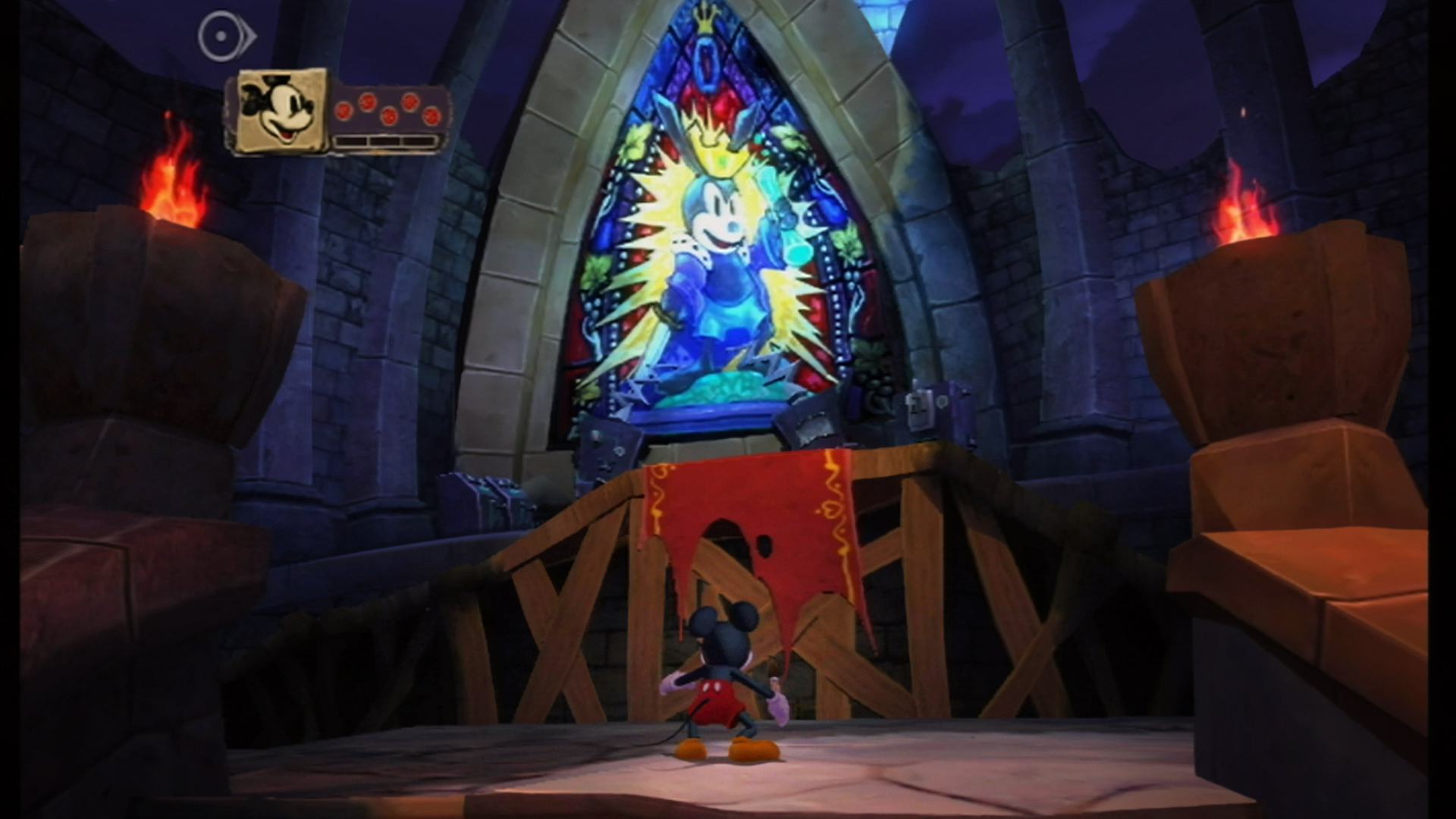
Epic Mickey

That's not to say I haven't enjoyed the gameplay so far. Splashing paint and thinner around is great fun, especially when you watch enemies become friendly or dissolve. But once Mickey and his Gremlin guides started spouting boxes of text, they definitely lost some of their charm. And it made me wonder how many other games could benefit from a vow of silence.


I mean, I know Epic Mickey is supposed to be kid-friendly and has to include some sort of instructions. But there's a difference between tutorial text and endless nattering about things the game has already made obvious. Narratively, it serves little purpose. And when you're deliberately trying to hearken back to a time before cartoons had dialogue, it seems like a misstep.

Don't get me wrong -- I'm definitely not calling for more silent protagonists. As Bitmob community member Joel Gifford wrote earlier this week, that's a narrative cop out. I don't want games where the player's character says nothing while all the NPCs chatter away mindlessly. I'd rather have everyone speak -- or no one at all.

Maybe it's the writing and voice acting in games that just hasn't progressed far enough. Realistic facial animations are also behind the curve (at least, in comparison to cartoon-like animation -- it's a lot easier to make a cartoon emote than a realistically-rendered face). But some titles, like the Uncharted series, show that those aspects can deliver at a high level. They might be the exception rather than the rule, but they prove that it is possible.

I think I'd rather just have more games show the confidence in their art and direction, though. In film, and especially in animated film, the most moving moments are often those where nothing is said. For example, the first few minutes of WALL-E are completely without dialogue (unless you count "Hello Dolly"). But that only made me feel more strongly for the little robot and his cockroach buddy. I sensed his personality, his loneliness, and his dogged optimism far better than any words could have told.

Games actually have a leg up on film in this regard, because they can (and should) use interactivity to convey what movies have to merely show. But it's too easy to treat the written or spoken word as a crutch to support emotions the gameplay should have communicated already.

Some developers have learned how to harness this power. Take indie titles like Limbo or Flower. Neither has any text at all, spoken or written. In fact, text would be a hindrance. It would interfere with the affecting and meaningful narrative each game tells. No words could fully indicate what it feels like to creep through Limbo's black forests or skim across the surreal beauty of Flower's fields. Nor should they try.

On the other hand, Shadow of the Colossus shows how to use sparse dialogue in concert with gameplay, rather than superseding it. Except for a brief, terse conversation to open the game, the protagonist remains silent throughout -- not because he can't speak, or for any other artificial reason, but because it serves no purpose to his character. The game communicates its story through music, sound effects, graphical detail, and the actions of the player. It could have no dialogue at all and be just as effective.

That's the unique power of this medium -- narrative through interaction. And I wish more games would pipe down long enough to take advantage of it.

 
Problem? Report this post
LAYTON SHUMWAY'S SPONSOR
Comments (9)
Assassin_shot_edited_small_cropped
December 02, 2010

I'm currently reading a book by a former storyboard artist at Disney, and have been astounded by how much narrative you can convey through character lines (eg. body shape, posture, facial expression) and an uncluttered background.

Throughout the book, he tells the One Thousand and One Nights story with typical storyboard frames. In his version, Scheherazade (the woman who tells the king a story each night) loses her voice and has to use drawings to get the story across.

I think we could learn a lot from studying the storytelling techniques of storyboard and animation (and comics, too), in trying to figure out how best to convey the character-based/driven elements of narrative in games.

Mikeshadesbitmob0611
December 02, 2010

Beaten to the punch AGAIN on an awesome article idea.

My favorite, and the one I was going to talk about in my own piece, is Super Metroid. One prologue screen setting the stage, then silent narrative. Tells a wonderful story without anything more, as opposed to Other M, which tries too hard.

230340423
December 02, 2010

@Michael: Haha, sorry man! You should still write it -- I'll read it for sure. Super Metroid is a fantastic example -- and Other M is just the opposite.

Dscn0568_-_copy
December 02, 2010

The thing with mentioning WALL-E is that eventually Pixar does have to resort to dialog, even if it's one- or two-word sentences by WALL-E and Eve.  We should probably advocate smarter use of dialog and knowing when not to use dialog. 

37893_1338936035999_1309080061_30825631_6290042_n
December 02, 2010

I have to disagree. The "endless natterings" you speak of do serve a purpose: they help put players on the right track not just when playing through the game, but also when coming back to it.

Think about it. You're playing a game and then have to stop for some reason. Maybe you don't get back to it for about a week or so. Then you get back to it. Can you remember what it is you're doing? Who're you supposed to be looking for? How do you get there?

Not all games can have a magic sword that tells you exactly where to go at any time like in Shadow of the Colossus. It's just not a natural system. Talking, however, is a very natural and understandable concept. Having an NPC refresh you on the situation is helpful.

I'm not saying all dialogue found in games is justified. I just think a lot more is justified than you're giving credit for.

230340423
December 02, 2010

@Chase: That's true, some sort of instruction is necessary. I guess it's not feasible for every game to go totally silent. I'm just worried that too many games take the easy way out and don't try to use their gameplay to assist the narrative.

Default_picture
December 03, 2010

I have to agree with the article. you'd be surprised at just how effective you can convey humanity and emotions if you 'handicap' yourself by not relying on dialogue. I suppose it could be similar to how someone who has lost the use of their sight uses the other senses to 'see' the world just as well, if not better than those with 20/20 vision.

Alexemmy
December 03, 2010

Wander isn't totally silent throughout SotC. You forgot about "AGGGRROOOOOOOOOOOOOOOO!!"

Interesting idea that I never really thought about, Layton. Some of my favorite games just drop you into a world and leave to to explore and figure out where you are and what to do. The lack of a talking owl or something to blab at you just helps reinforce that. Great article.

Robsavillo
December 03, 2010

My friends and I talk about this every now and then. Usually, we focus our criticisms on BioWare. This is probably heresy, but I'll say it anyway: BioWare uses way too much completely useless and utterly boring dialogue in their games.

I put down both Dragon Age and Mass Effect early on for that reason. I just didn't care about any of the characters (because exposition is all tell and no show), and I couldn't wait for them to just shut the hell up.

You must log in to post a comment. Please register if you do not have an account yet.