
Why Multiplayer Should Be About Competing, Not Winning

230340423
Monday, December 06, 2010

You remember that scene in the movie Groundhog Day when Bill Murray sits and watches Jeopardy and knows all the answers?

Yeah. That's pretty much me. Minus the whole trapped-in-a-time-warp thing.

See, I played Buzz! Quiz World for the first time this weekend. Doing so taught me three things:

  1. I'm really freaking good at trivia games.
  2. I actually had the most fun when I lost the final match (the only match I lost all evening).
  3. It doesn't matter if you're winning or losing -- Buzz! is a lot of fun.
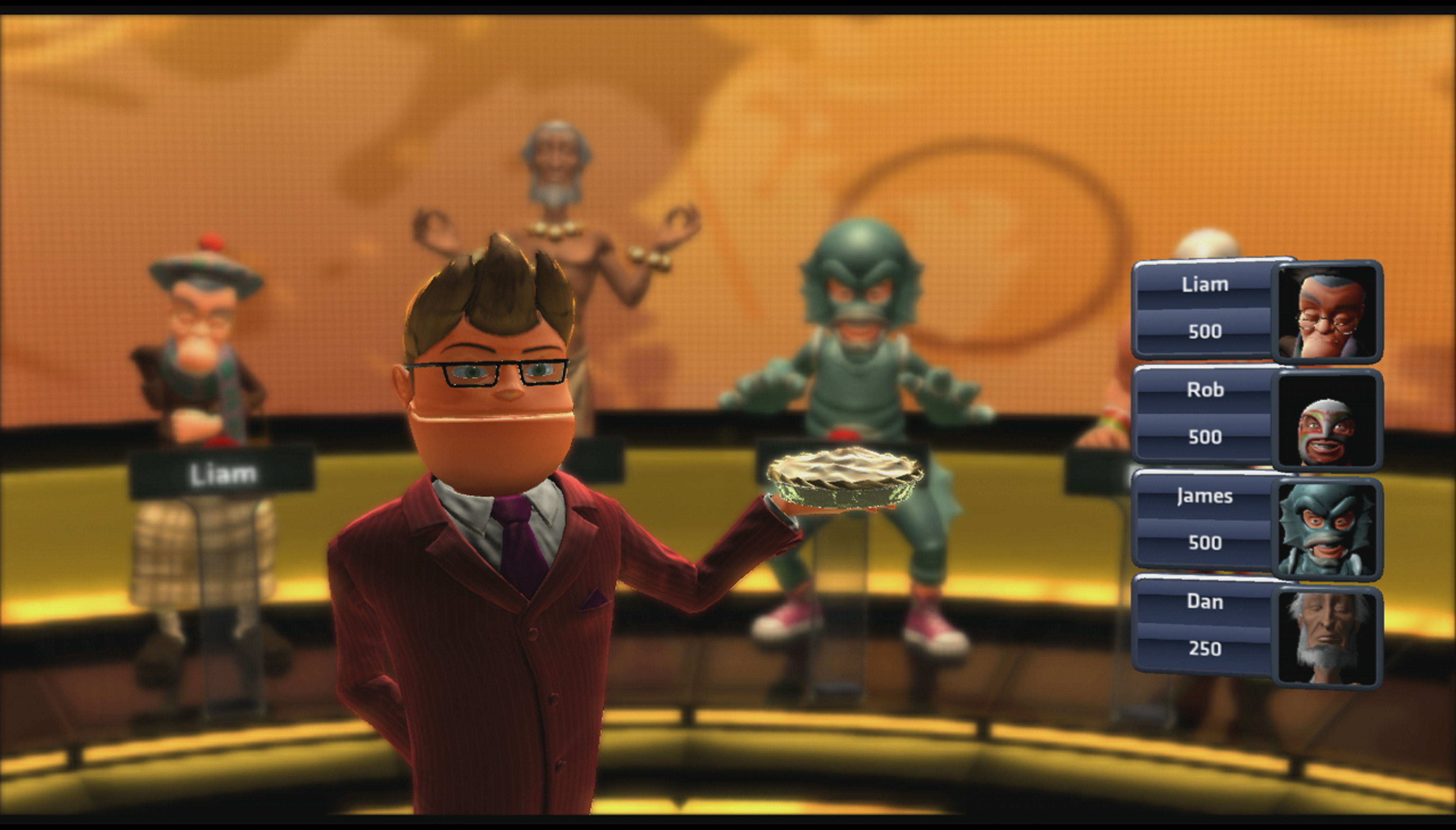
Buzz! Quiz World

At heart, multiplayer games are about competition. But you don't have to win every time to enjoy it. That's the key to a successful multiplayer experience -- making sure players can remain competitive no matter the skill level or outcome.


I mean, if we were just going by who got the most questions right, I would have won every time. Easily. (I promise I'm going to stop bragging at some point.) But that's not how Buzz! works -- the game provides a multitude of question types. Some questions are worth more if you buzz in faster. Some rounds allow you to steal points from other players. And sometimes you get a virtual pie in the face.

The motive for these different question types isn't just to provide variety. It's to level the playing field. Once my friends realized they weren't going to beat me to the answer (last time, I swear), they learned how to use the game modes to gang up on me. They began clicking in madly, stealing my points, and pie-ing my face at every opportunity.

In the end, thanks to their tactics and a string of good luck, I stood a beaten Buzzer. And I loved every second of it.

This same principle is the driving force behind the popularity of the Mario Kart series. While driving skill will help a great deal, the item boxes are the equalizers. If you're in last place, you'll get a lightning bolt or a star to help you recover. If you're in first, prepare for lots of banana peels.  

Due to the frequency of special items, Mario Kart races rarely feel totally out of hand -- the game encourages players to keep going, because their fortunes could change in an instant.

The end result is that the "best player" doesn't always win in Mario Kart, and the player that does win perhaps did not deserve it.

The Halo/Call of Duty multiplayer crowds would be up in arms over Mario Kart-esque reversals of fortune. True, some entries in the Call of Duty series grant certain bonuses after a string of deaths, but they pale in comparison to the rewards offered for success. This leads to a rich-get-richer dynamic that punishes weaker players. And in fact, the death streak rewards have been removed from Call of Duty: Black Ops, making it even more difficult for inferior players to keep pace.

But the Call of Duty reward template is nothing compared to its multiplayer ancestor, Counter-Strike, where the rich literally get richer every round. If you die in Counter-Strike, you start the next match with a basic weapon and less money to purchase a better one. On the other hand, if you play well, you get more cash, so you can buy better weapons and do even better.

It's a vicious cycle that discourages me from wanting to play because I can't compete -- let alone win. The online format pretty much guarantees that someone in your particular match will be better than you. And if he's better, he's going to win.

So which multiplayer philosophy is better? Maybe it depends on whether you're playing online or off. I just know that I'd rather feel competitive in every game I play, regardless of who I'm playing with.

And you can trust me -- I know all the answers. Usually.

 
Problem? Report this post
LAYTON SHUMWAY'S SPONSOR
Comments (8)
There184
December 06, 2010

Battlefield BC2 used to (still does?) mistakenly tell you your team lost. There's so much going on in that that it doesn't matter most of the time. I do wish the unlockable stuff didn't cripple the newer players though.

Twitpic
December 06, 2010

You genius, you! 

I remember the first time I played Counter-Strike. I was at a LAN party, and I was the only new player. They didn't give me any hints, or even try to give me a fighting chance. Actually, this helped me become a better player, because I had to play people that were a billion times better than I was. And it also prepared me for what online matches would end up being: me dying at the beginning of the round, over and over and so on to infinite.

Photo_159
December 06, 2010

I don't entirely agree, but I like where your heads at!

Default_picture
December 06, 2010

A multiplayer experience that is inclusive to both the winner and the loser is a valuable thing. That said, I also like multiplayer experiences that are extremely competitive - I'm totally into Street Fighter for instance, which is exceptionally frustrating to lose at, even if you manage to mostly win. But that property of the game has led to one of the more exciting competitive communities out there: it is by no means inclusive, but from the inside it is very enjoyable. I would like to see more games with the multiplayer experience such as you describe here come to be, but I wouldn't like to see frustratingly victory-oriented games disappear entirely. 

Me_and_luke
December 07, 2010

After playing countless matches of Domination in Call of Duty where nearly every player is in it to kill- and XP-farm, I'm hesitant to agree with you.  It's one to thing create a rewards system to keep everyone happy regardless of the outcome of the match, but when it gets to the point that nobody cares about winning aymore, a line needs to be drawn.  As somebody who has always vied to win and be the best, maybe I'm just coming at from a bit too hardcore if an angle, but if the primary incentive isn't winning the match (while having some fun in the process, of course), then I believe you fail as a developer.

Default_picture
December 07, 2010

I generally agree with you. There are games like Metal Gear Online, that I greatly enjoyed, but as the game got older, the player base slowly began to consist of only the elite.. This seems to happen with all online multiplayer experiences.. Somehow Uncharted 2 still remains fun, even though most of the people playing are clearly elite players, but more often than not in these types of experiences, I feel like every other player is an asshole. That's probably due in part because of my frustrations, and also that most of the players are in fact trash talking assholes.

Buzz is a blast, for sure.  But I have to disagree on Mario Kart Wii.. it's easily my least favorite of the series. Rather than finding that sweet spot, like Buzz, or any other great multiplayer or party game, Mario Kart Wii's design feels lazy. A nonstop barrage of shit that keeps you and all players out of control for the entire race does not equate to fun..  I really don't enjoy it.

For another Buzz like example, check out some of the earlier Mario Party games.  The minigames offered a ton of fun, but there were also plenty of other ways to win the game beyond coin count. As of now, the series has reverted to shit because it's also taken more of a lazy approach, like Mario Kart Wii, in keeping players on the same level.  It ceases to be fun when matters are entirely beyond your control, but there were just enough options and special chances in the better Mario Party games where a good strategy could overcome an incredibly skilled player.  That's the opposite of our problem in Mario Kart Wii, and a lot of Nintendo's newer party and multiplayer focused games.... they're a mess where neither strategy nor skill is welcome.

Nintendo's minimalist design philosophies are hurting game experiences...  meanwhile, I'm also turned off playing any largely competitive online game because I usually fall into a crack in the middle.. where I win just as much as I die... and I'm doing my damndest to play well... I come out feeling frustrated and disappointed.  Don't get me wrong, these types of games can be a real blast, but usually when it's among friends with a similar skill level.

Robsavillo
December 07, 2010

I'm not sure I understand the disconnect you've made between "winning" and "competition," specifically because your definition of "competition" doesn't necessarily require a test of skill between participants. In my eyes, a test of skill is inherent to competition; therefore, removing that test of skill means that we are no longer competing. I'm not sure what we'd be doing, exactly.

Still, your Buzz and Mario Kart examples are still tests of skill, but we've just shifted to different skill sets. Mario Kart isn't a racing game -- it's a power-up management game. The skill necessary to win is centered around how to best use power-ups to your advantage. I'm not familiar with Buzz, but I imagine that it's less a trivia game than it is about who can best exploit the interruption mechanics you've described.

And I don't think that these characteristics necessarily mean that either game doesn't encourage winners or winning in general.

(Side note, Counter-Strike isn't actually a counter example to Buzz and Mario Kart. Instead of power-ups to "level the field" as you say, the great equalizer in that game is not cash or weapons but acquired player skill.)

Bmob
December 08, 2010

To be honest, I'd be fine with a 1v1 which didn't further punish the victims of rage-quitters. I still haven't won an online game of FIFA this generation, because every time I take the lead the opposition mysteriously disconnects.

You must log in to post a comment. Please register if you do not have an account yet.