Home
Home
I'd personally love to see more natural motion controls for shooters like Gil suggests. I just hope we get the increased accuracy that the developers promised us and maybe the ability to tweak some of the settings. I never really enjoyed aiming with an analog stick, so I'm looking forward to trying some of these shooters on a console again.
Motion control and hardcore gaming are not only compatible, but should be paired more often in the form of shooters.
Shooters have evolved with one outlandishly masculine protagonist after another. With each step forward, fans of the genre have adopted revamped modes of gameplay and discovered more and more reasons to love fragging friends and foes alike. However, motion controls, despite being the most logical advancement for a genre in which aiming is mortally ingrained, have seemingly been spurned by hardcore gamers and, quite frankly, game developers.
Point and shoot — that’s how you make a loaded gun go boom. Two steps are all it takes. Yet, the controller interface capable of simulating this simple reflexive sensation has frequently been rebuked by the gaming elite. Why is that? Because it’s simpler? Is unnecessary complexity a prerequisite for a particular gaming experience to satisfy “hardcore” audiences? That makes no sense. If I recall correctly, the Atari 2600 had a joystick, and the original Nintendo only had two action buttons and a D-pad; hardcore gaming is historically grounded on the concept of simple controls. So why snub a slight retraction in controller interface over an obsession with multiple buttons and double analog sticks? This stubborn prejudice has only misrepresented a legitimate control system seemingly tailor-made for the hardcore shooter.
In the age of Wiimotes and Nunchucks, I acknowledge a huge source of our cynicism. As consumers, we can only like what we’re given; and despite a four-year monopoly over the motion-control market, Nintendo’s campaign to support the shooting genre and appease its expansive fanbase has been virtually non-existent.
However, regardless of the Big N’s unfortunate priorities, motion controls do, in fact, make the shooting genre better. I’m sure that many others — myself included — have experienced the improvements bequeathed by motion-based gameplay firsthand.
I first played Resident Evil 4 on the Nintendo Wii. With motion controlling enabled, I had set out to rescue the president’s daughter, unaware that doing so would systematically alter my perception of the traditional shooter. It was not until I played Resident Evil 5 on the PlayStation 3 that I recognized how spoiled I was. As visually appealing as the laser sight was, its functionality as an aiming system felt slow and often aggravating by comparison. Aside from the vexing task of dispatching distant targets with a clammy thumb, the quick one-two punch of shooting an enemy’s legs to halt their advances then finishing with a headshot became a gratuitous production of moving the analog stick down, then up, with varying degrees of left and right intermixed between the two. And, to be honest, I felt less like a badass and more like a dude sitting on his couch. What my ego craved in RE5 were the minute attributes to motion-control gameplay in RE4 like keeping my Wiimote pointed and flicking my wrist to reload or unsheathe my knife. All these seemingly negligible motions — in their own charming way — had transcended Leon’s exemplary combat skills into impressive feats of my own. In this manner, I discovered that the physicality required by motion controlling not only aligns well with the intensity of the shooting genre, but also offers gamers a level of immersion unachievable with standard controls.
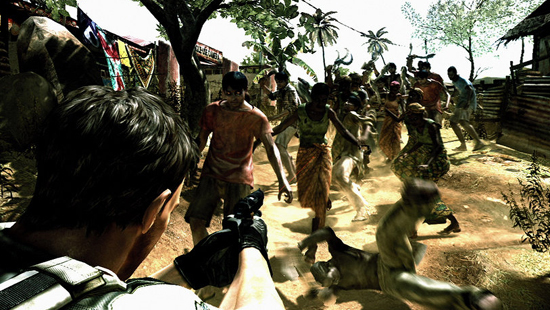
My Wiimote was especially missed during high-tension scenarios in RE5. The sensation of mowing down several enemies with a pointed controller is incomparable to simply moving an analog stick from side-to-side.
I'm not saying that shooters automatically surrender their intrinsic value for utilizing the analog system, but rebuffing an improved interface that enhances aiming speed and precision, while enriching the gaming experiencing, is just silly. Although the traditional method of moving an aiming indicator from one target to another has always been sufficient, the absence of a more organic sense of control has always stilted my complete immersion.
For these reasons, I’m excited about Sony’s PlayStation Move. Motion control shooters finally have the opportunity to flourish. Unlike on the Wii, mature content on the PS3 isn’t treated like a boil on society’s ass. Add to that a laundry list of third-party support, and what comes to fruition is a potential golden age of epic motion-control-based shooters that could get hardcore gamers to deny their previous aversion.
Sony has already announced a few impressive Move titles in Resident Evil 5, Killzone 3, and SOCOM 4 amid a launch lineup riddled with the usual casual gaming fair. This is disheartening, I know, but revamping the image of motion controls won’t be easy and requires long-term dedication.
"It's exciting to be on the cutting-edge of the technology that, I think, could really redefine the way shooters are played in the future." -Kevin Schmitt, SR. Systems Designer, Zipper Interactive
So forget the stigmatic perception of motion controls and hardcore gaming. Just because you may not be accustomed to the concept, it doesn’t mean they don’t belong together. I admonish the community to not disparage the progression of motion controls; instead, as a people dedicated to the unceasing improvement of the gaming experience, demand content and disallow Sony from simply settling on the laurels of an established casual market.
We've had enough ping-pong paddles and bowling balls, Sony. Bring us the boom and redefine the shooting experience as only motion-controls can.