Home
Home
I've already mentally pre-ordered my copy of BioShock Infinite.
After Irrational Games passed on doing a sequel to their 2007 hit BioShock and, more to the point, after 2K Marin stepped in to deliver BioShock 2, that's not something I ever expected to say. But then, I also never expected Irrational to debut a literally all-new version of BioShock...one that leaves behind virtually everything familiar to series fans.
Instead of watery and crumbling Rapture, we get bright and beautiful Columbia, city in the sky. Faceless cipher Jack Ryan is replaced by Booker DeWitt, a Pinkerton agent on a mission. In lieu of Little Sisters, we're partnered with the mysterious Elizabeth. The heavies are giant mechanical Handymen with waxed mustachios where we used to pick fights with diving-suited Big Daddy behemoths. It all adds up very big for me.
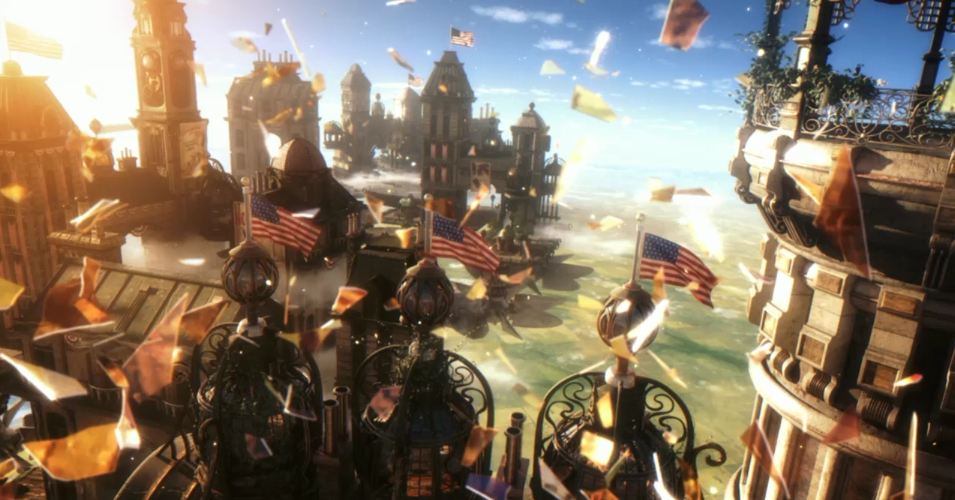
Your new happy place.
A lot of people were surprised, pleasantly or otherwise, by the drastic shift away from the dystopia they know and love. After the excitement died down, the vitriol fired up: "Too much change!" or, ironically, "It's the same game!"
Personally, I get the sense this is exactly the departure BioShock needed.
See, to me, BioShock as a franchise isn't and shouldn't be about Rapture and Big Daddies, iconic as they are. It's not even about the game mechanics, which are similar to a dozen other titles, including precursor game System Shock. No, it's more a clash of dueling philosophies, set in an environment that accentuates the game's chosen theme. The original married off Objectivisim -- a hyperbolic version of enlightened self-interest pushed by novelist Ayn Rand -- to Captain Nemo, with spectacular results.
According to Objectivisim, if you can do it, you should do it, period. Those who don't are weak or deluded. Those that can't must be left behind without hesitation or guilt. Let's just say Rand wasn't big on charity work.
Lead writer (and Irrational CEO) Ken Levine took that brand of institutionalized monomania to its most extreme. The Rapture we experienced was the end-result of its own everybody-for-themselves culture. This decaying former utopia of fractured people, driven insane by their pursuit of self-improvement, stood as a monument to Objectivism run amuck. The environment itself served as the ideal metaphor for what went wrong. Everywhere you looked, you saw the effects of unchecked greed, entitlement, and ambition.
Pack it up, Tiny.
Then the game offered to make you a willing participant in that greed. Hack vending machines, ransack the dead -- standard game mechanics suddenly given thematic meaning -- and of course, the central conflict of saving Little Sisters for long-term rewards or killing them for immediate gains. You chose between repeating Rapture's mistakes or actually becoming a better person. Ironic, seeing how becoming better people was the original goal of Rapture's citizenry.
That's why BioShock worked so well. Every element folded into the central idea, even if only in small ways, and it happened so passively that it never felt intrusive. You could just go sickhouse on a few Big Daddies and not worry about it, though you'd still be exposed to those sneaky little ideas just by wandering through the city. Everything clicked together like a meticulously devised puzzle.
That's also why BioShock 2 didn't work so well.
When 2K Marin (staffed by former Irrational employees) took over for the sequel, they basically left the first game's characters alone and went with an "Incident #2" scenario. Smart move, all things considered. The duel this time was Objectivisim's individuality vs. Communism's conformity. You can see where they were trying to go with it, putting players in an obedient Big Daddy's shoes, converting Little Sisters into homicidal Big Sisters, pitting you against Sophia Lamb's psycho cult of personality. Good fun, that.
Only they couldn't quite make it click. BioShock 2 is a decent enough game by its own standards, but it turned Rapture into a mere location, Big Daddies into blank obstacles, and Little Sisters into an empty yes/no question. The new story just didn't fit in the old surrounds.
Second verse, same as the first.
Internal politics between Irrational and parent company 2K played a part when Levine passed on doing BioShock 2, but he had other reasons as well. The best reason, actually. "We felt we had said what we wanted to say about Rapture," he told Eurogamer in August, "about those kind of environments and that kind of feel." So for his sequel, Levine is taking the step 2K Marin should have and didn't (or more likely, wasn't allowed to by 2K). He's creating a new environment with a new meaning for his new story.
And let's be honest. A flying city has just as much iconic steampunking potential as an underwater metropolis. If this is "just BioShock in the sky," as I've heard some detractors claim, I'm good with it. At least it won't be even more of the same Nazis/Russian separatists Call of Duty trots out every year to play bad guys. Most franchises play it safe like that, never straying from the formula. For Infinite, we know the ideas will be different from previous installments.
Columbia doesn't look nearly as run-down as Rapture, and the announcement trailer gives us a brief glimpse of the new philosophies in play. Check out the billboard of a Lady Liberty-type in start-spangled corset holding one baby while spurning another held out to her. The caption reads "Burden NOT Columbia with your CHAFF!" I'm getting a nice "racial/class purity" vibe off that.
It's also nice to hear that Irrational is breaking from some of its well-worn tropes as well.
Booker will have a voice and a personality, as opposed to the silent protagonist that's practically an Irrational calling card. Hopefully they'll do something different with their standard audio logs -- a friend of mine suggested they could activate side missions, for example -- or do away with them altogether in favor of something else. Whatever they have up their sleeve, I can't help but suspect Levine and his team are stepping up their game both technically and thematically, perfectly matching every element to the story they want to tell. Just like they did before.
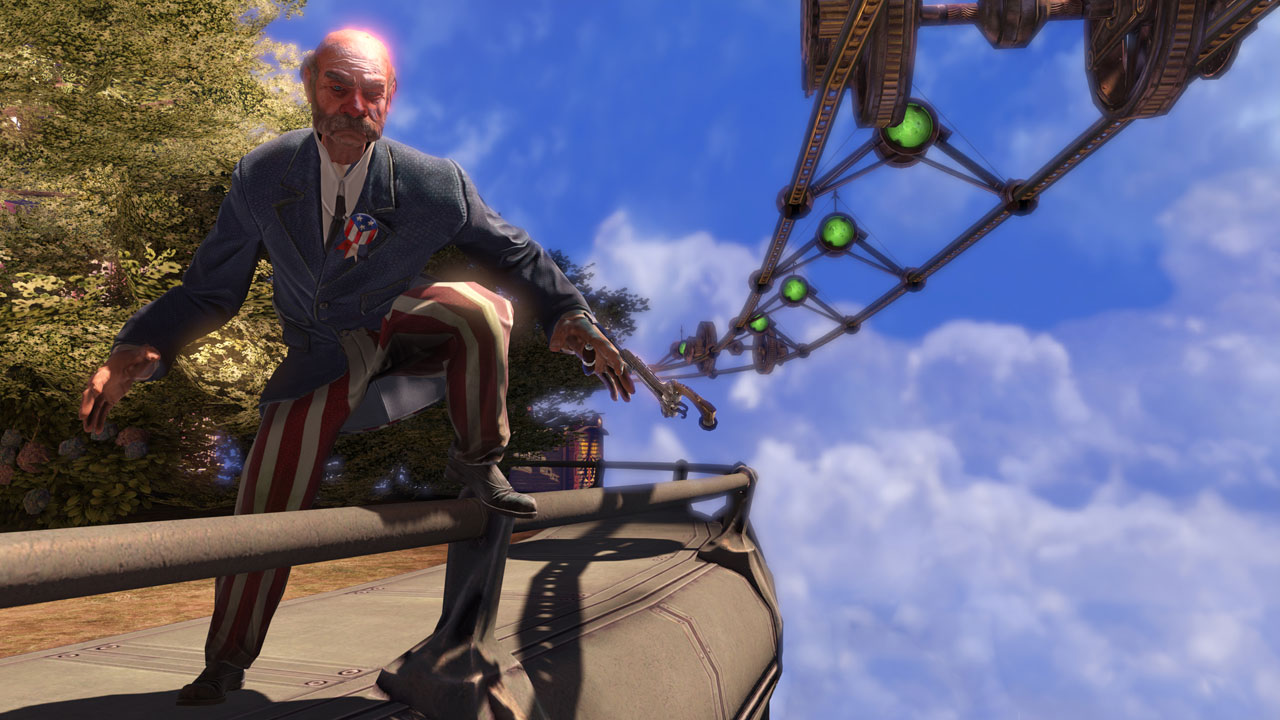
BioShock: now staring Evil Sean Connery.
Plus, it just looks cool. So did Rapture, but I've been to Rapture. Twice. I'm ready for a new tourist destination where everybody has freaky powers and tries to kill me. Yes, customers want familiarity in their sequels (the Infinite gameplay seems to fit that bill), but I guarantee you, they don't want sameness. Unless a radically different approach is taken, a third trip to Rapture would be derivative at best. By shifting locations, BioShock Infinite opens up possibilities that don't exist under the sea anymore.
Like, for example, the ability to actually shock us again. I want to walk into a new world and experience it for the first time. I want to feel uneasy taking my first steps into it. I want to discover the unknown in dark, unfamiliar places. Those aren't things I can do in Rapture anymore. They are things I'll do in Columbia.
Really, the location isn't so important. The first game could just as easily have been set in the clouds, in a rotting version of Columbia. What's important is that you are enveloped in a strange new world with a story to tell. That's BioShock, and that's where my expectations live.