Separator
What Makes a Video Game's Story Successful?
Aj_newfoundland_avatar
Friday, August 06, 2010

Editor's note: I think A.J. is spot-on with his analysis of what makes a game's story sing. What games do you think have successful stories? -Brett


We hear it all the time: Stories in video games suck. They’re too complex, too long, and ultimately too boring. Often, gamers skip cut scenes entirely to get back to the gameplay.

But there are some successful examples of storytelling in games. The Uncharted series, the Mass Effect series, and Red Dead Redemption all contain critically acclaimed tales. What is it about the stories in these games that succeed where so many others fail?


First, let's establish the basic characteristics of a story. A good story gives equal attention to dialog, characterization, setting, pace, and plot. People often cite the plot when they say a game's story is weak or lacking, but that usually isn’t the only problem. In fact, I'd argue that we need less plot in our games and more of the other elements.

For example, here's the plot of the Uncharted series: Treasure hunter Nathan Drake goes on an adventure to find a lost artifact. Along the way he works with friends while looking for said artifact. Some of them betray him. In the end, he finds what he is looking for and gets the girl. In four simple sentences, I have basically laid out the plot of the whole Uncharted series.

So what makes the overall story in Uncharted so good then? It's good because it does the little things so well: the sharp dialogue, the strong relationships forged between the characters, and the brisk pacing. On top of that, the top-notch acting (voice and physical), gorgeous cinematography, and general presentation all enhance the story experience.
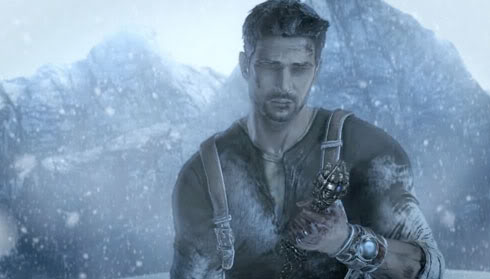
Uncharted 2
Basically Drake spends the game trying to hold on to this dagger.
But he's got something very clever to say about it.

The plot lines of other games with acclaimed stories are similarly straightforward. Mass Effect? You and your team save the universe from an alien menace. Red Dead Redemption? Settle the score with your old partner while dealing with your past. Dragon Age is about stopping an evil dragon from destroying the world. Grim Fandango is about saving a girl from a long journey and a corrupt man. Fallout 3 is about finding your dad and fixing a big machine.

Now try to simply summarize Final Fantasy 13. How about Heavy Rain? Bayonetta? And let's be honest here: Who went straight to Wikipedia after they beat Modern Warfare 2 so they could figure out what the hell was going on?


Those who know me saw my FF13 criticism coming from a mile away. Let me put on my flame-retardant clothing.

Thankfully, game studios have started to see the value in having a writer on staff. Just look at the brilliant work Amy Hennig did for Naughty Dog on the Uncharted series. And, while many people disliked the real-time strategy elements of Brutal Legend, few disputed the excellent writing done by creator Tim Schafer. In other words, it's no longer enough to hire a novelist to write a skeletal plot outline and rely on people trained to create code, art assets, and animation to write the rest.

 
One of these men is a writer. The other two are not.

I feel we’ve reached a point where we should expect a game to have a well-written story with memorable characters to drive the gameplay forward. What do you guys think? I’m sure I’ve yucked somebody’s yum. Did you actually like the story of Final Fantasy 13 or the character of Bayonetta? Do you have some other examples of good/bad storytelling in games?

 
Problem? Report this post
A.J. MINOTTI'S SPONSOR
Comments (9)
Lance_darnell
August 06, 2010

A good post, but you want a good story? Hmmm. That's tricky. The last story in a game that I remember well is Team Fortress 2. Those characters have back stories, tons of personality, and they are not boring or forced.

Strange choice, but that's my choice! :)

Aj_newfoundland_avatar
August 06, 2010

I totally agree! Again, that comes from fantastic writing and strong characterization. There never even was a plot in TF2 until the recent Engineer comics gave a bit of backstory.

I think you've hit on another strong point there, Lance. Personality is often lacking in characters. All too often a game's protagonist is just a vehicle for you to mow down baddies while one liners are spit out.

Default_picture
August 06, 2010

Hmm. A plot to FF13 in a brief period? A group of people persecuted by their government because they were in the wrong place at the wrong time, manipulated by other parts of said government, all journey with their own motivations and weather betrayals and forge friendships, ultimately defeat the portions of the government that sought to control them. Simple enough? It's about as detailed as your description of Uncharted. 

Aj_newfoundland_avatar
August 06, 2010

But then you have to explain the Fal'Cie or whatever, the dynamic of the two worlds, blah blah blah. I know there's more detail to Uncharted as well, but it still isn't nearly as complicated.

Photo_on_2010-08-03_at_16
August 06, 2010

Bayonetta's story was utter nonsense but it was handled in such a cartoonish, over-the-top way that the fact it didn't really make sense ceased to matter; it was all about the spectacle. For some games I think that's okay. Look at the number of films that do well that are pure eye-candy. I'd argue that it's perhaps more acceptable for a game to be nonsense in the story department—but only if the gameplay is up to scratch. Bayonetta delivered on that front, so the fact that it was nonsense was less important.

I think we are starting to see more and more in the way of good stories. The examples you cite are all great ones. I'd like to draw particular attention to Dragon Age for having a relatively simplistic story, but one of the richest settings I've ever seen. It's one of the only RPGs I've ever played where I actually read every book and codex entry. They're all optional, but knowledge of each gives the player a greater understanding of the game world and the characters. Little references that characters make suddenly make sense. It's extremely well handled.

Can't beat a bit of Uncharted, though.

Default_picture
August 06, 2010

AJ: 

Why do you need to explain the Fal'cie? You didn't explain Eddie Raja's pirates or any of the other groups, you didn't mention the curse and the deformed spanish. At the same level of detail you left out the same kinds of stuff. All of the Fal'cie and L'cie are just labels for different groups. At a basic level, it's just those who govern, and those with odd abilities they are either trying to persecute or control.

Aj_newfoundland_avatar
August 06, 2010

@Ek Fair enough. Still, as pointed out by Tycho of Penny Arcade, by the time one progresses what people call the "tutorial stage" of FFXIII, you could've gone through Uncharted 2's entire narrative arc three times over. Again, it just depends what you're looking for in a game. Different strokes for different folks and all that.

Default_picture
August 07, 2010

I'm OK with that myself. It has to do with how branchy the game is and what the replay value is. I played Uncharted about 4 times and feel that I got my money's worth from it. those 4 times took roughly the same amount of time as beating FF13 once. But after beating FF13 I don't feel like playing it again from the start, and I didn't need to replay it to feel like I had gotten my money's worth. With Uncharted, the game actually forces you to play through twice if you want to get all of the trophies in the game. FF13 on the other hand only requires a single playthrough. 

I still don't agree with the assessment that the first 20-30 hours is a "tutorial" stage. I consider that the "storyline" stage where it's basically alternating gameplay and storyline. At 10-12 hours you've unlocked the paradigm system and most of the classes, and the tutorial is mostly over. The rest of the time is spent utilizing your new abilities to play the game and unlock more storyline details. After 30 hours, the storyline fades mostly into the background for the next 10-20 until you head back to Pulse. If you consider 30 hours of FF13 to be a tutorial, then Uncharted is still in tutorial mode all the way until you get out of the Nazi base, because the game is still teaching you new ways to play and use your weapons and completely shifts you to a new playstyle to learn at that point.

Default_picture
August 07, 2010

Here's another counterexample to the complaint that FF13 is too long.

The game that I felt cheated most about in the past year? Last Rebellion. It was 14 hours 43 minutes to both completion and platinum trophy, and it was an RPG. There was no replay value whatsoever. I felt like I enjoyed the game, but certainly didn't get my $40 worth out of it. Add to that the difficulty curve was like an upside-down check mark. (Moderate at the start, tough in the early middle, then it plummeted down to too darn easy.) 

I'll take a short game as long as it has replay value, or I'll take a long game as long as I don't need to replay it again to get all of the content done. Short replayable RPGs can be done. Look at SaGa Frontier and Romancing SaGa for some examples of 20-25 hour games with multiple playable storylines. I would have preferred it if Dragon Age had followed their lead instead of tried to make a 60 hour epic where you couldn't see all the content on one play through.

You must log in to post a comment. Please register if you do not have an account yet.