Home
Home

I think every adolescent has to deal with the paralyzing, crippling fear that he will turn out exactly like his parents.
In Infinity Blade, you don't have a choice. Unless you can do what your ancestors could not: defeat the God King.
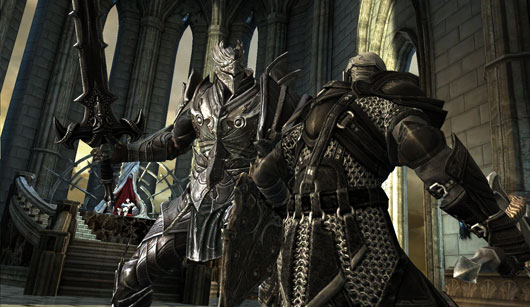
Epic Games' new iOS title, developed by Shadow Complex creators Chair Entertainment, is a gorgeous technical marvel. I'm stunned that a game of this graphical quality can run on my iPod Touch (and I don't even have a "Retina Display" model). But as I played into the wee hours of Thursday night, Infinity Blade's beauty was not what stuck with me.
Because Infinity Blade doesn't just tell its story with graphics but with the cycle of death and blood, father and son. And from that cycle, there is no escape.
Infinity Blade begins with an armored warrior assaulting the castle of the God King. After a short conversation in subtitled gibberish (reminiscent of Shadow of the Colossus' quasi-language), the God King's guardian defeats the warrior, absorbing his power with the titular Infinity Blade. "Perhaps your descendants will have better luck," the God King scoffs.
Fast-forward 20 years, and a figure stands on a promontory looking towards the castle -- a figure clad in identical armor and bearing the same weapon as the slain warrior from the opening. "Father, I will avenge you," the new fighter whispers.
Unlike the tech demo Epic Citadel, released months earlier to show off its graphical prowess (Unreal Engine 3! On an iPod!), Infinity Blade is not a free-roaming first- or third-person adventure. Rather, your character moves through the castle via cut-scenes, stopping periodically to allow the player to look around. Health power-ups, treasure chests, and bags of gold litter the castle, so it's advantageous to swipe the screen to shift your view. But you stand still while doing so, as do your enemies.
You fight by using the touch screen to dodge, parry, block, and attack your foes. Successful moves in sequence lead to big openings in your opponent's defense. The game offers a few different palette-swapped enemy types, each with unique fighting styles, strengths, and weaknesses (often of the standard ice/fire/thunder variety). But you'll encounter the enemies at the same places in the castle each time as you make your way to the God King's throne room.
You probably won't defeat the God King on your first playthrough. You aren't supposed to. If you do manage to make it to him, he dispatches you as he did your father, sucking your energy into his blade and musing that your progeny may fare better.
Another 20 or so years pass. Another identically armed warrior stands at the same promontory and swears the same oath to avenge his father. And so the cycle continues.
And I'm actually more interested in the cycle itself than breaking it.
Like the aforementioned Shadow of the Colossus, Infinity Blade says more with its gameplay and aesthetic than it explicitly states through dialogue. Your character has one line in the whole game -- his vow of vengeance. Your foes also remain silent aside from their grunts and battle cries.
Only the God King speaks, offering you the only meaningful choice in the game. Otherwise, you can choose which weapons and armor to use and which path to travel through the castle. But your character and his descendants still tread that same path, over and over and over, until the God King is defeated.

The inflexibility tells the story. You don't know who the God King is, or what he's done to your family (apart from destroying your ancestors). But swaying from the path is not even an option. You were bred for this task. This is all that you know, all that you are.
The God King even seems complicit in this somehow -- he must have given the weapons and armor of his slain foe back to the family, in hopes that another would rise to challenge him. I like that that isn't explained overtly.
While Infinity Blade could be described as a role-playing game, I don't feel like I'm playing a role. At least, I don't think I'm playing the role of my character and his bloodline. I'm playing the part of fate -- the force that is shaping his destiny, leading him to his inevitable purpose.
That's something I haven't often encountered in a game. And it's an experience that shouldn't be missed.