

Editor's note: Psychonauts is in my pile of shame, too -- the games that I should have played but haven't (yet). I hope I like it as much as Davneet did once I finally right that wrong! -Demian
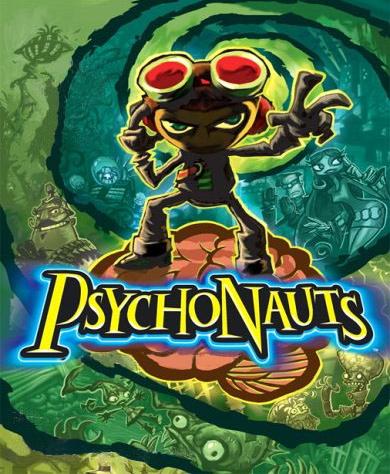
With the upcoming release of Double Fine Productions' Brutal Legend garnering much critical attention, I decided to prepare myself for such a unique title by examining the past work of Tim Schafer. Renowned for its quality writing and humor, Schafer's work in the adventure game genre has remained elusive to me, perhaps because I've always found adventure games to be slightly tedious, or perhaps because the genre was already in decline when video games became a staple in my life.
With the re-release of The Secret of Monkey Island and the episodic release of Tales of Monkey Island, I thought there could be no better time to delve into the adventures of Guybrush Threepwood. However, I remained hesitant due to my admitted and possibly unjust bias against adventure games.
Adamant about finding a threshold into the inner workings of Tim Schafer and discovering why his games are so critically well-received, I settled upon a more contemporary game, Psychonauts. Double Fine's inaugural game, released in April of 2005, was immediately recognized for its innovation and creativity, winning Best Original Game at the 2006 E3 Game Critics Awards, Best Screenplay at the 2006 British Academy Video Games Awards, and Best Writing at the 6th Annual Game Developers Choice Awards.
Despite the critical acclaim, I didn't have the opportunity or inclination to experience Pscyhonauts until recently. Upon playing, I found a game that is so diverse in scope, so creative in presentation, and so passionate in execution, that it is simply awe-inspiring.
Into the Minds of Others
 Exploring the insane asylum, Razputin, or Raz as he likes to be called, comes across Edgar, a well built man of seemingly Spanish decent. Edgar, despite having a chain around his left ankle, is lost in thought as he attempts to construct a house of cards. He clearly fancies himself as an artist, given the numerous splashes of paint across the floor and the many canvases lining the walls.
Seeing a particular unfinished painting on an easel, Raz announces himself with the question, "Whatcha painting there?"
Edgar, seeing Raz for the first time, responds in a heavy Spanish accent, "That is my patron, my psychiatrist, my warden."
"Looks like Dr. Loboto to me," proclaims Raz. "Is he the one who chained you up?"
Moving towards Raz and the painting, Edgar casually responds, "The doctor won't let me go until I complete my treatment."
"So why don't you just finish the painting and go home?" asks Raz.
"Why don't I just...?" Edgar's voice trails off as he picks up a brush and approaches the painting. He struggles to place the brush on the canvas, as if fighting some physical barrier, though it is obvious the barrier is an affliction of the mind.
Suddenly, Edgar breaks through his psychological impediment and very quickly and precisely touches paintbrush to canvas. In a matter of seconds it seems as if he has overcome his mental hurdles and completed the painting.
Not having yet seen the finished painting, Raz offers encouragement, "Wow! See. Sometimes you just have to..." As Raz moves to view the completed painting, he is dumbfounded. "Huh. You painted a bullfight over the doctor's face. Why a bullfight? Huh?"
Losing control of his calm temperament, Edgar becomes enraged and screams, "Every time! Every time it is the same! The matador! The bull! How I despise you both! But my hands won't let you go." He yanks the painting off of the easel and throws it to the side. Picking up a fresh canvas to replace the one he just discarded, Edgar states, "That is why I am here, chained in more ways than you can see."
"A prisoner of art," states Raz.
"A prisoner of art," confirms Edgar as he attempts to regain control of his temper.
After a brief but slightly awkward pause Raz declares, "Well, I'm gonna go downstairs...you good?"
"I'm good," replies Edgar in a lighthearted manner.
As a Psychonaut in training, Raz has the ability to enter other people's minds in order to help them overcome their psychological afflictions. Deciding to aid Edgar in his struggle against the matador and the bull, Raz enters Edgar's mind and is placed in a world inspired by Old Madrid and the father of velvet painting.
Thin alleyways wind their way through towering buildings of the most engulfing black, accented by fluorescent pastel cornerstones and windows that appear as chalk on slate. Rivers of bright orange and pink paint run through the town square and city sewers. The sky emulates the style of van Gogh as swirls of fuchsia and cadmium-yellow drift across a black background.
At the heart of the world stands Edgar, toiling endlessly to construct a house of cards tall enough to reach a beautiful yet tearful woman in the sky. His work is continuously thwarted however, due to the constant rampaging of El Odio, the bull.
In his desire to help Edgar, Raz bounds through the town, dodging El Odio's attempts at goring him. He purchases paintings from artistically-inclined canines that transform into useful tools, and battles masked wrestlers in an attempt to earn more playing cards for Edgar's tower.
Upon collecting all the necessary cards, Edgar finally completes a tower that is strong enough to stand up against El Odio, and Raz comes face to face with the mysterious and sad woman. Unfortunately, so does El Odio. A battle against Edgar's innermost demons ensues, demons that he has carried and allowed to affect his life since his days on the high school wrestling team.
Seemingly unrelated and random subject matter saturates Raz's surreal escapade into Edgar's mind. How can post-impressionist-inspired design, bull fighting, talking dogs, and professional wrestling share a common thread? Amazingly, when considering Edgar's personality and history, it's all perfectly cohesive. Every superficially distinct detail acts as an example or metaphor for Edgar's interests, desires, emotions, and faults. The cohesiveness of such random material is almost oxymoronic in nature. The amount of creativity and thought that went into designing Edgar's personality, history, and consequent mental world is simply unfathomable.
Perhaps most amazing of all is that Raz's episode with Edgar is only a small fraction of the experience that is Psychonauts. Raz must enter many other minds, each equal to Edgar's in diversity, creativity, intelligence, and cohesiveness; but all are completely different in subject matter.
Over the course of the game, Raz partakes in a 1970s Studio 54-inspired dance party, complete with disco balls, flashing dance floors, and lava lamps. He explores an M. C. Escher-derivative suburbia populated by poorly disguised clandestine agents, intent on discerning the location of the notorious Milkman. Raz even enters the mind of an oversized lungfish, and discovers a population so small that he is forced to take on the role of Goggalore, an amalgamation of Godzilla and King Kong.
The only elements that bind each of these fantastic realms are the Tim Burton-esque art style and of course, the main character, Raz.
Character, Character, Character
In a departure from the physically imposing, gun-toting adult protagonists endemic to video games, Psychonauts follows the exploits of a ten-year-old boy at summer camp. Far from shy and awkward, as most children would be at a foreign summer camp, Raz is outgoing to an extent that can only be a product of a repressed childhood. He is overconfident and brash, and even approaches an off-putting level of arrogance.
Raz, however, never reaches that level due to his selfless and noble nature. He is eager to meet and befriend all camp-goers regardless of their social status, and is tireless in all of his endeavors, whether they involve learning a new psychic power or saving his friends from evil machinations.
Raz is the consummate hero, albeit in a ten-year-old's body. In fact, it is that ten-year-old demeanor that truly endears him to the player. Despite combating enemies and overcome challenges that would daunt even the most highly trained adult, Raz never ceases to act like a lighthearted child. In some truly hilarious antics, he verbally taunts enemies and dances around their fallen bodies. He is even sensitive about certain adult issues, such as having a girlfriend.
"So hey, have you seen any other humans around here?" Raz asks a member of the Lungfishopolis resistance. "I'm looking for a girl called Lilly."
"The government archives might have some information about your young girl friend, Goggalore," declares the resistance member.
Becoming contemplative, Raz states, almost to himself, "Yeah, I don't know if she's really my girlfriend...I mean...I think she..."
The resistance member cuts Raz off, "I only meant that she is your friend who is a girl, Goggalore."
Raz's insecurity about his "friend who is a girl" provided me with one of many laugh-out-loud moments in Psychonauts. It also contributed to Raz being one of the most well-developed video game characters that I have ever encountered. Raz forced me to rethink my advocacy of the silent protagonist as the quintessential immersive avatar.
Collect This
Despite all the thought and creativity poured into Psychonauts, the game is not without its flaws. Perhaps the most glaring fault lies in one of its basic gameplay principles. In between fantastic adventures through deranged minds and boss battles that are both challenging and innovative, Psychonauts adheres to one of the oldest and overused mechanics, collecting objects.
Few objectives create a sense of tedium more than the finding and collecting of X number of items, to be returned to the quest- or objective- giver at a later date. It's an unfortunate staple of platform games and role-playing games alike.
Psychonauts offers an overwhelming number of collectable items, including Arrow Heads, Mental Cobwebs, PSI Cards, PSI Cores, Figments, and Brains. Each item serves a specific purpose in the game, such as increasing an attribute or acting as currency. For the most part, these items are easily accessible, acquired simply by following the prescribed path. Those items that require some additional exploration can be worth the effort, given the bonuses they provide, but are not typically necessary.
In a few instances, however, Raz is essentially removed from the overarching storyline, forced to collect enough of some item in order to return to plot events. One such moment occurred when Raz had to purchase a Cobweb Duster. Not having enough currency to purchase the item, Raz was reduced to scouring camp grounds in order to detect and extract deep Arrow Heads.
Missions of this type are often immersion-breaking, and the examples in Psychonauts are no exception. Given the importance of Raz's primary objectives, wouldn't it have been more prudent for the camp staff to have simply given Raz the Cobweb Duster? Perhaps not.
Regardless, all that is good in Psychonauts far outweighs any minor blemishes that may afflict the game. Even when faced with tedious tasks, I was more than happy to finish them quickly in order to discover the next stage of Raz's adventure.
Onward and Upward
Having finally experienced Psychonauts over four years after its initial release, I can say that few titles, if any, have had more of an impact on how I view video games in general. The game encompasses so many themes and emotions that I continue to process the experience days after completion. Poignant moments exist in between hilarity, action, and even horror.
Psychonauts stands at the peak of video game storytelling and character development. For better or worse, I will inevitably compare all future games to Psychonauts, at least on a subconscious level.
I now clearly realize why Tim Schafer's games are almost always so critically well-received. Though I am slightly sad about waiting so long to reach a conclusion already long held by avid video game players, developers, and journalists. All I can do is look forward to experiencing more of Tim Schafer's work, both past and future.