Home
Home

Imagine my surprise when, after entering the activation code into Steam for Humble Indie Bundle 4, I was presented with an End User License Agreement (EULA) from the largest publisher in Western markets, Electronic Arts. Cocking one eyebrow skyward in my best Spock impersonation, I accessed Steam’s store page for the offending title, a game named Shank. I ran headlong into an age gate. It seemed that EA’s EULA was not to be the last of my surprises.
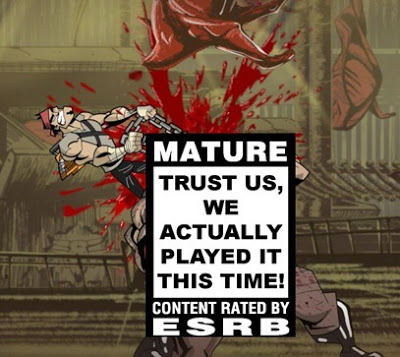
Shank has been rated M by the ESRB. And not just simply M for Mature but M for "blood and gore, sexual themes, strong language, and violence." Steam's store page proudly hocks Shank as "a graphic novel with the most fluid and violent 2D animation ever seen in a video game." Tom McShea’s review of Shank on GameSpot calls it "a savage game that revels in the brutality of street fighting" while GameTrailers likens Shank to "a savage Saturday morning cartoon filled with blood, boobs, and Berettas."
That's hardly the sort of title I would expect to see in a charity bundle of independently created games sandwiched between Super Meat Boy and NightSky without a single mention of either its ESRB rating or adult content. But then again, Shank is not exactly and independently created game.
So what makes an indie game...well, indie? Wikipedia defines an indie game as "video games created by individuals or small teams without video-game-publisher financial support." Hmm. Perhaps the answer lies in the Origin of Shank. It’s not unheard of for an independently produced title to be picked up by a publisher after completion. It is also not the case with this title.
Shank was originally revealed to the public during the Penny Arcade Expo on September 4, 2009. Developer Klei Entertainment signed with EA six months later on March 4, 2010. The game would not be released (on it’s first of three major platforms) until August 24, 2010. Hardly a textbook definition of an "indie" title. On the contrary, this is the way the video-game industry used to work: develop a prototype, shop it around to publishers, and complete and ship with the marketing and distribution powers of big business.
One second into Shank's intro movie.
Furthermore, Shank 2 had been announced in late September 2011 at an EA press conference in Las Vegas with an "early 2012" release date. What better way to drum up anticipation for the upcoming release than to get the original game into the hands of an additional 400-thousand-plus gamers as part of a program that continues to set record sales year after year?
The addition of a title from one of the biggest names in video-game publishing coincides with another change in Humble Bundle, Inc.’s operations: their decision to drop The Electronic Frontier Foundation (EFF) as a supported charity for the fourth Humble Indie Bundle.
What does the EFF do? Oh, nothing important....
What exactly is the EFF? Richard Esguerra, a former senior activist with EFF and member of Humble Bundle, Inc. explains in an interview with Nerd Age:
The Electronic Frontier Foundation works to protect digital civil liberties, like online free speech, privacy, and other rights. For example, the EFF fought to make it legal to jailbreak your smartphone. And they went after Sony for including rootkits in music CDs that compromised consumers’ computers.
Mr. Esguerra would leave the EFF on September 17, 2011 for a position with Humble Bundle, Inc....just in time for the ramp-up leading to the launch of Humble Indie Bundle 4 featuring Shank, an ultra-violent game from mega-publisher EA, a company known for its judicious use of DRM, questionable data mining practices, locking unruly forum members out of games they’ve purchased, and sponsoring Internet censorship legislation.