Home
Home

EDITOR'S NOTEfrom
Rob Savillo
Kate explores an interesting game-design topic: What is the mechanical value of character death? Peronsally, I'd like to see developers investigate other, perhaps more pertinent, ways to express failure.
Alyssa Rosenberg, a blogger whose writing I quite enjoy, covers many new media and pop culture phenomena but doesn't say much about games. In talking about Portal, she begins to address why: "I find dying in-game incredibly stressful." She concludes:
But for all the overblown talk of what video games do or don’t make us comfortable doing, I’m surprised that there isn’t more conversation about what dying in-game makes us feel about our own deaths.
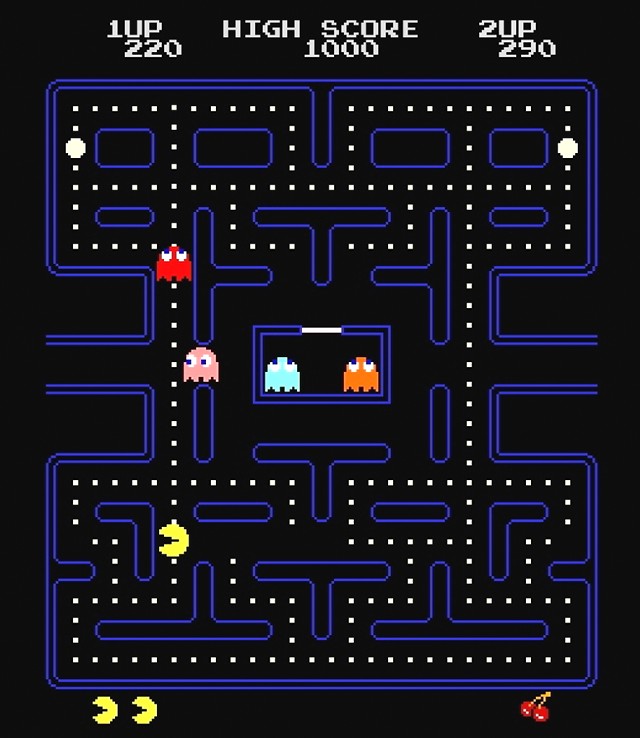 |
| I don't remember which one is Clyde, but I always blame him. |
I got thinking about character death in gaming after reading this. Really, it's an odd concept because it's a mixed bag of concepts. We lump a whole bunch of different occurrences and design choices into this one idea.
Thirty years ago, avatar "death" or destruction made perfect sense as a design concept. You need a mechanism in your game to tell players that they have lost or failed at their tasks.
Beyond just communicating failure to the player, avatar "death" used to be a mechanism that meant the kid behind you at the arcade would get a chance, eventually, to put his quarter in the machine and take his turn after you or at least a mechanism by which you would keep pumping in your change for one more chance at the challenge.
Simple, easy -- a time and talent constraint built in. The more you suck, the more quarters the machine will consume!
In the 1980s, though, the arcade famously entered our living rooms. Throughout the NES era and into the SNES age, though, we had the convention of game "lives" built in. By then, it was just how we played, and 1UP was part of the lexicon. Trying and failing to cross a chasm or fight an enemy meant you "died," and you needed another guy.
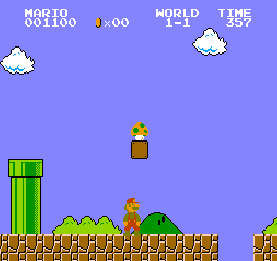 |
| I was always really glad for the collected 1UPs by World 3. |
As we all know, though, games have come a long way since the 1980s. There was a time when they were all sets of arcade skills that sometimes had stories attached; now, we have a whole collection of stories that also have skill sections built in.
Unlike Alyssa, I don't get stressed when my first-person player character "dies" in Portal. Her death is impermanent; the player's respawn is nearly instantaneous and the game puts the avatar pretty much right back at the site of the player's failure.
I no more stress out about launching myself into a turret (oops) than I do about laying a jigsaw puzzle piece in the wrong corner or about missing a move in Tetris. Portal is ultimately about solving puzzles, and although there's a great narrative framework going on, I don't feel personally affected by Chell's ceasing to be; I only feel frustration at my lack of talent or timing.
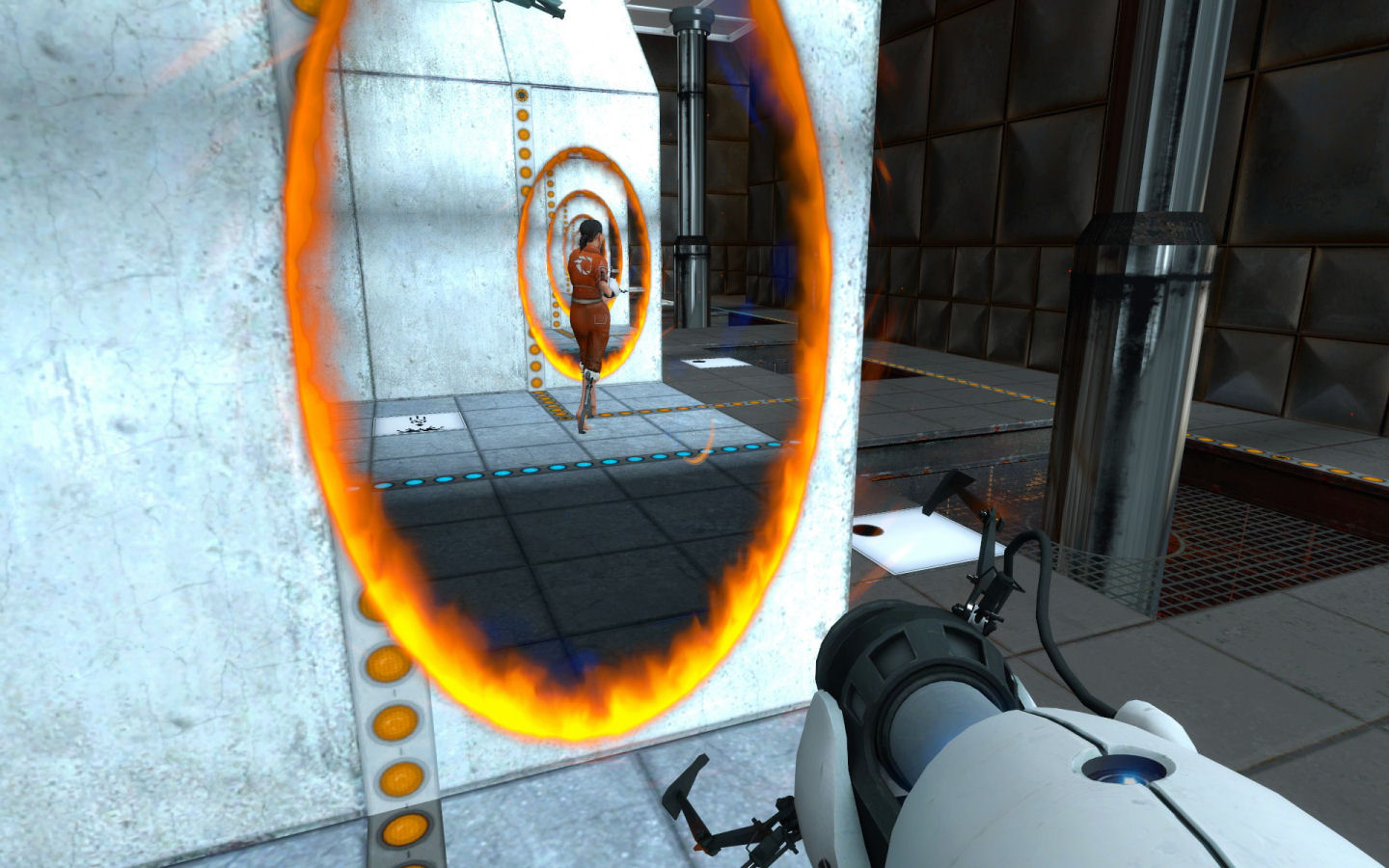 |
| To infinity and beyond! Wait, what? |
That said, there is indeed the frustration of bruised pride to contend with. I don't feel any more attached to the persona of Chell or to her story in Portal 2, but I take more offense at dying because the game is easier. It relies more on thinking puzzles through (which I can do -- and do well) rather than on reflex timing (which I can't do well at all). When I fail at something that I could physically have done right because I hadn't thought it through more clearly, I take personal offense at the failure. This puzzle -- this story -- must have a right answer, and so I must find it. Otherwise, I, personally, have failed.
We very rarely have a limited number of second chances anymore. Our games do still exist along the pass/fail, do/die dichotomies, but our stories, as a general rule, no longer continually penalize failure. Rather than face a character death, we are instead taking a Mulligan on the last five minutes. We get a rewind (sometimes literally as in World of Goo) back to before that jump or that shot or that ambush in the corridor.
Sometimes, though...sometimes, it is still personal. I got really ticked off on the very few occasions when my Commander Shepard died and I had to reload. In her case, I did feel deeply invested in that character. She was important, her story is important, and death didn't feel like taking a do-over on a game mission: It felt like a deeper kind of failure, the kind with some sort of betrayal or judgement attached. The feeling only got worse in Mass Effect 2, where I had the ability to get other characters permanently killed off. During the climactic mission of the game, I routinely let my fear of harming others send me into a kind of paralysis, during which I had to pause the game and pace around the room instead.
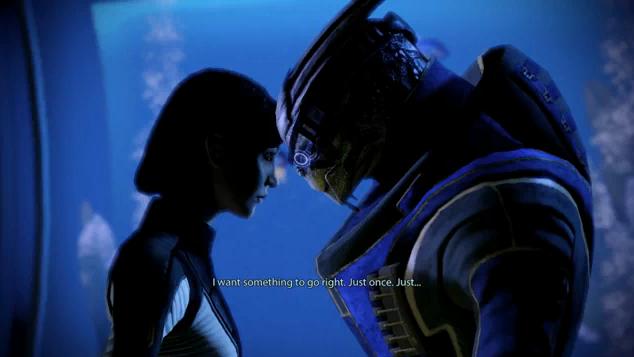 |
| My indecision had nothing to do with this. By which I mean, it had everything to do with this. |
Of course, that's entirely by design. When BioWare can make me pace around the room and ask my cat for opinions on who should lead a team (his response was to nibble on my arm), they've won. Anyone designing a huge-budget, open-world, cinematic-style, triple-A game is invested in the player's investment. That so many of us seem to have fangirled over this franchise is not an accident.
Not all games, though, are so large scale.

9

Problem? Report this post