


Editor's Note: Thought the Wii Vitality Sensor was lame? Nicholas has some really interesting ideas for how it could work, from casual to hardcore. Give the full story a read. -Shoe
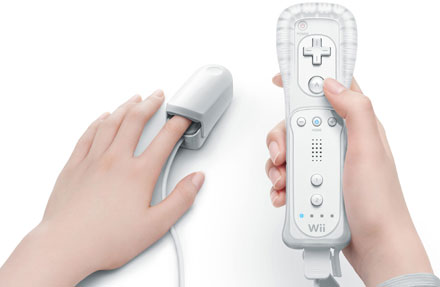
At E3 2009, Nintendo President Satoru Iwata surprised everyone with a new peripheral for the Wii, known as the Wii Vitality Sensor. The Wii Vitality Sensor is supposed to detect how relaxed you are while playing games. The audience, mostly gaming journalists with core gamer audiences, were left scratching their heads at the revelation.
Truthfully, it's very difficult to try to understand how the Wii Vitality Sensor has any application to the realm of videogames at all. However, the reality is that the Wii Vitality Sensor is most likely another important step in Nintendo's Blue Ocean strategy: getting as many people to play and enjoy video games as possible.
Take a step back for a moment and analyze Nintendo's strategies in the market. First, with hardware, they broke down complicated control schemes by utilizing simple, familiar technology. Second, they broke down menus and firmware into their simplest terms so that users would feel comfortable using the hardware. Third, they selected different types of software to bring non-gamers into the market. Nintendo's Blue Ocean strategy thus far has been all about breaking down barriers, making the path of entry into the realm of gaming for non-gamers as painless as possible.
However, the barriers must be broken down even further for some. Browse through Kotaku and look for a story about a patent for Nintendo's "Kind Code" -- a type of gameplay mechanism that basically functions as an in-game hint system to aid gamers when they feel lost or are feeling like they're having difficulty playing. Take into consideration a gameplay mechanic that we've heard developers speak about for years: curving difficulty. Certain games adjust in difficulty based on the game's perception of the player's skill. In games where curving difficulty works, it makes games more accessible. In games where it doesn't work or doesn't work as well as it should, curving difficulty is frustrating.
Wouldn't it be great for a game to adjust in difficulty based on the player's level of frustration?
Enter the Wii Vitality Sensor, potentially the biggest breakthrough in player/game interaction in years. If the Wii Vitality Sensor can detect how frustrated you are, it could transmit that data to the game in your Wii console in real-time. So, hypothetically speaking, that data could be used to curve the game's difficulty automatically or bring up "Kind Code" to aid the player through a frustrating section of the game.
Imagine being in a game where you're fighting a difficult boss. You're wearing a Wii Vitality Sensor. Your frustration level goes up. The Wii Vitality Sensor transmits this information to the game. Suddenly, the boss becomes a little less difficult. Maybe health or various other power-ups start emerging more in battle. Maybe a portion of that boss' health suddenly disintegrates. Maybe his tactics become less aggressive and your opportunities to strike him increase. Or maybe it's something simpler: maybe Kind Code pops up and the game starts pointing out to you tactics to defeat the boss. Maybe the Kind Code shows you a spell you should be casting or a weapon you should be using. Maybe if a few hints don't help, the Kind Code becomes more aggressive, pointing out every single opportunity and tactic to help you beat him.
You eventually slay the boss. You are relaxed and you feel accomplished. Welcome to the purpose of the Wii Vitality Sensor.
However, in theory, the Wii Vitality Sensor could go beyond merely detecting frustration. Imagine a game like Rez being fitted for the Wii Vitality Sensor. Your pulse dictates the flow of the game, increasing or decreasing the number of enemies and their difficulty. Now, a game like this could be used in the sense that I mentioned above, which is increased frustration equals decreased challenge. However, it could also function as a type of reverse gaming psychology. Maybe increased frustration increases the difficulty, forcing the player to adhere to the Wii Vitality Sensor's ultimate underlying purpose -- relaxation while playing videogames -- in order to continue making progress in the game.
Let's continue on the topic of relaxation. Take a game like Endless Ocean, which is supposed to be very relaxing. Add Wii Vitality Sensor support to that title. Imagine you're the main character, swimming deep into the ocean, admiring wildlife. But you can't enjoy it. You're frustrated -- maybe you've had a bad day, maybe you were playing another game and it frustrated you -- but for whatever reason, you can't enjoy it. Through Wii Vitality Sensor data detection from previous playthroughs, the game knows there's certain wildlife you like seeing more than others. The game brings up those fish and mellows out the soundtrack so that you can enjoy the game more, hoping to make you relax.
The Wii Vitality Sensor could also be applied to fitness, which is a software priority not only for Nintendo, but their third-party partners at EA and Ubisoft as well. Imagine standing on the Wii Fit Balance Board, wearing the Wii Vitality Sensor. You're doing your daily Wii Fit workout. The game adjusts the workout based on the readouts it's getting from the Wii Vitality Sensor. If you're doing better, maybe you get an increased challenge in your workout. If you're not doing as well and getting frustrated, maybe you get an easier workout or a change in routine to help you.
Or, imagine that you're playing a Dance Dance Revolution-type game, still on the Balance Board with the Wii Vitality Sensor. If you're having difficulty keeping pace with the game, it could slow down the pace of your "steps" or decrease the number of "steps" you have to make in order to continue (or vice versa).
Now, let's look at a more core gamer-friendly application for the Wii Vitality Sensor. Imagine you're playing Resident Evil or Silent Hill, where the game not only gets more or less difficult, but more or less frightening based on your data from the sensor's readings. If you're really scared or too scared, maybe the game tones down the scare level a bit. If you're not scared at all, maybe Silent Hill starts taking pages from The Exorcist in order to frighten you more and add to the game's mood.
The Wii Vitality Sensor has plenty of potential for gaming applications, albeit much of it hidden at first glance. If developers can capitalize on said potential, we could be looking at a new level of immersion in video games. Games might not just replicate 1:1 movement thanks to motion controllers, but react in real time to your mood and frustration level. Certain genres of games, like fitness, music and survival-horror titles could gain entirely new dimensions because of it. However, just like with any peripheral, the real measure of its success will be how developers utilize it. If developers never try to maximize the Wii Vitality Sensor's full potential, the peripheral could be looking at nothing but negative feedback.