


Previously, on Game Diary: Civilization 5, I was dismayed to find my Egyptian civilization was stuck on a small island. The imposing appearance of “clouds” on low detail levels added to a sense of claustrophobia and isolation, as I spent the best part of two thousand years doing everything I could to get some units off the island.
Blow this screenshot up to full-screen and you'll see why I felt so oppressed.
It soon became apparent that I was on an archipelago map, with my nearest rival being the city-state of Genoa. I had a trireme chased by Barbarians and had to fend off a Barbarian invasion of my homeland before I declared war on Genoa. The war dragged on -- and on, and on -- while I continued to explore the world, meeting several other civilizations and learning the new diplomacy system.
I came into this latest session on the back of forming a Pact of Secrecy with the Greeks (against the Romans), despite not really knowing what that meant, in addition to discovering two technologies that would help my somewhat stalled war effort against Genoa, if only I could find some iron.
25 October 2010
My return after eleven days away from the game was met with news of a major patch having been installed. Great -- hopefully this will fix any bugs and balance issues that I have yet to encounter (but am sure are/were present). Not so great, though, is that my two War Chariots each have upgrades that don’t do anything, and the patch can’t retroactively change them to the right thing.
A few turns after I formed a Pact of Secrecy with the Greeks, they asked me to declare war on Rome. I thought, “sure, why not?” I haven’t experienced war with another civilization yet -- only the city-state of Genoa. But there was an option to ask for ten turns to prepare, which has never been present in the series. Since I was in no way ready for a war with the Romans I chose this option. (Of course I had no intention of actually using that time to prepare -- I was focused entirely on getting Genoa.)
At this point I encountered my first real frustration with the AI. All of my advisors had told me to build a new scout -- so I did. I then set this scout to auto-explore, thinking it would utilise the embarkment ability to go out and explore the world. Several turns later, I found it sitting in my capital city. The damn unit had moved there (which takes one turn using the road) and sat around doing nothing. Why? I have no idea, but I’m guessing that units won’t embark unless you explicitly tell them to.
The war with Genoa was still in stalemate, but I got my second Great General in 1010 AD. I hoped somehow this would turn the tide, with all three units involved in the offensive now getting a 25% attack and defence bonus. The experience points were coming on thick and fast, so it seemed like just a matter of time before the upgrades would give me an edge.
Hey dude, it's nothing personal, but I'm gonna wipe you off the planet...eventually.
Meanwhile, the time came to start the war with Rome...and, as expected, nothing happened -- we’re too far apart for a serious conflict at this stage of the game. Tycho Brahe, my first Great Scientist, was born in Thebes the next turn. I opted to start a new Golden Age.
I’d like to make a little aside here to air my disappointment about the Great People in Civ 5. They seem like a step backward, with the option to use them to construct an academy no longer present. I don’t think I saw an option to add them to an individual city’s output, either. These two options were a great way to enhance your cultural, economic, and science output, in addition to giving you one city that could churn out highly specialised military units. I don’t know why they were taken out, since they didn’t strike me as an issue in keeping the game balanced.
The Golden Age brought a flurry of advancements to my civilization. The Civil Service technology provided extra food from farms and the ability to build Pikeman units. (And it was introduced with a great quote: “The only thing that saves us from the bureaucracy is its inefficiency.”) Thebes, my capital city, completed the Angkor Wat wonder, which drastically reduces the culture cost of acquiring new tiles (extending your territory). Then I discovered Chivalry, thanks to a previous Research Agreement. Now I could build knights.
I upgraded my spearman to pikeman, using a warrior unit to absorb the attacks of Genoa for the three turns it took to move this unit in and out of position. And one of my war chariots got a long-awaited upgrade: a siege bonus, which provides a 25% bonus in bombarding cities. Suddenly, my siege of Genoa was having a noticeable effect on the city’s defences. The tides had turned -- Genoa would soon be mine.
Around this time, I completed my first horseman unit, which I don’t think I’ll need for the war with Genoa. Still, it’s good to have, and it might shorten the war by a few turns.
My long search for a source of iron took an interesting twist. My scout found some iron in the middle of the ocean, far away from any civilization. I wonder if it would be worthwhile building a city there.
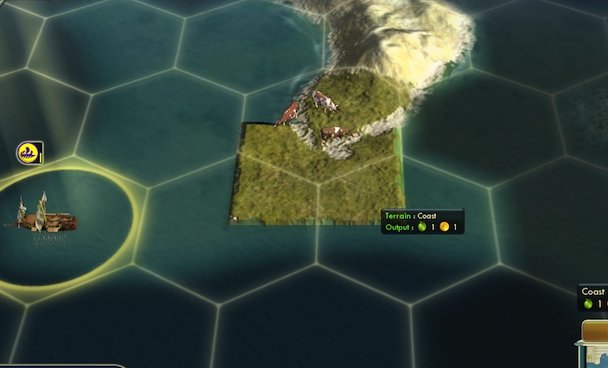
Is it just me, or does something not seem right about this image?
Previous entries:
Later entries:
- Game Diary #5: Civilization 5
- Game Diary #6: Civilization 5
- Game DIary #7: Civilization 5
- Game Diary #8: Civilization 5
- Game Diary #9: Civilization 5
- Game Diary #10: Civilization 5
- Game Diary #11: Civilization 5
- Game Diary #12: Civilization 5
- Game Diary #13: Civilization 5
- Game Diary #14: Civilization 5
Starting conditions
I decided to go with Prince (“normal”) difficulty on a standard map size, with standard game length. My civilization was determined randomly, as were my opponents and the map itself.