Home
Home

Chris looks at some of the best examples of games that do what games alone can do -- marry interaction and narrative into a complementary experience. It's a lot harder than it sounds.
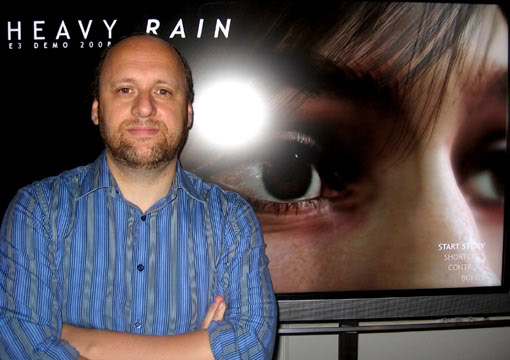
When Heavy Rain's David Cage recently likened game cut-scenes to the story segments of porn films, I couldn't help but laugh a little; a lot of games do feel like that. When I was playing Metal Gear Solid 4, its exposition felt very empty and pointless. Unlike previous entries in the series, Guns of the Patriots' story bored me to death with meaningless dialogue and intellectually vacant narrative. A shame, considering how the previous games successfully blended high-quality cinematography with stealth gameplay, giving players the feeling that they were immersed in a spy flick.
Metal Gear Solid 4, in short, sums up everything that's wrong with a lot of video-game narratives these days. It demonstrates the gulf between story and gameplay, and how cut-scenes often only provide some sort of vague grounding to the action.
On the flip side, some titles emphasize story first and gameplay second, though these mostly take on the form of adventure games like Broken Sword, Monkey Island, and Grim Fandango. Here, the puzzles function as barriers to continuing the narrative, which is what many adventure gamers are there for.
More and more developers, however, try to blur the boundaries and forge a symbiotic relationship between gameplay and narrative. These kinds of games spam a variety of genres -- RPGs, shooters, action adventures, even puzzlers -- but share a common quality: their stories couldn't translate to another, non-interactive medium without losing significant impact. After the jump, I outline five of my favorite examples and what makes them work so well.
[Warning! Potential spoilers ahead for: Shin Megami Tensei: Persona 4, Portal, Deus Ex, BioShock, and Mass Effect 2. You've been warned.]
Shin Megami Tensei: Persona 4
[Note: I haven't played Persona 3 yet, which many people tell me has similar ideas.]
Taking place over the duration of a Japanese school year, Persona 4 tied characterization with gameplay via its Social Links system. Spending time with your peers increased your Social Links, which, in turn, let you create different Personas. And these character developments also affected the narrative: The player learned more about characters that he had made the strongest Social Links with.
The narrative, in turn, also dictated the dungeons you explored, and the abducted character's worst fears directly influenced the layout and theme of the dungeon.
Very few Japanese RPGs offer such an accomplished mix of narrative and gameplay. Most rely on the story to complement a traditional RPG system, or cynically slap JRPG mechanics on top of an anime tale, but developer Atlus made the effort to really merge the two. When players care about the mechanics as much as they do about character development, that's a really rewarding experience, and one I feel only games can deliver.
Persona 4 would be utterly outstanding if it weren't for the underwhelming voice acting and some script issues. No wonder many consider it one of the finest JRPGs in recent memory.
Portal
Portal was a tough choice for me to mention in this piece, but the more I thought about it the more I felt it rightfully deserved a place. While it would've been a great puzzle game even without any narrative at all, the game's scenario and humor rank it up there as one of the more forward-thinking narratives of the last decade.
However, developer Valve didn't just write up a few gags and then call it a day. They successfully managed to tie player emotions to an inanimate object: the Weighted Companion Cube. Gamers had to carry the Cube from room to room only to be told later on to incinerate it, which in turn spawned a slew of fan-made Weighted Companion Cube tributes and, later on, Valve's very own plush toy.
And the Weighted Companion Cube was there for a very important reason, fan obsession notwithstanding. With its demise, it taught the player a new gameplay mechanic that was instrumental in the final boss battle with GLaDOS.
The final battle also neatly joined narrative with gameplay as GLaDOS first pleaded with you not to destroy her and then insulted you in a more juvenile fashion as you incinerated physical parts of her. The impact of GLaDOS's reaction and the satisfaction (not to mention the slight guilt) of tearing a now-near-defenseless being into pieces was an accomplished piece of gameplay and storytelling.