Home
Home

Chris looks at how two very different games handle failure and the concept of "game over." I also liked his original title, so here it is for posterity: "I'm a loser, baby, so why don't you let me carry on regardless?"
A confession, first: for a video-game hobbyist of some 22-odd years, I am terrible at them. I can count the number of games I managed to finish in the 8- and 16-bit eras on my fingers, while my failures are innumerable. In fact, I remain one of the few people in history to discover the secret tragic ending of Mavis Beacon Teaches Typing, in which that car skids off a road, wraps itself around a tree, and explodes in a shower of missed keys.
I've come a fairly long way over the years, though. These days I finish almost half the games I buy. Sometimes even on normal difficulty. I've even got a couple of gold PSN trophies, not that I can prove it at the moment since the Japanese PSN is still down as of this writing. Which is no bad thing, really: Online multiplayer decimations only remind me that my perceived successes are more due to games becoming more accessible than my skills evolving.
I'm no stranger to the game-over screen, then, and it seems that of late, games are diversifying in how they present failure. Two I've been playing this week stand out in particular -- Bumpy Road and L.A. Noir.
In one corner, we have Bumpy Road -- a charming, bite-sized iOS game about a cartoon couple driving a vintage car along the street (which also acts as a metaphor for their life together), collecting opportunities to reminisce about their first meeting.
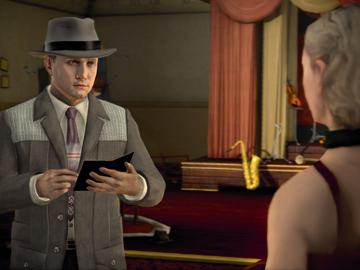
In the other, there's L.A. Noire, a heavily hyped, gritty crime drama published by a company famed for creating open worlds designed for dedicated hobbyists with hours to invest.
It's fairly odd, then, that the more casual, relaxing, and non-violent proposition of the two is the game where player deaths occur more often. Bumpy Road is in effect an endless runner game, a genre popularized by developer Semi Secret's 2009 iPhone and Flash hit Canabalt. Your couple's car pootles on down the road out of your direct control, while you can touch sections of the ground ahead to raise the terrain in the hopes of speeding the duo up, slowing them down, or leaping them over chasms.
Said chasms pop up alarmingly frequently, though, and it doesn't take long for the jaunty background music to screech to a halt as the lovers fall to their untimely demise. It's an ancient philosophy --the better you are, the longer you play, and your only reward for playing well is to play for longer. To an extent this removes a lot of the frustration involved in constantly dying -- rather than punish failure per se, the endless runner removes success from the equation since there is no way to 'win' the game.
Bumpy Road's story unfolds through collectible slide-show images, but these occur randomly -- they aren't rewards for doing well but rather simply incidental pick ups. When the only drive to keep going is to improve on high scores, it's arguable that high difficulty and frequent failure is more tolerable since you aren't really losing anything by dying. If Space Invaders had a story interlude after every few waves, say, would players be more frustrated with the loss of their quarter/100 Yen when the opposition inevitably overwhelmed them?
Bumpy Road may share a 1940s vibe and some classic cars with L.A. Noire, but that's where the similarities end, not only with regards to scope but in terms of how it deals with failure.
See, the game-over screen is a rarity in L.A. Noire. You can go down in a hail of bullets from time to time, granted. Alternatively, a crucial suspect may give you the slip, forcing a retry. An early scene for me featured a level of incompetence that was less L.A. 1947 and more Reno 911: While trailing a suspect, traffic would constantly get between me and my target, leading to a crunch at an intersection and the bad guy hot footing it. The most embarrassing of my six or seven failures here involved accidentally clicking in the analog stick as I rounded the corner. Sirens went wailing and I'd given the game away. Hard work, this detecting lark.
As I was starting to fume, however, I got the most interesting message: "Would you like to skip this action sequence?" To my knowledge, this is a gaming first. Perhaps I should feel sad and ashamed that the game took pity on me so, but I was elated to have the ability to leap ahead of what was in truth, a very short, minor sequence. Stress suitably relieved, I felt refreshed as I gave the sequence one last try and produced the desired result.
Music games have featured the "no fail" mode for a while now, designed for those who don't play games much or want a party-friendly experience, but L.A. Noire is the first gamer's game that I know of that removes the fear of failing. Why does it take these steps? The cynic in me sees it as an admission of guilt -- the truth is Noire's driving, like its gunplay, is passable but bland. The ability to skip action segments, like the option to let your partner ferry you to locations, is a conscious step to accentuate the game's strengths and hide its weaknesses.
Hiding flaws and accentuating strengths is what good design should be all about, though. Getting suspects to crack under your investigative pressure is a true joy, but it's interesting that here, too, at the game's crux, failure is not an option. There are wrong answers, but the story adapts to them. Noire wants you to reach its conclusion and tries to accommodate you, even if you play less like Columbo and more like Police Academy. Unlike the endless runner games, success is almost guaranteed, with the rewards coming in the form of a more well-rounded story experience if you do a better job.
Could other games benefit from removing failure from the equation? Classic point-and-click adventure games are closest to the feel of L.A. Noire, and while death is rare in that genre outside of the obtuse and overrated Sierra Quest titles, if you can't quite figure out what the game wants you to do there's almost a perpetual fail state in place. More recent additions to the genre try to get around this via in-game hints, but that's a clumsy solution nowhere near as elegant as L.A. Noire's. Noire subtly presses you on while the recent Monkey Island remakes would have you consult an in-game FAQ, which is as jarring an occurrence as it sounds. Heavy Rain, meanwhile, uses multiple endings to remove a sense of failure when a main character bites the big one, but isn't a "bad" ending merely a glorified and delayed (not to mention poorly acted) game-over screen?
Of course, in the majority of genres, failure isn't only an option but a necessity. If Modern Warfare 3 let you skip a bit if you died more than three times you'd probably finish it, oh, 20 minutes earlier. And when a character faces swarms of opposition, removing the risk of failure also removes all the drama. Noire can get away without "failing" you per se because if anything, progressing regardless is the most realistic course. Screw up in your real-life job and there aren't any restarts -- your boss will chew you out and you'll try to make things better next time. When the player has to deal with a matter of life and death, things are different. No death, no excitement.
So, more death, more excitement? Well, I'll refer you to the Bumpy Road argument for that case, but the iPhone-equipped may well want to check out a free title called One Single Life from Freshtone games. This game pits you against a course of perilous gaps between buildings, and should you die, you're dead for good. With no continues and no second chances, the only way to try again is to delete and reinstall the app. It's an interesting riff on failure in games, and what risks the player takes for what rewards -- in this case, continually updating billboards between levels that tell you what percentage of global players you've outlasted thus far.
No failure, frequent failure, or ultimate failure. It's hard to tell which is the best tactic to appeal to the most people. As new audiences file through gaming's door via motion control, social/mobile games, and mini-games and start to look for something to sink their teeth into, maybe L.A. Noire is taking the best possible route.