Separator

Is the S.T.A.L.K.E.R. series in poor taste?

Sunday, February 06, 2011

GSC Gameworld's S.T.A.L.K.E.R. games (which shall henceforth be referred to with no attention for the pointless acronym) can be viewed as a point of contention; a point which was sorely lost on me until a recent moment of brief contemplation.

The series, now in its third iteration (tentatively titled Call of Pripyat,) is based within the Chernobyl exclusion zone, taking place in a fictional future in which subsequent reactor explosions occur and serve to worsen the irradiated state that the area is actually in.

And if cartoons have taught us anything, then we all know what that means: horrifically awesome mutation! I'm talking about:


Suspiciously Lenin-reminiscent Tentacle Face Man!


Leaping Gasmask Trunk Crusader!


Rejected Super Monkey Ball Auditionee!


...and This Thing!


So far, a solid premise: a well rounded first person shooter/survival horror. But stop. Take a step back. The Chernobyl disaster was one of the worst atrocities in the entire history of mankind. The huge area surrounding the power plant is humanly uninhabitable, and will be for what is calculated to be at least another two hundred years. It caused a great many deaths, and the radiation affected people in such a way that even today, children are being born with physical and mental deformities and disabilities. To post a picture here would be gratuitous, but the images of some of these children are genuinely scarring. They are the real world equivalent of the creatures which the game refers to as 'mutants' with what could be viewed as throwaway disregard, and many of them are clearly intended to have mutated from humans.

Obviously I won't be foolish enough to suggest any comparisons between reality and the vision of the developers; as was previously mentioned, the games take place in an alternate future where the area's exposure to radiation has increased through further disasters, but the premise remains a dubious one. The idea of a highly irradiated land and the fantasy possibility of otherworldly mutations in an atmospherically hollow environment is undeniably something which could be conjured when hearing about the events that transpired, but to base it in Chernobyl rather than translate the ideas to a fictional palette seems as through it could well be construed as exploitation.

You may recall that Call of Duty 4 also used Chernobyl as a backdrop for a number of its missions, leading into and around an accurate recreation of the city of Pripyat. This accuracy, unlike the Stalker games, is also seemingly reflected in the environment and nature; the area bears no signs of domestic human life, and certainly contains no feverishly imagined horror-mutations. There is even some small commentary on the poignancy of the atrocity that befell the area (though this pales into insignificance when you have to blow half of its immaculately represented fairground to shit using mines and grenades.)
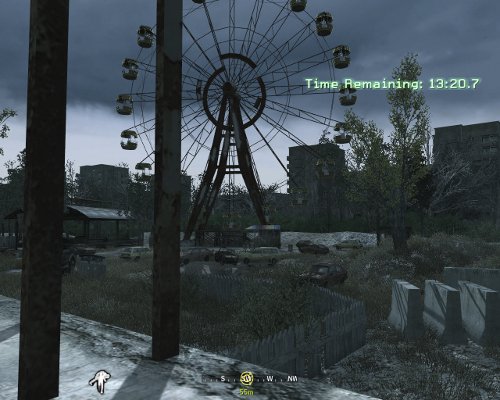

To complain about the Stalker games being offensive is probably an exercise in over-sensitivity, which, like almost all other kinds of over-sensitivity, will probably lead to something premature (oh no I didn't!) In the case of these games, however, this premature conclusion would be to write them off. They're intelligently and lovingly created and provide a truly unique experience, and honestly, in playing, they feel far enough from reality that they at no point feel like poor taste. It is clear that no malice has been intended (with the developers themselves being Ukrainian,) though it is some wonder whether or not they realised at any point during the game's conception that it may not go down entirely smoothly with those connected to the incident. It is another case of a product's worst criticisms being sourced with those who have little to no experience with or knowledge of the product; a frequently recurrent issue where video games are concerned, and most certainly a frustrating one for both developers and consumers.

More here than ever, though, it is possible to empathise with these critics, and from an exterior perspective these games beat even the infamous Grand Theft Auto series with regards to prospective arguments of poor taste. Through this, I think that GSC Gameworld can find comfort in the fact that the games they have created lack the kind of mainstream appeal and big budget PR of Rockstar Games' big name franchise.

 
Problem? Report this post
BITMOB'S SPONSOR
Adsense-placeholder
Comments (4)
February 16, 2011

The Stalker games also drew a fair amount of influence from the 1979 Russian film Stalker that envisioned a "Zone" of bizarre physics and abnormalities, which people would go into with the help of guides to discover great secrets and fullfill their innermost desires. As I recall, The Zone was created by disasterous alien contact and cordened off by the Russian government. But this film was interesting because presents an environment seems so remenscent of the Cherynobl blast area, yet the was film was created 7 years before it happened. I don't know if there is any indication whether it is a combination of radiation and alien activity that creates these enemies.

Just kind of a side comment that doesn't really defend or condemn the series. I mean, the games seek inspiration from the events, but then again, so does the Fallout franchaise.

February 16, 2011

It's rather odd that they drew those inspirations and applied them to a sensationalised version of actual tragic events. I have nothing against them, and I am a huge fan of the games. The point of the article didn't occur to me at all until perhaps a year after Shadow of Chernobyl, which sparked an interest in the history for me. The fact that it provoked such an interest could be used in the game's defense as a way of raising awareness, but it's not much of a thing that awareness can do much for. What's done is done. I imagine there are a handful of charities still raising money for the victims' families, but it raises no direct awareness for those.

It feels as though it can be viewed as a kind of exploitation, making money from the event without really giving anything back. It's interesting to hypothesise that the company could perhaps have put a (small) percentage donation into such a charity from sales.

I just feel that, were it more Western-produced or concerning itself with a more Western tragedy that there would be quite a fuss about it. Obviously all these things are on different scales, but it's hard to imagine that a game involving itself with the aftermath of, say, Hurricane Katrina in some way (I'm unsure how, but as a reference point) that didn't directly acknowledge it as tragic but more treated it as a point of complete fiction would be allowed to be produced.


Thanks for reading it by the way!

Christian_profile_pic
February 16, 2011

Great piece! I'm also a huge fan of the games.

Not to belittle your pint about the very real tragedy of CHernobyl, I feel that this is a rather endless discussion that we have all the time, and that you could apply it to just about anything in video games. Not about Chernobyl explicitly, but about the real-life "modern warfare" depicted in CoD, or the subject of WWII or Viet Nam, that one torture quest in WoW that caused a stir, the minor uproar over Civ: Colonization. ... There's no shortage of potential social/historical controversies in our (or most) media.

Also, just for posterity, I feel like pointing out that it isn't just radiation that caused the craziness in Stalker's Exclusion Zone, but also secret government experiments, super-powered psychics, unexplainable phenomena and, possibly, extraterrestria shennanigans. Pretty much all the usual suspects collecting in one, convenient location. As I recall from the press around the original Stalker, the reason the developers chose Chernobyl as a setting isn't, necessarily, for its history or excuse of "radiation did it," but because it was their "back yard," and a fascinating and alien landscape that's so rarely seen or discussed outside of that part of the world.

February 16, 2011

You raise good points, Fictionalised futures of real places are always confusing ground. Homefront, for example, has a plot built around the idea that an actual person who hadn't even any political power at the time of the game's conception (now cited as the heir to the country) would successfully invade and occupy the United States. I find that baffling, and incredibly dubious from a legal standpoint, and potentially quite unfair to the person in question (though seemingly apt given the bloodline.) Many 'modern conflict' games now have moved into fictional areas with fictional dictators or what have you; clearly almost all are just thinly veiled incarnations of actual places and people, however, and the most popular series, Call of Duty, insists on real places (again, also touching on Chernobyl, albeit in a way which couldn't really be conceived as exploitative in any way.)

I've always felt at least a little unease about games set in the Great War or World War Two (the only real conflicts simulated in games I've played.) I think the acceptance of those largely stems from it not being 'too soon,' but the amount of games the past decade fixated on the conflicts in Iraq and Afghanistan are also shocking. I do consider those in poor taste. Very few have you playing as the 'enemy,' as they are so clearly painted to be, with few portraying civilians at all, let alone their innocence. If the East produced a title from the other perspective, it's not hard to imagine the news jumping all over it calling it an Al Quaeda Training Simulator and such.

I can definitely understand their interest in the area, particularly if it is local to them. Were the military experiments not the result of the first blast though? I'm possibly confusing the game's fiction myself.

You must log in to post a comment. Please register if you do not have an account yet.