Separator

Morality systems in games don't need meters and points

Default_picture
Wednesday, December 07, 2011
EDITOR'S NOTEfrom Jay Henningsen

I agree with Paul. I'd much rather have a game react to individual choices and relationships instead of arbitrarily deciding that I'm good or bad and changing everything accordingly. I think it sucks that a lot of titles force you towards one of two polar-opposite playstyles in order to get the best experience when most people would more naturally let each situation determine the appropriate response.

When morality systems started becoming more prevalent in games, it sounded like one of the best ideas ever. It became one of those no-brainer, innovative steps that would evolve titles into deep, thought-provoking experiences that might possibly force Roger Ebert to get on his knees and apologize for underestimating the awesome emotive power of the medium.

Catherine's Karma Meter

Ironically, that seems to be the exact opposite of what we see today. The last couple of years brought some very important titles that brandished their morality-based gameplay at the forefront, and most of them couldn't be more artificial in that regard.

What do Infamous 2, Mass Effect 2, and Catherine have in common? They each use points and meters to determine whether the player has been good or bad. For that same reason, they all punish players who favor middling, natural response patterns. How often do normal people wake up in the morning and think "I'm going to be completely awesome to everyone today," or "I'm going to make it my mission to punch every last person I interact with in the balls." According to developers like Sucker Punch, quite a lot.


In the Infamous franchise, moral choices determine what powers the player gets, and the consistency of those choices determines how powerful they become. If the player doesn't stick to either exclusively good or exclusively evil responses, they'll make it to the end of the game without any high level abilities. This isn't any fun at all, especially since the difficulty of the game is pretty unforgiving.

In Mass Effect and Mass Effect 2, teetering between the Paragon (good) and Renegade (bad) responses meant, very soon, the player would encounter a choice requiring a high level of one or the other. Because they didn't commit to one extreme, the game will also limit all future decisions. Choosing a "neutral" reply (usually in the middle between the Paragon and Renegade options) doesn't do much of anything in terms of getting stuff done or expanding the situation. In fact, they seem more like punishments for players who didn't build points fast and consistently enough to choose one of the two moral-based responses, which is extremely frustrating.
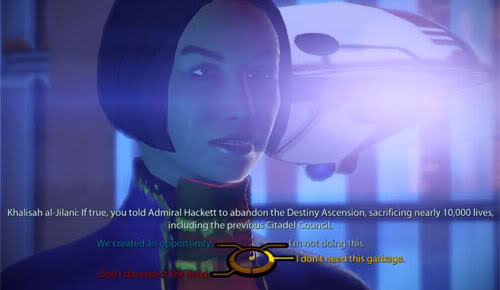
Reporter Choice

Catherine rests the entire plot on the foundation of its awkward meter that rates random personality tests and in-game dialogue options as Law (good) and Chaos (bad), which made that game incredibly frustrating to play. Not only will playing the middle-ground give one of the most depressing endings, but the entire moral choice mechanic is layered on top of the main character Vincent's scripted personality. The player may want to be as evil and chaotic as possible, but during most of the cut-scenes, Vincent is going to try his damnedest to be the good guy and pursue Katherine (the Law choice) until the end-game. Then the system tallies the morality points and serves up one of eight tacked-on ending scenes.

But wait! Those who crave a more genuine experience can find some saviors. CD Projekt RED's action role-playing game, The Witcher 2, introduces morality gameplay by not having a system at all. Gamers won't find any meters or points or any intrusive indicators to teach them right and wrong. They understand that, as human beings, we already know these things.

The brilliance of The Witcher 2's take on moral choices shines in character interaction. Whatever the player does to an NPC in the game, that NPC will remember and react to it. Scorn someone early in the game, and they'll likely respond in kind. Likewise, lend someone aid, and they might make life easier someday. This lends to a cycle of great characterization giving power to actual player choice, which, in turn, further expands characterization. It's a refreshing change from the stale mechanics gamers are used to.
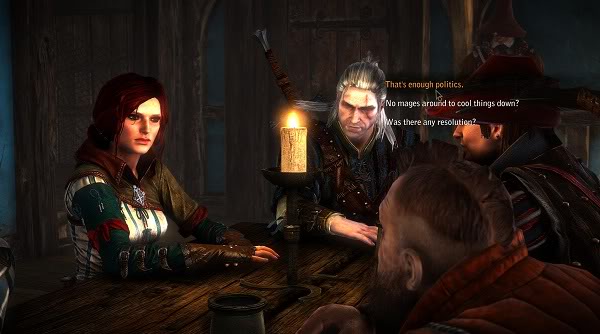
No color coding.

Eidos Montreal's Deus Ex: Human Revolution offers a similarly styled world. Nothing pops up to tell me how bad or good I've been. Everything is seamless. People just react to the things I do the way I would imagine a person would. Room for gray choices comes naturally in that design model, and it makes interacting with NPCs and the world as a whole that much more satisfying.

Meters and points can't offer that kind of experience, because all possibilities have to fall somewhere on that meter. The player ends up with situations where they can see something switch in the world. In Infamous and Infamous 2, crowd interaction changed the moment the point threshold broke. Suddenly, protagonist Cole MacGrath was either instantly liked or disliked. The programming of the entire world shifted right before his eyes. This didn't mark the revelation of The Matrix's hold on Empire City and New Murais; it was just a side-effect of a severely flawed set of metrics.

On one hand, I would argue that games like Infamous don't actually need these systems at all. The game doesn't seem to want one itself. When morality gameplay is added to the Empire City and New Murais, those weird Matrix-esque effects crop up and give everything an unnecessary coating of open-world clumsiness. Considering that Sucker Punch decided to completely abandon the evil arc of Infamous when they wrote the sequel, it would probably be better to just abandon that particular mechanic in favor of a richer, more streamlined narrative.
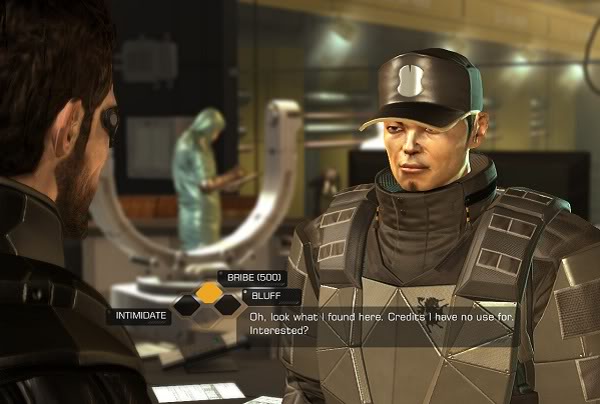
Deus Ex: Human Revolution Dialog

On the other hand, when morality is done right, it can be pretty amazing. What if the current Infamous and Mass Effect formula followed The Witcher 2's and Deus Ex: Human Revolution's examples by having the world react to Cole and Shepard organically?

The balance of action versus interaction in the setting makes the idea of choice feel natural and relevant to both the story and gameplay. It's a twisted kind of "less is more" logic, really. By removing the crazy bells, whistles, and omniscience of most morality mechanics, developers like CD Projekt RED and Eidos Montreal have proven that moral choice in games can become more than a fad that is showing its age.

 
Problem? Report this post
PAUL JOHNSON'S SPONSOR
Comments (12)
Jayhenningsen
December 07, 2011

I'm getting more and more frustrated with dialog-heavy RPGs that basically force me down a completely good or completely evil path in order to get the best experience or the most powerful character. It makes me feel like I'm not allowed to actually play my character the way I want without suffering penalties in-game.

Tones
December 07, 2011

I wholeheartedly agree.  I hate having to subscribe to being a jerk or a saint 100% of the time so that my character isn't punished.

One thing I did like about Mass Effect 2 was the character "Loyalty" Bioware implemented.  I found it interesting that characters could still be loyal to Shephard even if he chose the evil route during their sidequests.

Photo3-web
December 07, 2011

I would point out that Catherine's "morality system" very clearly doesn't follow a good-bad scoring criteria. Rather, the opposite ends represent order (your girlfriend, Katherine) and Chaos (the vixen, Catherine). There's a variety of endings based on where you fall on that scale, and the game doesn't judge your decisions.

Pict0079-web
December 07, 2011

Catherine's morality system is actually very different. I take it that the writer didn't get the true ending for the middle ground, which is incredibly hard to do. I literally had to hunt around the Internet to figure out the nuts and bolts of the entire morality system

I still think that it was a solid attempt to try to add multiple endings. The game sets clear parameters about whether Vincent wants to stay with one or the other. The big factor that determines Vincent's fate consists of the answers in the final section of the game.

Honestly, I think I played the game too long to figure all of this out, but Vincent's true ending in the middle ground is an epic triumph on Vincent's part. It actually goes far enough to include outer space. The writer should correct the article to include this ending.

Photo3-web
December 07, 2011

I got the Katherine (True) ending and was happy with how it turned out. I didn't see them, but from what I read, both "Freedom" endings sound hilarious.

Default_picture
December 07, 2011

In the Mass Effect series, the first game inadvertently handled things pretty well. In addition to having Charm and Intimidate be levelable skills, the Paragon and Renegade meters were decoupled from each other - getting points in one meter didn't remove points from the other meter like in KotOR, Jade Empire, or something similar. Even better was that the game gave out free points in Charm/Intimidate during each playthrough, so taking one Shepard through the game enough times would allow you to play through the game with both skills maxed out if you wanted, allowing for "Paragades" and "Renegons."

ME2 did the whole "pick one track the whole way or you end up gimping yourself" thing and didn't allow for Paragon/Renegade scores to carry over between playthroughs, which I was very disappointed with. Still, the redeeming factor with the series as a whole is that the divide between the two moralities is at least slightly blurrier than "saving orphans vs. kicking puppies," like in Jacob's loyalty quest - do you send his corrupt father off to face court justice at the hands of the Alliance, or bloody justice at the hands of the people he enslaved for ten years?

Default_picture
December 07, 2011

Instead, I wonder if adding a third storyline might help, a "Paragade" or "Renegone" option. So Bioware creates a set of mission endings and rewards for the good player, and a set of options only available in an evil playthrough, but then they create a third set of dialogue options and endings, ONLY if you have a certain amount of paragon AND renegade points.

Default_picture
December 07, 2011

The morailty system was one my biggest pet peeves with Infamous. Terrible execution. Giving choices to do acts of good or evil constantly when you really only have a single option made the whole system needless. The second game only made it worse given the fact that, while playing a villain, Cole still basically acts all heroic and stuff because the story calls for it. Terrible discrepancy there.

Default_picture
December 07, 2011

What I hate the most about the morality system in inFamous 1 (can't speak for 2)  is that you essentially have to play the game two times to see minor changes in the story. Want to see how a certain event would play out? Better play the game a second time to see that minute-long cutscene.

It's even worse for achievement/trophy hunters. Want to get a Platinum? Play that sucker twice!
 

Default_picture
December 07, 2011

Infamous 2 was a little better about that. The specific good and evil story missions actually had some notable differences to them, particularly that they played out differently from a gameplay standpoint depending on which you went with. That's better than getting five seconds of new cutscene action, but not enough to fix the core problems with the morality system.

Default_picture
December 07, 2011

I can't help but feel that part of the responsibility falls to us gamers when it comes to moralilty systems.  Who cares if you can't get all the way Paragon or Renegade in Mass Effect or you get a bad ending in Catherine?  There is something for living with the choices you made and accepting whatever consequences come with that.

Default_picture
December 08, 2011

The problem with that is that developers have designed their systems such that it limits the player's choices based on their progression through each morality system - i.e. Charm/Intimidate choices grayed out in ME2, powers locked until you achieve Hero/Infamous rank, etc.

This especially stinks in role-playing games, where some arbitrary system says that I can't be a badass in a situation where I'd like to, simply because I haven't been enough of a badass in prior situations. Well, what if the character I'm trying to role play didn't call for badassery in those prior situations, but it does now? What benefit to the story or gameplay does it serve to lock us in to these tracks at the beginning of the game?

You must log in to post a comment. Please register if you do not have an account yet.