Warning: This article contains spoilers from Professor Layton and the Unwound Future. Do not read on if you don't want the game's story spoiled.
Professor Layton became known more for its many puzzles than its gripping narrative, but the fact remains that the games have always put a great deal of effort into quality stories and characters complete with full voice acting and animated cutscenes. Unfortunately, they’re seen as superfluous by many since they have nothing to do with the puzzles themselves, which are the reason people play the games. And the recurring characters, charming as they are, become one-note archetypes when put under a microscope. But the third game in the seires, Professor Layton and the Unwound Future, leverages these perceived weaknesses to create perhaps one of the most moving game stories of the year.
The Layton games always end with some preposterous explanation for why the game world is a lie, but that usually just sets the stage for some bittersweet personal tragedy. Unwound Future is no different. You find out that the London of the future you’re running around in is actually an elaborate stage built in a vast underground cavern set up by one of the antagonists to fool Layton, among others, into thinking they were stranded in time. This also sets things up for another tragedy, but this time the tragedy is Layton’s. The entire point of the charade was to trick a group of scientists into creating a working time machine so that Dimitri, the antagonist you pursue through most of the game, can go back and stop a lab accident that killed the woman he loved, Claire, who also happened to be Layton’s love.
The game provides a bittersweet moment that rivals the other games with the final antagonist Clive. Posing as the future version of Luke, he manipulated both Layton and Dimitri with the sole purpose of destroying London to get revenge on the prime minister, who was responsible for the lab explosion that killed his parents. As Clive is being taken away by the police after his plan is thwarted, we are treated to a flashback of young Clive being restrained and comforted by none other than Professor Layton. It’s a poignant moment that tugs at the heartstrings slightly, especially given what Clive just tried to do and fits with the rest of the series’ melancholy endings.
But this is not where the story ends. It is then revealed that Celeste, the woman who appears to aid Layton in the final hours of the investigation and claims to be Claire’s sister is actually Claire herself, who was sent ten years into the future thanks to the lab accident. She was unstable, however, and could be sent back at any moment to face the resulting explosion and her death. The moment Layton learns all of this is mere minutes before this happens, meaning that Layton is forced to say goodbye to the woman he loves once more. Watching him come to terms with this is utterly gut-wrenching, especially if you’re a longtime Layton fan. This scene alone results in a giant emotional payoff for the player, but only because previous games laid the groundwork.
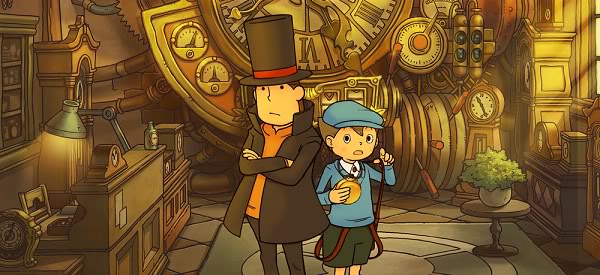
The story itself is not what makes this scene moving. After all, when taken out of context, it is very similar to Diabolical Box’s end, what with the themes of coming to terms with lost love. It is the fact that Professor Layton is the one who must do so here. Up until this point, Layton has been a fairly static character that served as merely a witness to tragic events through deduction. After two games of an unchanging Layton, the player is conditioned with a solid definition of who the Professor is: mostly stoic, occasionally cheerful, and always proper. The third game leverages the player’s preconceptions by making the story about him and his past. You begin to see why he is the way he is through several flashbacks of his time with Claire. We see his trademark gentleman’s mantra develop as he is preparing to accept a job at a university. Claire begins to refer to him as a true gentleman, even giving him his trademark top hat as a present. Through it all, Layton remains stoic, awkward even. It is completely characteristic of the character, and though he doesn’t change, we have a better understanding of why he is the way he is.
The moment where Claire is saying goodbye before warping to her death is where Layton’s unchanging characterization begins to shatter. He breaks down and begins to show real emotion, something he has never done in the previous games. He begins to cry and yells for Claire not to go, a scene amplified by his simple character design. After all, his face is just two dots for eyes and a line for a mouth, perfectly complimenting his stoic nature. Here, the expression in his eyes change for the first time in the series to a look of utter sadness and anguish, complete with tears streaming. The reason this is so striking is because it breaks from his established character. Normally this wouldn’t be a big deal, but fans have been conditioned to think of him as static and unchanging over multiple games. The sight of Layton losing it is jarring for players because it defies this conditioning, opening the flood gates for an emotional reaction. Any attachment or fondness for the character previous to this only compounds the feeling. You are suffering right along with him.
Professor Layton is not the only character who ceases to be static, however. Luke is also forced to face reality and reacts in a way we haven’t seen. The static Luke we are conditioned into knowing is clearly still a child, but behaves in every way like the apprentice he tells everyone he is. He models his life after the professor in every way, striving to become a gentleman at every turn. He goes with him everyone and has since the beginning of the series, leading the player to think that it always was that way in the same fashion that Back to the Future expected you to just accept the friendship between Marty and Doc Brown. But Unwound Future shakes up this vision: Luke’s parents are still a factor, as they are moving with Luke in tow. Suddenly, the relationship that we’re expected to blindly go along with is forever changed. Video game logic disappears for a moment and real life rules appear. As Luke is leaving for his new home and Layton tries to comfort him by telling him that gentlemen don’t make a scene in public. However, Luke says that it’s a good thing he’s not a gentleman yet and begins to cry even more, hugging Layton as they say their goodbyes. The boy who would do anything for the approval of his hero can’t contain himself anymore and shows his weakness. But Layton just got done with an emotional experience of his own, so he’s better equipped to respond accordingly. Or maybe we’re more ready to believe it after seeing Layton himself break down. Either way, it’s just one more moving moment in a game full of them.
Whether it be through attachment or conditioning, Unwound Future pulled no punches when constructing its story, an impressive feat for a game where most think it doesn’t matter. More impressive still is the game’s utilization of its own history and structure to advance its own storytelling methods, something that more series shouldn’t be afraid to do. Smart manipulation of characterization perception has lead a series with heart to a game that is unafraid to move the player’s heart. And with Professor Layton and the Specter’s Flute going back to explore how the Professor and Luke met, it stands that the series narrative will only continue to grow and develop.
1