


When my stoutly logical mathematician friend recently bought a DS and asked for game suggestions, Professor Layton immediately came to mind. How could he possibly dislike such a well-designed game steeped in brainteasers and methodical thinking?
A few days after he picked up The Curious Village, I learned just how.
“You can't skip the cutscenes,” he stated.
Whaaat? my English major brain screamed. You can't just cherry-pick the puzzles out of Professor Layton and throw the story away! That's ridiculous! Preposterous! Completely and utterly... crap; where's my thesaurus?!
His opinion perplexed me, but the more I considered it, the more I wondered whether the puzzles and plots of the Layton games go hand-in-hand as well as I initially believed. By no means am I saying the titles are bad, but is it possible the series's goals of providing both a puzzling and story-driven experience lead to some clashes? I went into the latest North American release, The Unwound Future, with this question in mind.
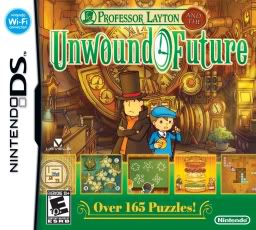
The Layton series would just be a digital puzzle book without its stories and it's clear that developer Level-5 has increased its focus on plot and character development over time. A feature-length animated movie in Japan, Professor Layton and the Eternal Diva, may be the most obvious indicator, but a Nintendo press release for Unwound Future says the game “features significantly more hand-drawn animated sequences and voice acting than the previous installment of the series.”
The additional attention to storytelling is felt almost immediately as spoken dialogue fills the opening. It was pleasant at first — voice acting not necessarily something by which Nintendo's systems are stereotypically known — but as minutes passed, I was really starting to ache for a puzzle. They were kind enough to provide one within the foundation-setting flashback, but it did feel like I pushed through quite a chunk of voice and text to get there. This can be compared against the quickly-arriving challenges of Curious Village, where the game seemed eager to make puzzle-heads aware that they were in the right place.
The puzzles do start to pick up after a bit, thankfully, and many do tend to have some relation to the current goings-on in the story — certainly more than the onslaught of now-infamous “This [object] reminds me of a puzzle!” quips in the first game. There are still a few of those moments in Unwound Future, but it does seem restraining that every puzzle should have to adapt perfectly to the plot. On the other hand, it feels somewhat anti-intuitive to the plot having Layton and Luke take a quick break from running for their lives from a mob to contemplate a discarded banana peel on the street.
It's tough, however, wanting to level criticism against Level-5's mixing of game and story, mostly because the story can provide such a satisfying experience once the pieces are set and mysteries begin to unfold. The whole aesthetic of the series and its characters is charming and the voice acting well done, creating a universe so appealing that it opens the player to more easily suspend his or her disbelief at times when the explanations for various plot points dive into left field or animals begin to talk. A design this pleasant and unique should be showcased, no doubt, but it does seem minorly diluted when the media switches from fully-animated scene to still voiceover to plain text — something that is necessary due to the also necessary inclusion of puzzles.
Is there a quantifiable “perfect balance” of plot advancement and puzzle provision to be found here? It's tough to say. The puzzles themselves are rewarding, but so are the characters and world. I wouldn't dream of sacrificing the ending of Unwound Future in any way for the substance it adds to everyone's favorite unsinkable professor and apprentice, but I almost wonder if that would be better served in a separate movie form. And for those who don't care much about the story — as egregious as that may sound — would they be better served by some sort of “freeplay” puzzle mode?
Professor Layton is a strange breed this way. Most would argue it's a standout in video games both in puzzles and plot. And although they it sometimes feels these elements jockey for position, is it possible their combination still provides something better than the sum of their parts?
I consider the series excellent purchases as I've played them, but I also look forward to seeing Level-5's continuation with the series. If more seams can be ironed out between the activities in the games and how they influence the stories, they can only become more unskippable.
[It would be rather ungentlemanly of me were I not to mention other articles on BitMob that discuss Professor Layton's plots: Professor Layton = Pixar + Possibly the Future of Japanese Games and Professor Layton and the Unwound Characterization]