Home
Home

When Derek Lavigne asked us to write about our favorite games I was a little torn, mainly because I have trouble picking favorites in any medium. I considered replaying Silent Hill 2, but that felt a bit obvious. Then I thought about playing Metal Gear Solid, but I played that a while ago in my series recap so I'd know what the hell was going on once I got to Guns of the Patriots (it didn't help much). Eventually, I narrowed it down to two titles: Driver and Legacy of Kain: Soul Reaver. And then, somewhat arbitrarily, I picked Soul Reaver.
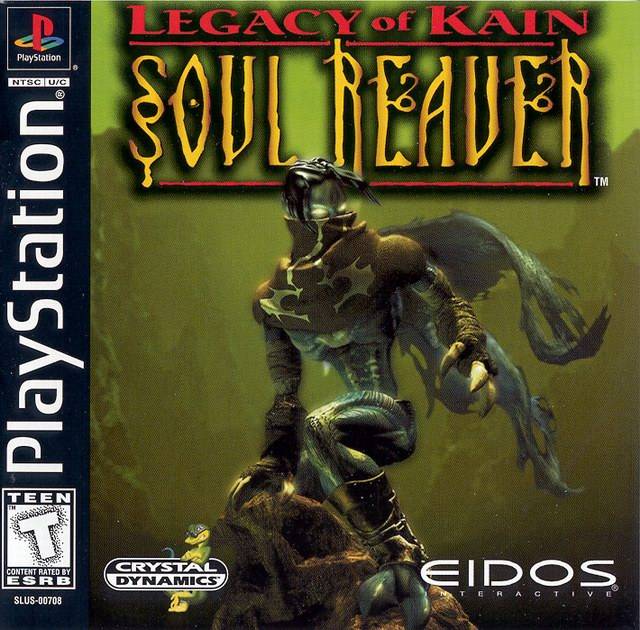
Legacy of Kain has been one of my favorite franchises for a long time. It is the product of an era in which talking about vampires was still pretty nerdy and analog control was an option to be toggled. But there are several aspects of Soul Reaver that are impressive, even by today's standards, not the least of which is the opening cinema.
In just three and a half minutes we are introduced to protagonist Raziel and antagonist Kain, learn that vampires have been running the world for a thousand years, and discover that it is a lot easier than one might think to de-bone a giant pair of wings.
It's difficult to imagine how this series would fare in today's vampire climate, but my guess is "not well." It is, for example, very difficult to imagine Raziel attempting to seduce Bella Swan, even if we ignore the fact that he is so obviously without genitals. Even taking his junklessness into account, vapid teenage girls probably prefer their men with lower jaws.
One might describe Legacy of Kain as "overwritten," but I think that's just another part of its charm. This is an epic story of revenge and redemption, and there's time travel. So when there's dialogue like, "In the Spectral Realm water has neither heft nor lift; it stands as thin as air," I'm inclined to just roll with it. Also Amy Hennig directed and co-wrote the bulk of the series, including this entry, and as a gamer on the Internet I'm obligated to love everything she does.
Seriously, though. Amy Hennig is awesome.
 Despite the time-hopping shenanigans of the rest of the series (the timeline of the first two games can be found here, and it only gets more complicated after that), Soul Reaver is a straightforward action-puzzle game in which the newly-wraithified Raziel slashes, impales, crushes, and burns his way through his vampire "brothers" and their minions in his quest to avenge himself upon Kain for the loss of his wings, jaw, skin, eyelids, underlings, and time.
The game doesn't offer a whole lot of guidance; you'll get some cryptic riddle from the betentacled Elder God pointing you in the general direction of your next objective, and it's up to you to figure out what the hell he's on about. This is, at most, a slight inconvenience, since you're always heading for whichever previously inaccessible area the power you acquired from the previous boss now allows you to enter.
This makes Soul Reaver sound a bit like a Zelda knock-off, but there are important differences. First, Raziel gains new powers by eating his brothers' souls, and Link will never do anything that metal. Second, the powers are used primarily for navigation of the world, not combat; in fact, all but one of the boss fights would be winnable with the abilities with which Raziel starts the game.
So what's the point of adding to Raziel's abilities, other than getting from level to level? Honestly, there isn't one unless you like exploring, and the game rewards those who do. There are six optional dungeons with puzzles that will bestow additional powers, like a paralyzing earthquake attack or the ability to emit a blast of concentrated sunlight. They're not necessary, or particularly useful in some cases, but they do add some variety to the combat.
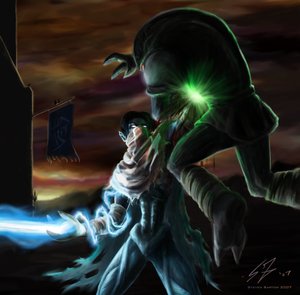 I would describe Soul Reaver's combat system as "simple-but": there's not a whole lot to it,but it is surprisingly satisfying. Raziel can kill vampires by throwing them into water or sunlight, impaling them on the decorative spikes inexplicably placed on most walls, setting them on fire, or exploding them with his lightsaber-like "wraith blade," the Soul Reaver. These finishers are of varying degrees of satisfaction, but they never really get old.
The game has held up remarkably well in the ten years since its release. There are still some baffling puzzles and archaic control choices -- for example, camera movement is executed with shoulder buttons instead of that new-fangled right analog stick. However, it remains one of the better action-puzzlers of that console generation, and the writing, music, and voice-acting are all excellent.
Now that I've replayed Soul Reaver, I want to go back to the rest of the series. Sure, my Gamerscore will stagnate, but until someone makes a new game (which is looking increasingly unlikely) this is really the only place to go for an epic tale of verbose, time-traveling vampires who solve block puzzles. It is, admittedly, a fairly limited market.
Soul Reaver is available for download on PSN, as is Blood Omen, the first game in the series.