Home
Home
Editor's note: Chas is really into games-as-training-sims, and so am I. Read more from him on the subject here and here. -Demian
It's not just the military that's turning to games as a training and teaching method -- universities are as well. NettOp, a web-based study unit of the University of Stavanger in Norway, is developing a video game to help nursing students learn to prepare proper drug dosages for patients. Dr. Mario or Trauma Center it is not.
Nursing students must master proper drug dosage to pass an exam before earning certification, but the subject often proves difficult for a significant portion of students. A single miscalculation results in failure. NettOp's game aims to help the less-mathematically adept students master drug dosage calculations by offering a visual representation of the process.
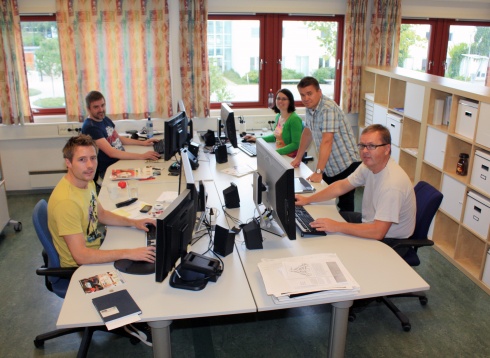
Siril Grude, Atle Løkken, and Karsten Tillerli.
"At the University of Stavanger, the students have three goes at handing in an exam paper without mistakes. The last few years the percentage of fails has been between 36 and 39 both for the first and second attempt," writes the university's Journalist/Communications Advisor Leiv Gunnar Lie.
Atle Løkken, director of NettOp, believes the problem stems from most nursing students joining the program without being prepared for the complex calculations required within the profession.
"We don’t have much scientific verification, but we believe a major reason is that the students that want to be a nurse primarily are interested in and expect the human and social aspect of the profession and are not prepared for the math and science that indeed also come with it," he said.
Løkken points to renowned American psychologist Howard Gardner’s multiple intelligence theory -- the idea that there are a variety of intelligences that don’t necessarily trump one another -- as an explanation for why some nursing students struggle with the math of drug dosages.
"In Gardner’s theory, we may expect the nursing students to be predominantly more 'visually' and 'socially intelligent' than 'mathematically,'" Løkken said. "This does not mean that 'visually' and 'socially intelligent' people can't solve mathematical problems; it simply means that 'socially intelligent' individuals approach mathematical problems differently from how math is normally taught in academia by 'mathematically intelligent' instructors."
Gardner also inspired Løkken and his team to use a video game to assist nursing students who struggle with the math.
"Referring to Howard Gardner again, he pointed out already in 1996 that 'new media work may enable ordinary students to gain an understanding that may have been accessible only in the extraordinary classroom in years past,'" Løkken said. "Video games embrace most of the [best properties] in computing and network technologies [today] and are unique compared to other means of communication and teaching."
Løkken feels that video games offer numerous advantages when combined with education. "[They introduce a method of teaching] appealing to a larger group of students than traditional education, and a safe environment to training otherwise not available." Løkken said. "A video game gives us a visual interface to mathematical problems, giving us a methodology and a tool that appeals to students that may be more 'visually intelligent' than 'mathematically.'"
With a limited budget and the goal of educating students, Løkken and his team were inspired by Nintendo’s philosophy of focusing on effective game mechanics rather than impressive visuals.
"Graphically, the interface will be 2D, which is sufficient for all we need to convey at this point," Løkken said. "The main task of the interface is to visually present the concepts of the relationship between weight, volume, liquid, dissolutions, etc."
Løkken expects the game to be completed for this fall, and then he and his team will begin gauging its effectiveness with students. The team plans to use its findings to develop an extended version of the game next year.
"The intention is to develop a game to also deal with the treatment and distribution of medicines," Løkken said. "The idea is to make the game train all stages from the point the nurses receive the prescription to the selection of the right drug in the medication room, preparation of the medication in the prescribed dosage, and the distribution of the medication to the patient -- and also the effects of the medication on the patient, including the fatal cases. It will [include] scenarios where we will add external distractions and time restrictions often found in the hospitals and health institutions that easily may lead to short cuts and eventually fatal errors. The idea is simply to make the whole game more real."
Simulations have another benefit -- if you screw up, you don't lose a patient. "It is not possible, or, for practical reasons, feasible, to do this safely in any other way," said Løkken. "Students do, of course, handle drugs while in practice, but we have seen examples of serious errors during their practical training. Thus the game will simply reduce the risk."
---
Read about how video games can be more than just entertainment at BOLDSTATE.