Home
Home

Too much dialogue can ruin a game for me -- more often than not because many titles just have horribly written exchanges between characters. Not to mention that I don't think the medium is quite there yet regarding the expression of lifelike, emotional performances through animation. But Antonio argues that a focus on setting and gesture can make all the difference when telling a story, and I especially like this approach when designers can work gameplay systems into the underlying themes of the experience.
My Xbox 360 got the red ring of death New Year's Eve, and I'm too lazy to let Microsoft know. If I can send an email to someone in a few seconds, I should be able to digitially deliver my 360 and get it fixed; sending it in a box seems so 20th Century.
But now would be a good time to buy a Playstation 3, as Fumito Ueda's The Last Guardian will be released this year, and I have a soft spot for his two previous games: Ico and Shadow of the Colossus. He knows how to tell a story.
Rather than throw ham-fisted dialogue at the player, Ueda expresses story through settings and gestures between characters.
I love the environments of both games. They focus on one immense location; because they are scarecly populated, gamers can have an intimate relationship with their world.
You don't have time to gawk at the White House in Call of Duty: Modern Warfare 2 while Russians try to kill you. Everything moves fast with bullets flying and bombs exploding. Then again, it's a war zone, so there's not much to admire anyway.
But in Ico and Shadow of the Colossus, time doesn't seem to exist -- you're in no hurry to move on. Feel free to race your horse, Argo, up a cliff to stare at the sea in Shadow of the Colossus. Take a break from a difficult puzzle in Ico and admire the detail put into the windmill soaring above you or the softness of the grass as sunlight hits the ground. I haven't played many games where I truly want to stop and look around mostly because I'm too busy killing something else.
The mood of both really carries over into the slow pace of the action. Together, they put me in a quiet and pensive state of mind. And those emotions are essential to completing the puzzles in them. Mood and pace seem genre-specific: I don't think a quiet gamer can play a fast-paced action game. That would probably require a more proactive emotion: fear, for instance. But who says an action game must be fast-paced and create a sense of danger? I guess it ceases to be an "action" game when everything crawls from point to point.
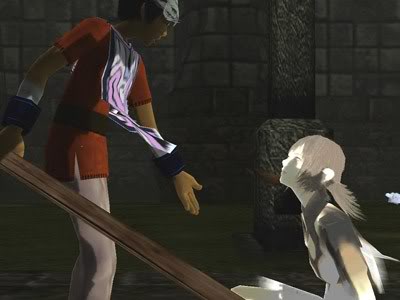 Telling the story through character complements the mood in Ico and Shadow of the Colossus. Dialogue remains sparse. When characters do speak, it's brief and straight to the point. But more importantly, dialogue does not drive the narrative -- action does. Ico stretching his hand out to help Yorda stand must be the best moment in the game.
The scene leading up to that moment is perfect. The couple reaches the main gate of the castle -- it's wide open. As they race for the exit, the gates begin to close, yet it looks like they'll make it. Then Yorda falls. Ico goes back for her. The gates close. And Ico calmly reaches out for Yorda. It says far more than dialogue could. What would they say if I rewrote the scene? Ico says, "Are you okay?" And then Yorda replies, "Yes...I think so." And finally Ico finishes with,"Come on. We'll find another way."
The gamer can see that Yorda is okay and that they need to find another way out. Eliminate the talking, keep the movement, and the scene will say exactly that. The Wanderer in Shadow of the Colossus can scream upon his first encounter with a giant. He can gasp and say, "That thing is huge!" But we see that it's huge. Let the appearance of the creature say everything. Ninety percent of communication is non-verbal, anyway. I appreciate a friend's show of kindness rather than his saying kind words, whispering sweet nothings in my ear.
I expect more of the same with The Last Guardian, and that's not a bad thing, especially when I like how Ueda tells his stories.
So, what's your favorite way to tell a story?